
Gross income and pass-through reporting
On this page
Taxable receipts enter gross income
Jordan receives a $5,000 gift from a parent, a $5,000 consulting fee, and $5,000 of tax-exempt municipal interest. Which receipts enter gross income?
The consulting fee enters gross income. The gift and municipal interest do not. Gross income is the starting measure before deductions.
Internal Revenue Code §61(a) includes income from whatever source. Examples include pay for services, interest, dividends, business income, and gains from property. Individuals, preparers, and the IRS use gross income to determine what belongs on the federal return.
Some receipts are excluded by a specific rule. Some receipts are reported after the taxpayer's death instead of on the decedent's final return. A partnership or S corporation generally reports its activity through to its owners.
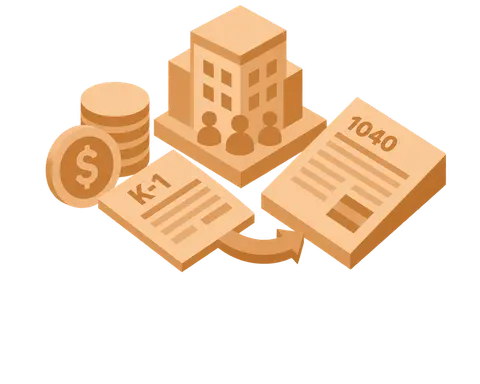
Schedule K-1 tells the owner whether an amount is ordinary business income, interest, a dividend, a capital gain or loss, tax-exempt interest, or another separately stated item. The central questions are:
- What amount is included?
- When is it included?
- What character does it keep?
- Which Form 1040 line receives it?
From taxability to Form 1040
A receipt is first classified as taxable, excluded, or reportable outside the decedent's final return. A taxable receipt is then measured using cash received, basis, or the taxable share of a distribution. Its character and timing are preserved. Pass-through items are separated when the K-1 supplies them. The final step traces every included amount to a Form 1040 line and checks for omissions or double counting.
Loading diagram…
Taxability controls entry into gross income. Measurement controls the amount. Character controls the destination and later tax treatment. The K-1 classification and source-document review complete the chain.
Taxable, excluded, and post-death receipts
Taxable, excluded, and post-death receipts
Section 61(a) generally includes compensation, interest, dividends, and guaranteed payments. Jordan's $70,000 of cash wages is taxable.
Employer health coverage of $12,000 is generally excluded under §106. Group-term life coverage creates taxable imputed cost above the first $50,000.
For a person age 42, the 2024 Table I rate for the age 40-44 band is $0.10 per $1,000 per month. The excess $50,000 creates $60 of taxable cost for the year.
Taxable bank interest is $1,200. Ordinary dividends are $2,000. The qualified $1,500 is part of those dividends, not an additional amount.
A $4,000 partnership guaranteed payment is taxable ordinary income under §707(c). A $12,000 traditional IRA distribution with $3,000 of after-tax basis produces $9,000 of taxable income. This assumes it is the only relevant IRA basis.
A $5,000 cash gift is excluded under §102(a). $800 of municipal bond interest is excluded under §103. A $20,000 death benefit is excluded to the beneficiary under §101(a)(1).
For a cash-basis decedent, amounts received before death go on the final return. A fee earned before death but paid to the estate afterward is income in respect of a decedent under §691.
The detailed rules for included pay, benefits, and retirement distributions are in Wages, investment income and benefits. Excluded receipts and final-return timing are covered in Exclusions and a decedent's final income.
Amount and character of a property gain
A gain is amount realized minus adjusted basis under §1001. Jordan sells stock for $18,000 with an $11,000 basis after holding it for 13 months. The result is a $7,000 long-term capital gain.
Virtual currency is treated as property for these purposes. $6,000 of proceeds less a $4,500 basis produces a $1,500 gain. An 8-month holding period makes it short-term.
A holding period of one year or less is short-term. More than one year is long-term. Inherited property generally receives a date-of-death fair-market-value basis under §1014. It is treated as long-term when sold under §1223(9).
A net capital loss deduction against ordinary income is limited to $3,000 under §1211(b). Excess loss carries forward under §1212(b).
The detailed gain and holding-period rules are in Capital gains and holding periods.
Ordinary and separately stated K-1 items
A pass-through owner's K-1 amount is included whether or not the owner receives cash. Ordinary business income is the residual business result. It is reported through Schedule E.
Items with a different owner-level tax result are separately stated. Jordan's K-1 reports:
- $10,000 of ordinary business income.
- A $4,000 guaranteed payment.
- $400 of taxable interest.
- $600 of qualified dividends.
- A $700 short-term capital loss.
- $200 of tax-exempt interest.
The interest goes to Form 1040 line 2b. The $600 dividend goes to lines 3a and 3b. The capital loss goes through Schedule D. The tax-exempt interest goes to line 2a.
A $5,000 cash distribution reduces outside basis from $30,000 to $25,000. It is not income while basis covers it. The $600 qualified dividend is part of ordinary dividends. It must not be added twice.
The owner-level destinations and ordinary-versus-separately-stated distinction are covered in Reporting Schedule K-1 items on Form 1040.
Source documents and Form 1040 lines
Review begins with each W-2, Form 1099, K-1, and brokerage statement. Each source amount is compared with the related return line.
Jordan's correct entries are:
- $70,060 of wages on line 1.
- $1,000 of tax-exempt interest on line 2a.
- $1,600 of taxable interest on line 2b.
- $2,100 of qualified dividends on line 3a.
- $2,600 of ordinary dividends on line 3b.
- A $12,000 gross IRA distribution on line 4a.
- $9,000 of taxable IRA income on line 4b.
- A $7,800 net capital gain on line 7.
- $14,000 of partnership income and guaranteed payments through Schedule E to line 8.
A draft showing $70,000 on line 1 has a source-document error. The same is true for zero on line 2a, $1,200 on line 2b, $1,500 on line 3a, or $2,000 on line 3b.
A draft showing $7,000 on line 7 or only $10,000 on line 8 also has a traceable error. The source-to-line review is developed in Reviewing Form 1040 income items.
Taxable, excluded, and post-death receipts


Amount, character and reporting label
The artifact that moves from one decision to the next is the included amount plus its label. Labels include wages, interest, dividends, ordinary business income, guaranteed payments, long-term gains, short-term gains or losses, tax-exempt interest, and distributions.
A wrong basis changes a gain. A wrong holding period changes its character. Treating qualified dividends as an addition overstates income.
Treating a cash distribution as K-1 income duplicates the owner's income. Putting tax-exempt interest into total income overstates gross income. A source-document error makes every later line and the final tie-out wrong.
The label is as important as the number. Similar amounts can reach different lines because their character and timing differ.
Each amount has a reporting destination
The same receipt can have a gross amount, a taxable amount, and a separate reporting label. The table keeps those fields separate for tax-exempt interest, taxable distributions, K-1 items, and capital gains.
| Idea | Trigger or source | Amount recognized | Character and timing rule | Form 1040 or other destination |
|---|---|---|---|---|
| Wages and group-term life benefit | Services and employer coverage | $70,060 = $70,000 wages plus $60 imputed life cost; $12,000 health coverage excluded | Compensation is ordinary income; first $50,000 of group-term life coverage is excluded | Form 1040 line 1 |
| Interest and dividends | Bank, municipal bond, and dividend statements | $1,200 taxable bank interest; $800 municipal interest excluded; $2,000 ordinary dividends including $1,500 qualified | Tax-exempt interest remains reportable information; qualified dividends are a subset | Lines 2a, 2b, 3a, and 3b |
| Retirement distribution | Traditional IRA distribution | $12,000 gross distribution less $3,000 basis = $9,000 taxable | Pre-tax portion is taxable under §72; basis is not taxed again | Lines 4a and 4b |
| Property sale | Stock or virtual currency sale | $18,000 less $11,000 = $7,000 long-term gain; $6,000 less $4,500 = $1,500 short-term gain | One year or less is short-term; more than one year is long-term | Schedule D and Form 1040 line 7 |
| K-1 ordinary income and guaranteed payment | Partnership K-1 box 1 and guaranteed payment | $10,000 ordinary business income plus $4,000 guaranteed payment | Ordinary income is reported through Schedule E; guaranteed payment is ordinary income | Schedule E and Form 1040 line 8 |
| K-1 separately stated items | Partnership K-1 interest, dividend, capital loss, and tax-exempt interest | $400 interest; $600 qualified dividend; $700 short-term loss; $200 tax-exempt interest | Each item keeps its owner-level character and is reported once | Lines 2a, 2b, 3a, 3b, and 7 through proper schedules |
| Cash distribution | Partnership cash distribution | $5,000 distribution against $30,000 outside basis leaves $25,000 basis | Distribution is not current income while basis covers it; excess cash can create gain under §731 | Basis schedule, not an income line |
| Decedent and post-death receipt | Cash-basis decedent's receipts | $9,000 wages plus $3,000 interest on final return; $7,000 later fee is IRD | Final return stops at death; IRD is reported by the estate or beneficiary under §691 | Final Form 1040 for $12,000; later recipient's return for $7,000 |
The destination follows character and timing, not simply the amount of cash received.
Jordan's taxable receipts and K-1 items
Jordan is a cash-basis individual, age 42, filing for 2024. Her W-2 shows $70,000 of cash wages. Her employer provides $100,000 of group-term life coverage and $12,000 of health coverage. Her bank pays $1,200 of taxable interest. She receives $800 of tax-exempt municipal interest. Her ordinary dividends are $2,000, including $1,500 of qualified dividends. She takes a $12,000 traditional IRA distribution with $3,000 of after-tax basis. She sells stock for $18,000 after holding it for 13 months. The stock basis is $11,000. She sells virtual currency for $6,000 after holding it for 8 months. The virtual currency basis is $4,500. She receives a $5,000 cash gift from a parent and a $20,000 life insurance death benefit as a named beneficiary. Her partnership K-1 reports $10,000 of ordinary business income, a $4,000 guaranteed payment, $400 of taxable interest, $600 of qualified dividends, a $700 short-term capital loss, and $200 of tax-exempt interest. The partnership makes a $5,000 cash distribution when Jordan's outside basis immediately before the distribution is $30,000. Determine Jordan's included gross income, each relevant Form 1040 line, and ending outside basis. Robert was cash-basis and died on June 30, 2024. He received $9,000 of wages and $3,000 of bank interest before death. A $7,000 consulting fee for work completed before death was paid to his estate afterward. Determine what belongs on Robert's final return.
Exclusions and timing determine which receipts enter income. Measurement, character, and basis then determine each reporting destination.
Solution schedule
| Step | Calculation or decision | Reporting result | Source pointer |
|---|---|---|---|
| 1 | Jordan excludes the $5,000 gift, $20,000 death benefit, and $12,000 health coverage. She reports $1,000 tax-exempt interest on line 2a. Robert's final return includes $9,000 wages plus $3,000 interest = $12,000. The later $7,000 consulting fee is IRD to the estate. | Excluded Jordan receipts do not enter gross income. Robert's final return is $12,000. The estate reports $7,000. | Exclusions and a decedent's final income |
| 2 | $70,000 wages + $60 group-life cost = $70,060. Personal interest is $1,200. Ordinary dividends are $2,000. The $12,000 IRA distribution less $3,000 basis equals $9,000 taxable. | Lines 1, 2b, 3a, 3b, 4a, and 4b receive the applicable amounts. Health coverage remains excluded. | Wages, investment income and benefits |
| 3 | Stock: $18,000 - $11,000 = $7,000 long-term gain. Virtual currency: $6,000 - $4,500 = $1,500 short-term gain. Less the $700 K-1 short-term loss gives $800 net short-term and $7,800 total capital gain. | Schedule D and line 7 show $7,800 net capital gain. | Capital gains and holding periods |
| 4 | $10,000 ordinary business income plus $4,000 guaranteed payment = $14,000 through Schedule E. The K-1 also reports $400 interest, $600 qualified dividends, $700 short-term loss, and $200 tax-exempt interest. The $5,000 distribution reduces $30,000 basis to $25,000. | Each K-1 item appears once by character. The distribution is not current income. | Reporting Schedule K-1 items on Form 1040 |
| 5 | Line 1 is $70,060. Line 2a is $1,000. Line 2b is $1,600. Lines 3a and 3b are $2,100 and $2,600. Lines 4a and 4b are $12,000 and $9,000. Line 7 is $7,800. Line 8 is $14,000. | Included gross income is $105,060. Tax-exempt interest is not added to that total. | Reviewing Form 1040 income items |
The schedule ties each source amount to one destination. Qualified dividends remain within ordinary dividends, and the distribution changes basis rather than current income.
Holding period variant
Your turn: the stock holding period is 12 months instead of 13 months. The proceeds remain $18,000. The basis remains $11,000. What are the gain and its character?
Answer
The gain is $7,000. It is short-term because one year or less is short-term.
Distribution variant
Change one thing: the partnership distribution is $32,000 instead of $5,000. Outside basis immediately before distribution remains $30,000. What are the recognized gain and ending basis?
Answer
The recognized gain is $2,000 under §731(a). Ending basis is zero.
Benefits, exclusions, gains, K-1s and Form 1040
These five items cover benefits and retirement income, exclusions and decedent timing, capital gains, K-1 reporting, and Form 1040 review. Each wrong choice reflects a specific classification, measurement, or tracing error.
The same source-to-line rules control every item. The rationales identify the controlling chapter and reporting destination.
Practice
Jordan is age 42. Her employer provides $100,000 of group-term life coverage and $12,000 of health coverage. The first $50,000 of group-term life coverage is excluded. The Table I rate for her age band is $0.10 per $1,000 per month. Jordan also receives a $12,000 traditional IRA distribution with $3,000 of after-tax basis. What amount from these two items is included in income?
Robert is a cash-basis taxpayer who died on June 30, 2024. Before death he received $9,000 of wages and $3,000 of bank interest. A $7,000 consulting fee for work completed before death was paid to his estate after death. Jordan, the named beneficiary, received a $20,000 life insurance death benefit. Which statement is correct?
Jordan sells virtual currency for $6,000. Her adjusted basis is $4,500, and she held it for 8 months. What is the result?
Jordan's partnership K-1 reports $10,000 of ordinary business income, a $4,000 guaranteed payment, $400 of taxable interest, $600 of qualified dividends, a $700 short-term capital loss, $200 of tax-exempt interest, and a $5,000 cash distribution. Which treatment is correct?
After reviewing Jordan's source documents, which set of Form 1040 entries is correct?
Carry character and timing to return
- Taxability and timing: §61 includes income unless a specific exclusion or post-death rule applies.
- Amount and character: Use proceeds minus basis, then apply the holding-period rule.
- Pass-through items: Report the K-1 amount whether or not cash was received, while preserving its character.
- Form 1040 review: Trace every line to a source document and never count a qualified dividend or distribution twice.
- The whole topic: Carry the correct amount, character, timing, and basis effect from the receipt to the return.
Unlock the full lesson and continue reading
Signup to continue reading this lesson and unlimited access questions, flashcards, AI notes, and more





Practice Questions: Gross income and pass-through reporting
1. During 2025, a lender accepted $30,000 in full settlement of a taxpayer's $70,000 recourse debt, creating $40,000 of cancellation-of-debt income. Immediately before the cancellation, the taxpayer's liabilities totaled $120,000 and the fair market value of the taxpayer's assets totaled $95,000. The taxpayer was not in bankruptcy and no other exclusion applies. How much cancellation-of-debt income must the taxpayer include in gross income?
- A. $15,000
- B. $25,000
- C. $40,000
- D. $70,000
Show answer
Answer: A. $15,000
> Key point: Taxable cancellation-of-debt income is the canceled debt minus the amount excluded because of insolvency. Why $15,000 is correct - The debt forgiven was $70,000 − $30,000 = $40,000. - The taxpayer was insolvent by $120,000 − $95,000 = $25,000 immediately before cancellation. Subtracting that exclusion leaves $15,000 includible. Working | Step | Working | Result | |---|---|---:| | Debt canceled | $70,000 − $30,000 | $40,000 | | Insolvency | $120,000 − $95,000 | $25,000 | | Income included | $40,000 − $25,000 | $15,000 | Answer: $15,000 Why the other options are wrong - $25,000: This is the insolvency exclusion, not the amount included in income. - $40,000: This is the canceled debt before applying the insolvency exclusion. - $70,000: This is the original debt balance; it ignores the $30,000 settlement and the insolvency exclusion.
2. A single taxpayer claimed the standard deduction on the taxpayer's 2024 federal income tax return. During 2025, the taxpayer received a $1,200 refund of 2024 state income taxes and $300 of interest paid by the state on the delayed refund. How much of these receipts must the taxpayer include in 2025 gross income?
- A. $300
- B. $1,200
- C. $1,500
- D. $0
Show answer
Answer: A. $300
> Key point: A state tax refund is excluded when the taxpayer took the standard deduction, but interest paid on the refund is taxable. Why $300 is correct - The $1,200 refund is excluded because the taxpayer claimed the standard deduction in 2024. - The separate $300 state payment is interest and is included in 2025 gross income. Why the other options are wrong - $1,200: Includes the excluded refund and omits the taxable interest. - $1,500: Includes both the excluded refund and the taxable interest. - $0: Excludes the taxable $300 interest along with the refund.
3. Under an unmodified divorce instrument executed in 2017, a cash-method taxpayer received $18,000 of alimony and $6,000 of child support during 2025. How much of these receipts must the taxpayer include in 2025 gross income?
- A. $6,000
- B. $18,000
- C. $0
- D. $24,000
Show answer
Answer: B. $18,000
> Key point: An unmodified 2017 divorce instrument follows the pre-2019 rule: alimony is included, but child support is excluded. Why $18,000 is correct - The unmodified instrument was executed before 2019, so the $18,000 of alimony is included in gross income. - The $6,000 of child support is excluded, leaving $18,000 includible. Why the other options are wrong - $0: This excludes alimony under the post-2018 rule, which does not apply to this instrument. - $6,000: This reverses the treatment; alimony is included and child support is excluded. - $24,000: This includes the $6,000 of child support, which is excluded.
4. In 2025, a taxpayer's personal residence was damaged in a federally declared disaster. The residence had an adjusted basis of $40,000, and its fair market value declined by $28,000. The taxpayer received $5,000 of insurance proceeds and had AGI of $100,000. Assuming the taxpayer itemizes deductions, what casualty loss deduction is allowable?
- A. $0
- B. $10,000
- C. $12,900
- D. $22,900
Show answer
Answer: C. $12,900
> Key point: For a personal casualty loss from a federally declared disaster, subtract insurance, $100 per casualty, and 10% of AGI. Why $12,900 is correct - The loss is the lesser of the $40,000 adjusted basis or $28,000 decline in value: $28,000. - Subtract $5,000 insurance, then $100 and 10% of $100,000 AGI, leaving $12,900. Working | Step | Working | Result | |---|---|---| | Loss before insurance | Lesser of $40,000 basis or $28,000 decline | $28,000 | | Uninsured loss | $28,000 − $5,000 | $23,000 | | After casualty reduction | $23,000 − $100 | $22,900 | | After AGI reduction | $22,900 − $10,000 | $12,900 | Answer: $12,900 Why the other options are wrong - $0: This ignores the stated disaster-related deduction and itemization. - $10,000: This is the 10% of AGI reduction, not the remaining deduction. - $22,900: This subtracts the $100 reduction but omits the $10,000 AGI reduction.
5. During 2025, a lender canceled $50,000 of a single cash-method taxpayer's personal debt. The cancellation did not occur in bankruptcy. Immediately before the cancellation, the taxpayer had assets with a fair market value of $120,000 and liabilities of $145,000. What amount of cancellation-of-debt income must the taxpayer include in 2025 gross income?
- A. $0
- B. $25,000
- C. $50,000
- D. $75,000
Show answer
Answer: B. $25,000
> Key point: The insolvency exclusion is limited to the amount liabilities exceed assets; any remaining canceled debt is included in gross income. Why $25,000 is correct - Insolvency immediately before cancellation: $145,000 − $120,000 = $25,000. - Exclude $25,000 of the $50,000 canceled debt, leaving $25,000 to include in gross income. Working | Step | Working | Result | |---|---|---:| | Insolvency | $145,000 − $120,000 | $25,000 | | Taxable canceled debt | $50,000 − $25,000 | $25,000 | Answer: $25,000 Why the other options are wrong - $0: Excludes all the canceled debt, although insolvency shelters only $25,000. - $50,000: Ignores the $25,000 insolvency exclusion. - $75,000: Adds insolvency to canceled debt; the calculation gives $50,000 + $25,000 = $75,000, but the exclusion is subtracted, not added.
6. In 2025, a degree candidate received a $24,000 scholarship with no requirement to perform services. The student used $16,000 for tuition, $2,000 for books required for enrolled courses, and $6,000 for room and board. What amount must the student include in gross income?
- A. $6,000
- B. $0
- C. $18,000
- D. $24,000
Show answer
Answer: A. $6,000
> Key point: A service-free scholarship is excluded for tuition and required course books, but not for room and board. Why $6,000 is correct - Tuition and required books total $18,000 and are excluded from gross income. - The $6,000 used for room and board is not excluded, so it must be included. Why the other options are wrong - $0: Treats room and board as an excluded education expense. - $18,000: Reports the excluded tuition and book amount instead of the taxable amount. - $24,000: Includes the full scholarship without excluding tuition and required books.
7. Married taxpayers filing jointly purchased qualifying Section 1244 small business stock for $130,000. The stock became wholly worthless in 2025, and the taxpayers received no proceeds. They have no other capital gains or losses. What total 2025 deduction in computing AGI is attributable to the worthless stock?
- A. $103,000
- B. $100,000
- C. $130,000
- D. $3,000
Show answer
Answer: A. $103,000
> Key point: Apply the Section 1244 ordinary-loss limit first, then add the deductible portion of the remaining capital loss. Why $103,000 is correct - The joint filers deduct $100,000 as an ordinary loss under Section 1244. - The remaining $30,000 is a capital loss; $3,000 is deductible in 2025, for a total of $103,000. Working | Step | Working | Result | |---|---|---| | Section 1244 ordinary loss | Limited amount | $100,000 | | Remaining capital loss | $130,000 − $100,000 | $30,000 | | Deductible capital loss | 2025 limit | $3,000 | | Total deduction | $100,000 + $3,000 | $103,000 | Answer: $103,000 Why the other options are wrong - $100,000: Omits the $3,000 deductible capital-loss portion. - $130,000: Treats the full loss as currently deductible, including $27,000 of capital loss beyond the deductible $3,000. - $3,000: Omits the $100,000 Section 1244 ordinary-loss deduction.
8. In 2025, a single taxpayer actively participates in a rental real estate activity but does not qualify as a real estate professional. The activity generates a $24,000 passive loss, the taxpayer has no passive income, and modified adjusted gross income before the rental loss is $150,000. What are the deductible loss and suspended loss for 2025?
- A. Deductible loss of $0; suspended loss of $24,000
- B. Deductible loss of $7,500; suspended loss of $16,500
- C. Deductible loss of $10,000; suspended loss of $14,000
- D. Deductible loss of $24,000; suspended loss of $0
Show answer
Answer: A. Deductible loss of $0; suspended loss of $24,000
> Key point: At modified AGI of $150,000, the rental-loss special allowance is fully phased out, so the loss is suspended without passive income. Why Deductible loss of $0; suspended loss of $24,000 is correct - The $25,000 special allowance is reduced by 50% of modified AGI above $100,000. - At $150,000, the $50,000 excess produces a $25,000 reduction, leaving no allowance. With no passive income, none of the $24,000 loss is deductible in 2025. Why the other options are wrong - Deductible loss of $7,500; suspended loss of $16,500: This split does not follow the full phaseout at $150,000. - Deductible loss of $10,000; suspended loss of $14,000: This assumes some special allowance remains, but the phaseout eliminates it. - Deductible loss of $24,000; suspended loss of $0: The loss cannot be deducted currently when the special allowance is fully phased out and there is no passive income.
Flashcards: Gross income and pass-through reporting
1. Which accounting method do individual taxpayers generally use for federal income tax reporting?
Show answer
Individuals generally use the cash method, although a particular activity may require or permit a different method under applicable tax rules.
2. Are interest and dividend income active, passive, or portfolio income?
Show answer
Neither active nor passive; they are classified as portfolio income.
3. What income components may contribute to the Qualified Business Income Deduction (QBID)?
Show answer
The tentative §199A deduction generally includes 20% of qualified business income (QBI) plus 20% of qualified REIT dividends and qualified PTP income. The combined deduction is subject to the taxable-income limitation, and the QBI component may also be subject to W-2 wage and UBIA-of-qualified-property limits.
4. What is the basic taxable-income limitation on the qualified business income deduction (QBID)?
Show answer
The taxable-income limitation is 20% of taxable income before the QBID, reduced by net capital gain. The total QBID is generally limited to the lesser of this amount or the combined preliminary deduction for qualified business income and applicable qualified REIT dividend and publicly traded partnership components.
Everything you need for CPA prep
Get full Oncourse access with lessons, practice questions, flashcards and AI study tools.
Scan to download app