Consolidated taxable income

Consolidated taxable income

Published September 28, 2026

Consolidated taxable income

On this page

Separate member income and deferred gain

Parent P and wholly owned subsidiary S file a consolidated return. P owns 100% of S, so the 80% vote-and-value affiliation threshold is met. P has $300,000 of outside operating income, a $140,000 tax basis in land, and sells the land to S for $220,000; S still holds the land at year-end. P reports an $80,000 gain, S reports no income from holding the land, and the first answer is $380,000, but that answer is wrong because the sale stayed inside the group and the gain is deferred.

No carryovers from Corporate NOLs and ownership-change limits or Corporate capital loss carrybacks and carryforwards are used. Group eligibility was established under Consolidated return eligibility and filing.

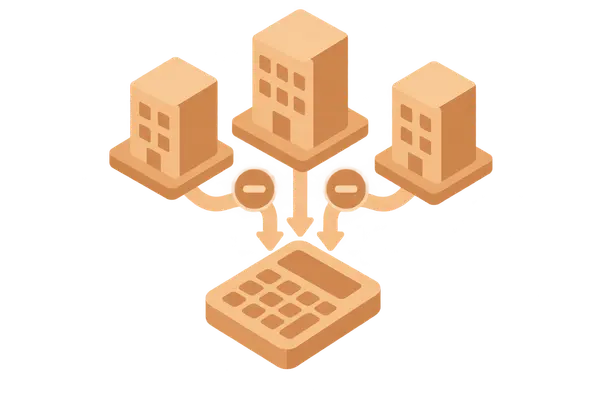
The separate returns show P's gain, but the group has not sold the land to an outside party. The schedule starts with member income and removes the internal gain before calculating the total.

Consolidated taxable income schedule

The member lines come first because consolidated taxable income begins with each member's separate taxable income. The intercompany line follows because the group result must reflect an outside transaction.

LineHow it is foundWhy
P separate taxable incomeUse P's taxable income before consolidated adjustmentsStarts with P's own tax result
S separate taxable incomeUse S's taxable income before consolidated adjustmentsAdds S's own tax result
Consolidated itemsAdd or subtract group-level items not already in member incomeCaptures group-level items
Intercompany transaction adjustmentSubtract a deferred gain, add a deferred loss, or use zero when the outside item is recognizedRemoves an internal result
Consolidated taxable incomeAdd all lines aboveProduces group taxable income

🔑 RULE: Under Treas. Reg. §1.1502-11(a), consolidated taxable income takes into account each member's separate taxable income and the consolidated items. Under Treas. Reg. §1.1502-13, matching and corresponding-item rules coordinate intercompany items when the related outside item is taken into account.

P and S appear as separate lines, and more members would be added in the same way. Separate taxable income comes from each member's own tax computation. Consolidated items belong to the group as a whole. The intercompany adjustment removes a deferred gain, adds back a deferred loss, or remains zero when the related outside item is recognized in the same period.

Removing an intercompany land gain

P's separate taxable income includes its $300,000 outside operating income and its $80,000 land gain. S has no outside income because it still holds the land. The $80,000 gain is removed while the land remains inside the group.

LineHow it is foundAmount
P separate taxable income$300,000 outside income + ($220,000 sale price - $140,000 basis)$380,000
S separate taxable incomeNo outside income; land is still held$0
Consolidated itemsNone$0
Intercompany transaction adjustmentRemove the deferred gain: -($220,000 - $140,000)($80,000)
Consolidated taxable income$380,000 + $0 + $0 - $80,000$300,000
Check$300,000 outside operating income + $0 outside land gain$300,000

The $80,000 gain stays out of current consolidated income because S still owns the land. The check ties to $300,000 of income from outside the group.

When the land is sold outside

S sells the land to an outside buyer for $260,000 during the year instead of holding it at year-end. P's facts remain $300,000 of outside operating income, a $140,000 basis, and a $220,000 sale to S. S's outside sale creates a $40,000 gain, and the related outside sale causes the intercompany adjustment to be $0.

LineHow it is foundAmount
P separate taxable income$300,000 + ($220,000 - $140,000)$380,000
S separate taxable income$260,000 outside sale price - $220,000 purchase price?
Consolidated itemsNone$0
Intercompany transaction adjustmentThe related outside sale occurs in the same period?
Consolidated taxable incomeAdd all schedule lines?

Practice

S separate taxable income from the outside sale is ____ .

The intercompany transaction adjustment is ____ .

Consolidated taxable income is ____ .

The outside sale changes the timing line, not P's original separate taxable income. S reports a $40,000 gain, and the group recognizes the full $120,000 economic gain, producing $420,000.

Intercompany gains, losses and dividends

Each question turns on a different schedule line: a deferred gain, the related outside item, a deferred loss, or an intercompany dividend.

Practice

P has $300,000 of outside operating income. P sells land with a $140,000 tax basis to S for $220,000, creating an $80,000 intercompany gain. S holds the land at year-end and has no other income. What is consolidated taxable income?

P has $300,000 of outside operating income and sells land with a $140,000 tax basis to S for $220,000. S sells the land to an outside buyer for $260,000 in the same year. What is consolidated taxable income?

P has $300,000 of outside operating income and sells land with a $260,000 tax basis to S for $220,000. S holds the land at year-end and has no other income. What is consolidated taxable income?

P has $300,000 of outside operating income and receives a $30,000 dividend from S. S has no other income, and the group has no other consolidated items. What is consolidated taxable income?

The first question uses the deferred-gain line. The remaining questions test outside recognition, the sign of a deferred loss, and the dividend adjustment.

Basis changes alter deferred loss

Was: P had $300,000 of outside operating income, sold land with a $140,000 basis to S for $220,000, and S held the land. P's separate taxable income was $380,000, the adjustment was ($80,000), and consolidated taxable income was $300,000.

Now: P's tax basis in the land is $260,000 rather than $140,000. The sale price remains $220,000, S still holds the land, and which schedule lines move and in which direction?

Answer: P's separate taxable income falls from $380,000 to $260,000 because P has a $40,000 intercompany loss rather than an $80,000 gain, and the adjustment changes from subtracting $80,000 to adding $40,000 because the loss is deferred. Consolidated taxable income remains $300,000 because the internal transfer produces no outside gain or loss and P's $300,000 outside operating income is unchanged.

Computing consolidated taxable income

  1. Compute each member's separate taxable income.
  2. Add or subtract consolidated items.
  3. Identify intercompany gains, losses, dividends, and other internal items.
  4. Defer an internal gain or dividend, or add back an internal loss, unless the related outside item is recognized in the same period.
  5. Add the adjusted lines to produce consolidated taxable income.
  6. Check the result against income from outside parties.

The worked check is $380,000 + $0 + $0 - $80,000 = $300,000. That total ties to $300,000 of outside operating income.

Unlock the full lesson and continue reading

Signup to continue reading this lesson and unlimited access questions, flashcards, AI notes, and more

Scan to download app

Scan to download
UNLOCK FREE ACCESS

Practice Questions: Consolidated taxable income

  1. 1. A calendar-year C corporation incurs a $50,000 net capital loss in 2025. It reported net capital gains of $20,000 in 2022, $15,000 in 2023, and zero in 2024. The corporation has sufficient ordinary taxable income in every year. How should the 2025 net capital loss be treated?

    • A. Carry back $35,000 and carry forward $15,000
    • B. Carry back $50,000 and carry forward $0
    • C. Carry back $0 and carry forward $50,000
    • D. Deduct $50,000 against ordinary income in 2025
    Show answer

    Answer: A. Carry back $35,000 and carry forward $15,000

    > Key point: A C corporation’s net capital loss offsets capital gains through the carryback period; any unused loss carries forward. Why carrying back $35,000 and carrying forward $15,000 is correct - The three-year carryback period includes 2022–2024, when the corporation had $35,000 of net capital gains in total. - The remaining $15,000 of the 2025 loss carries forward; ordinary taxable income does not absorb it. Decision path mermaid flowchart TD A[" 2025 capital loss $50,000 loss "]:::input --> B[" Apply three-year carryback "]:::rule B --> C[" Prior gains total $20,000 plus $15,000 "]:::step C --> D[" Use $35,000 "]:::step D --> E[" Carry forward $15,000 "]:::outcome Why the other options are wrong - Carry back $50,000 and carry forward $0: The carryback years contain only $35,000 of net capital gains to absorb the loss. - Carry back $0 and carry forward $50,000: This skips the carryback despite gains in 2022 and 2023. - Deduct $50,000 against ordinary income in 2025: A C corporation’s net capital loss offsets capital gains, not ordinary income.

  2. 2. At January 1, 2025, an S corporation shareholder has zero stock basis and $20,000 of basis in a bona fide $50,000 open account advance to the corporation. During 2025, the shareholder is allocated $15,000 of ordinary business income, and the corporation then repays $40,000 of the advance. There are no other basis adjustments. What gain does the shareholder recognize on the repayment?

    • A. $0
    • B. $5,000
    • C. $24,000
    • D. $12,000
    Show answer

    Answer: D. $12,000

    > Key point: Restore debt basis for allocated income, then allocate basis proportionally to the portion of the advance repaid. Why $12,000 is correct - The $15,000 income allocation increases debt basis from $20,000 to $35,000. - The corporation repays 80% of the $50,000 advance, so $28,000 of basis applies to the repayment; the excess repayment is gain. Working | Step | Working | Result | |---|---|---:| | Restore basis | $20,000 + $15,000 | $35,000 | | Repayment fraction | $40,000 ÷ $50,000 | 80% | | Basis assigned to repayment | $35,000 × 80% | $28,000 | | Gain | $40,000 − $28,000 | $12,000 | Answer: $12,000 Why the other options are wrong - $0: Using the advance’s $50,000 face amount as basis gives $40,000 − $40,000 = $0. - $5,000: Subtracting all $35,000 of basis, rather than the 80% assigned to the repayment, gives $40,000 − $35,000 = $5,000. - $24,000: Omitting the income-based restoration gives $40,000 − (80% × $20,000) = $24,000.

  3. 3. For 2025, Aspen Corp., a calendar-year C corporation, has taxable income of $300,000 before its net operating loss deduction. Aspen has a $400,000 net operating loss carryforward generated in 2022. Aspen has no other tax attributes affecting taxable income. What amount of taxable income should Aspen report after the net operating loss deduction?

    • A. $240,000
    • B. $0
    • C. $60,000
    • D. $300,000
    Show answer

    Answer: C. $60,000

    > Key point: A post-2017 NOL carryforward may offset no more than 80% of taxable income before the NOL deduction. Why $60,000 is correct - The allowable deduction is 80% × $300,000 = $240,000. - Subtracting the deduction from taxable income gives $300,000 − $240,000 = $60,000. Working | Step | Working | Result | |---|---|---| | Maximum NOL deduction | 80% × $300,000 | $240,000 | | Taxable income after deduction | $300,000 − $240,000 | $60,000 | Answer: $60,000 Why the other options are wrong - $240,000: This is the allowable NOL deduction, not taxable income after the deduction. - $0: This uses the full carryforward to offset income, ignoring the 80% limit. - $300,000: This ignores the available NOL deduction.

  4. 4. During 2025, a domestic corporation pays an $80,000 royalty to an unrelated foreign corporation for the right to use a patent solely in the United States. The foreign corporation has no effectively connected U.S. income, and no income tax treaty applies. How much federal tax generally must the domestic corporation withhold?

    • A. $0
    • B. $8,000
    • C. $24,000
    • D. $80,000
    Show answer

    Answer: C. $24,000

    > Key point: A U.S.-source royalty paid to a foreign corporation is generally subject to 30% gross-basis withholding when no treaty reduction applies. Why $24,000 is correct - The patent is used solely in the United States, so the royalty is U.S.-source income. - With no effectively connected income or applicable treaty, withholding is 30% of the gross royalty: $80,000 × 30% = $24,000. Why the other options are wrong - $0: No effectively connected income does not eliminate withholding on this U.S.-source royalty. - $8,000: This is 10% of the payment; no reduced rate is given. - $80,000: This withholds the entire payment, rather than 30%.

  5. 5. During 2025, Alpine Ltd., a foreign corporation with no U.S. trade or business, earns $40,000 of interest on deposits maintained with an unrelated U.S. commercial bank. Alpine is not eligible for treaty benefits. How much U.S. federal income tax is generally required to be withheld from the interest?

    • A. $0
    • B. $6,000
    • C. $12,000
    • D. $14,000
    Show answer

    Answer: A. $0

    > Key point: Qualifying interest on deposits with an unrelated U.S. bank is generally exempt from U.S. withholding for a foreign corporation without a U.S. trade or business. Why $0 is correct - Alpine earns interest on deposits at an unrelated U.S. commercial bank and has no U.S. trade or business, so the bank-deposit exemption applies. - Treaty benefits are unnecessary because the interest is exempt under this rule. How they compare | Amount | Basis | Why it applies or fails | |---|---|---| | $0 | Bank-deposit exemption | No withholding is generally required | | $6,000 | 15% treaty rate | Alpine is not eligible for treaty benefits | | $12,000 | 30% general rate | The qualifying bank-deposit interest is exempt | | $14,000 | 35% rate | This rate does not apply to the interest | Why the other options are wrong - $6,000: This applies a treaty rate despite Alpine’s ineligibility for treaty benefits. - $12,000: This applies the general withholding rate to interest that is exempt. - $14,000: This uses an inapplicable rate.

  6. 6. In 2025, Dana created a trust and retained an exercisable power to revoke the trust and revest all trust property in Dana. The trust earned $45,000 of taxable interest and distributed $20,000 to Dana's adult child. Who must include the trust's $45,000 of interest in gross income?

    • A. Dana must include $45,000
    • B. Dana must include $25,000, and the child must include $20,000
    • C. The trust must include $45,000
    • D. The child must include $45,000
    Show answer

    Answer: A. Dana must include $45,000

    > Key point: When Dana retains the power to revoke the trust and recover its property, Dana includes all its taxable interest. Why Dana must include $45,000 is correct - Dana can revoke the trust and revest all property, so Dana is treated as the owner for federal income tax purposes. - Dana therefore includes the full $45,000 of interest, regardless of the distribution to the child. Why the other options are wrong - Dana must include $25,000, and the child must include $20,000: the distribution does not split the trust’s interest between Dana and the child. - The trust must include $45,000: the trust is not treated as a separate taxpayer for this interest when Dana is treated as its owner. - The child must include $45,000: the child received $20,000, and the distribution does not shift the interest income from Dana.

Flashcards: Consolidated taxable income

  1. 1. For a C corporation, what is the general NOL carryforward rule for NOLs arising in tax years beginning after December 31, 2017, and what limit generally applies to their use in tax years beginning after December 31, 2020?

    Show answer

    Such NOLs generally carry forward indefinitely. For taxable years beginning after December 31, 2020, the deduction generally is limited to 80% of taxable income computed before the NOL deduction. The CARES Act temporarily permitted carrybacks and suspended the 80% limit for specified tax years beginning in 2018–2020.

  2. 2. For corporate NOLs arising in tax years beginning after December 31, 2017, how are NOLs generally carried and limited?

    Show answer

    They generally cannot be carried back, except for statutory exceptions such as certain farming losses and insurance-company NOLs. They may be carried forward indefinitely, but the deduction is generally limited to 80% of taxable income. NOLs from tax years beginning before January 1, 2018, follow different carryforward and limitation rules.

  3. 3. At what rate are net short-term capital gains taxed in a C corporation?

    Show answer

    They are taxed at ordinary income rates.

  4. 4. How are capital losses treated by a C corporation?

    Show answer

    A C corporation may deduct capital losses only against capital gains.

Everything you need for CPA prep

Get full Oncourse access with lessons, practice questions, flashcards and AI study tools.

GET STARTED FOR FREE
75% OFFLimited time offer
GET 75% OFF