
C corporation losses and consolidated returns

On this page
Who may join a consolidated return
P owns 80% of a subsidiary’s vote and value, but the subsidiary is foreign. Can P include it on a consolidated Form 1120? No. Foreign corporations are generally excluded from an affiliated group under IRC §1504(b), even when ownership is sufficient.
A C corporation has a net operating loss when deductions allowed under IRC §172, with statutory modifications, exceed gross income. A corporate capital loss stays on a separate schedule because it generally offsets only capital gains. An affiliated group may elect one Form 1120 when ownership, entity-status, and filing conditions are met.
The parent and its subsidiaries prepare member-level income and loss data. The parent files the group return under the election in IRC §1501. The IRS checks that the group did not include an ineligible entity or use a loss twice. Internal sales are removed or postponed so the group reports profit from outsiders.
From member results to consolidated income
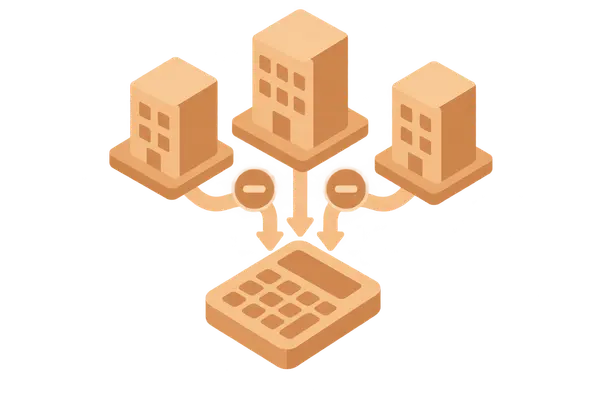
Read the ladder from left to right. Start with each corporation’s operating income, deductions, capital gains, and capital losses. Then test whether the corporations form an includible affiliated group. Apply the NOL, ownership-change, and capital-loss limits. Combine eligible members, remove or postpone intercompany items, and report consolidated taxable income and carryovers.
Loading diagram…
Eligibility controls which members enter the calculation. Loss limits control which attributes reduce income. Intercompany rules clean the combined amount before final taxable income is reported.
NOL, ownership-change and capital-loss limits
Current NOLs and ownership changes
Under IRC §172(a), (b), and (d), a corporation has an NOL when modified deductions exceed gross income. With $600,000 of gross income and $700,000 of deductions, the current NOL is $100,000. If unused, the carryforward is $100,000.
An NOL from a taxable year beginning after December 31, 2017, generally has no carryback. It has an indefinite carryforward. Its later deduction is generally limited to 80% of taxable income before the NOL deduction. A $400,000 carryforward against $400,000 of pre-NOL taxable income has a $320,000 maximum deduction. The remaining NOL is $80,000.
NOLs from taxable years beginning before January 1, 2018, generally follow the prior 2-year carryback and 20-year carryforward framework.
An ownership change generally occurs when 5-percent shareholders increase their ownership by more than 50 percentage points during the 3-year testing period. Under IRC §382(b), the annual limit for pre-change NOLs equals stock value immediately before the change multiplied by the long-term tax-exempt rate.
With $1,000,000 of stock value and a 4% rate, the annual limit is $40,000. Unused annual limitation carries to later years under IRC §382(b)(2). A loss arising after the change is not a pre-change loss and is not limited by §382. The ownership-change rules also use IRC §382(g) and (h).
For the detailed computation, see Corporate NOLs and ownership-change limits.
Corporate capital losses use only gains
Under IRC §1211(a), a C corporation’s capital loss cannot offset ordinary income. Current capital gains absorb current capital losses first. With a $30,000 capital gain and a $70,000 capital loss, the corporation has a $40,000 net capital loss.
Under IRC §1212(a), carry that loss back to the earliest of the 3 preceding years first. Then use the next years. Carry any remainder forward for 5 years.
If the prior gains are $20,000 in the earliest year, $10,000 in the next year, and $0 in the latest year, $30,000 is carried back. The remaining $10,000 is carried forward. If the current gain were $90,000 instead, the result would be a $20,000 net capital gain. No capital-loss carryover would remain.
For the detailed schedule, see Corporate capital loss carrybacks and carryforwards.
Eligibility requires vote and value
Under IRC §1504(a), a common parent must directly own at least 80% of both the total voting power and total value of at least one includible corporation. Each other includible subsidiary must meet the same 80% vote-and-value connection directly or indirectly through other includible members.
The corporations must be domestic C corporations or other includible corporations. Section 1504(b) excludes certain corporations, including foreign corporations. The group must elect consolidated filing and include every includible member.
An 80% vote and 79% value position fails the value test. An 80%-by-80% chain can include a lower corporation. The parent’s indirect ownership can be 64% through that chain.
For the filing conditions, see Consolidated return eligibility and filing.
Consolidated income removes internal profit
Under IRC §1502 and Treas. Reg. §§1.1502-11 and 1.1502-13, combine the members’ separate taxable incomes. Then postpone or match intercompany items so the group reflects transactions with outsiders.
If P sells inventory to S for $100,000 and P’s basis is $40,000, P has a $60,000 separate gain. That internal markup is postponed while S holds the inventory.
If S later sells the inventory outside for $160,000, the group’s total gain is $120,000. The amount equals the outside price less P’s original $40,000 basis.
If S sells it outside for $70,000, the group’s total gain is $30,000. The postponed $60,000 gain matches S’s separate $30,000 loss.
Consolidated NOL carryovers also follow Treas. Reg. §1.1502-21. For the consolidated schedule, see Consolidated taxable income.
NOL, ownership-change and capital-loss limits


NOL, capital-loss and intercompany carryovers
The handoff numbers are the current NOL and its carryforward, the pre-change NOL and its annual §382 allowance, the net capital loss and its ordered carryback or carryforward, and the intercompany item held in postponement. In the main calculation, the $120,000 pre-change NOL produces a $40,000 annual allowance and an $80,000 remaining balance. The $40,000 capital loss produces a $20,000 earliest carryback, a $10,000 next carryback, and a $10,000 carryforward. The $60,000 internal gain is removed before the $400,000 pre-NOL consolidated amount becomes $360,000. If the capital loss is treated as ordinary, taxable income is understated by $40,000. If §382 is ignored, the NOL deduction is overstated by $80,000. If the internal gain is left in, income is overstated by $60,000.
These amounts are not interchangeable. An NOL reduces future taxable income. A capital loss moves only through capital-gain years. An intercompany gain waits for the matching outside event.
How loss limits differ
Each row answers a different question. Select the loss or group rule before applying the dollar limit.
| Rule | Trigger | What it affects | Time or amount limit | What moves forward |
|---|---|---|---|---|
| Current C corporation NOL | Modified deductions exceed gross income | Future taxable income | Post-2017 NOLs generally have no carryback, an indefinite carryforward, and an 80% pre-NOL taxable-income cap | Remaining NOL |
| Pre-change NOL after an ownership change | More than 50 percentage-point ownership increase during the 3-year testing period | Pre-change NOLs | Annual limit equals stock value immediately before the change multiplied by the long-term tax-exempt rate; unused limit carries forward | Annual §382 allowance and remaining NOL |
| Corporate capital loss | Current capital losses exceed current capital gains | Capital gains only | 3-year carryback, then 5-year carryforward, earliest year first | Capital loss carryover |
| Consolidated-return eligibility | At least 80% vote and 80% value through an includible ownership chain | Whether member results may enter one return | Domestic and includible status; all includible members are included | Consolidated filing status |
| Intercompany item | Sale or other transaction between members | Group income and basis timing | Defer and match until the corresponding outside item is taken into account | Deferred item and adjusted group result |
Each row uses a different trigger, so the loss label must be chosen before the dollar limit.
P owns 80% of S’s vote but 79% of S’s value. Can P and S file a consolidated return?
Answer: No. The 80% value test fails even though the vote test is met.
P and S consolidated loss calculation
P and S are domestic C corporations. P owns 80% of S’s vote and value throughout the current year. The acquisition that created the relationship was an ownership change before the current year. S’s stock value immediately before that change was $1,000,000. The given long-term tax-exempt rate is 4%. S has a post-2017 pre-change NOL of $120,000. No other loss limitation applies. P has $180,000 of ordinary operating income. P sells inventory to S for $100,000. P’s basis is $40,000. P’s separate intercompany gain is $60,000. S has $220,000 of separate ordinary operating income. S holds the inventory at year-end. P has a $70,000 capital loss. S has a $30,000 capital gain. The group had capital gains of $20,000 in the earliest preceding year, $10,000 in the next preceding year, and $0 in the latest preceding year. Determine whether the group may file a consolidated return, the current capital-loss result, and consolidated taxable income after the intercompany item and S’s pre-change NOL.
| Step | Calculation | Result | Source chapter |
|---|---|---|---|
| Eligibility | P owns 80% of S’s vote and 80% of S’s value; both are domestic and includible; all members are included | Consolidated filing is permitted | Consolidated return eligibility and filing |
| Capital-loss schedule | $70,000 loss minus $30,000 current gain equals $40,000 net capital loss; carry back $20,000 to the earliest prior year and $10,000 to the next prior year; $10,000 remains | $30,000 carried back and $10,000 carried forward; no ordinary-income deduction | Corporate capital loss carrybacks and carryforwards |
| Separate income and elimination | P: $180,000 plus $60,000 intercompany gain equals $240,000; S: $220,000; combined separate ordinary income equals $460,000; remove the $60,000 internal gain while S holds inventory | $400,000 consolidated taxable income before the old NOL | Consolidated taxable income |
| §382 and NOL deduction | Annual limit: $1,000,000 times 4% equals $40,000; 80% cap: $400,000 times 80% equals $320,000; allowable deduction is the lesser of $120,000, $40,000, and $320,000 | $40,000 NOL deduction, $80,000 NOL remaining, and $360,000 consolidated taxable income | Corporate NOLs and ownership-change limits |
The schedule first establishes eligibility, then preserves the capital-loss result, removes internal profit, and applies the old NOL limit.
S’s stock value immediately before the ownership change is $1,500,000. The long-term tax-exempt rate is 4%. What annual §382 limitation applies?
Answer: $60,000, calculated as $1,500,000 × 4%.
The change is a stock-value change. It is distinct from the foreign-status hook and the 79% value-test change.
Which rule controls each loss
These cases change one controlling fact at a time. Each rationale identifies the specific rule that controls.
Practice
S has a pre-change NOL of $120,000. Its stock value immediately before the ownership change is $1,000,000, the long-term tax-exempt rate is 4%, and S has $400,000 of taxable income before the NOL deduction. Ignoring other limits, what is the maximum pre-change NOL deduction this year?
A corporation has a current capital gain of $30,000 and a current capital loss of $70,000. It had net capital gains of $20,000 in the earliest preceding year, $10,000 in the next preceding year, and $0 in the latest preceding year. How much of the current net capital loss remains to carry forward after the required carryback?
P owns 80% of S’s total voting power but 79% of S’s total value. Both corporations are domestic C corporations and no exclusion applies. Can P and S file a consolidated return?
P has $180,000 of separate ordinary operating income and a $60,000 gain on an intercompany inventory sale to S. S has $220,000 of separate ordinary operating income and holds the inventory at year-end. Before NOLs and capital items, what is consolidated ordinary taxable income?
Keep loss and group rules separate
- Current NOL: Deductions exceeding gross income create an NOL, generally carried forward indefinitely for post-2017 losses and limited to 80% of later pre-NOL taxable income.
- Ownership-change NOL: A pre-change NOL is limited each year to stock value immediately before the change multiplied by the long-term tax-exempt rate.
- Corporate capital loss: Current capital gains absorb losses first. A remaining net loss goes back 3 years and forward 5 years, earliest year first.
- Affiliated group: The group needs at least 80% vote and 80% value through an includible ownership chain, and every includible member must be included.
- Consolidated taxable income: Combine eligible members, remove or postpone intercompany items, then apply allowable loss attributes.
- Whole topic: Keep NOLs, capital losses, affiliation status, and intercompany adjustments on separate schedules until the final consolidated amount is known.
Unlock the full lesson and continue reading
Signup to continue reading this lesson and unlimited access questions, flashcards, AI notes, and more


Practice Questions: C corporation losses and consolidated returns
1. For 2025, Aspen Corp., a calendar-year C corporation, has taxable income of $300,000 before its net operating loss deduction. Aspen has a $400,000 net operating loss carryforward generated in 2022. Aspen has no other tax attributes affecting taxable income. What amount of taxable income should Aspen report after the net operating loss deduction?
- A. $240,000
- B. $0
- C. $60,000
- D. $300,000
Show answer
Answer: C. $60,000
$60,000 - Aspen’s 2022 net operating loss carryforward is subject to the 80% limit on 2025 taxable income computed before the NOL deduction. - The allowable deduction is 80% × $300,000 = $240,000, leaving $60,000 of taxable income. $240,000 - This is the allowable NOL deduction, calculated as 80% × $300,000. - Reporting the deduction as taxable income is the slip; Aspen must subtract $240,000 from $300,000. $0 - This results from using the $400,000 carryforward to offset all $300,000 of income. - The 80% limit prevents Aspen from reducing its 2025 taxable income to zero. $300,000 - This leaves Aspen’s income unchanged by disregarding its available $400,000 NOL carryforward. - Aspen can deduct $240,000 of that carryforward against its 2025 income.
2. During 2025, Alpine Ltd., a foreign corporation with no U.S. trade or business, earns $40,000 of interest on deposits maintained with an unrelated U.S. commercial bank. Alpine is not eligible for treaty benefits. How much U.S. federal income tax is generally required to be withheld from the interest?
- A. $0
- B. $6,000
- C. $12,000
- D. $14,000
Show answer
Answer: A. $0
$0 - Interest on Alpine’s deposits with an unrelated U.S. commercial bank is generally exempt bank-deposit interest for a foreign corporation with no U.S. trade or business. - Because the $40,000 is exempt, the bank generally must withhold $0, even though Alpine has no treaty benefits. $6,000 - Applying a 15% treaty rate to $40,000 produces $6,000. - Alpine has no treaty benefits, and the bank-deposit exemption makes a reduced withholding rate unnecessary. $12,000 - Applying the general 30% withholding rate to $40,000 produces $12,000. - That rate applies to taxable U.S.-source interest, but Alpine’s qualifying bank-deposit interest is exempt. $14,000 - Applying an inapplicable 35% rate to $40,000 produces $14,000. - That is not the withholding rate for this interest; the bank-deposit exemption requires no withholding.
3. During 2025, a domestic corporation pays an $80,000 royalty to an unrelated foreign corporation for the right to use a patent solely in the United States. The foreign corporation has no effectively connected U.S. income, and no income tax treaty applies. How much federal tax generally must the domestic corporation withhold?
- A. $0
- B. $8,000
- C. $24,000
- D. $80,000
Show answer
Answer: C. $24,000
$24,000 - The $80,000 royalty is U.S.-source income because the patent is used solely in the United States. - With no effectively connected income or applicable treaty, the general 30% gross-basis withholding is $80,000 × 30% = $24,000. $0 - Having no effectively connected U.S. income does not exempt this U.S.-source royalty from withholding. - Treating that fact as a zero withholding rate produces $80,000 × 0% = $0. $8,000 - This amount results from applying a 10% rate: $80,000 × 10% = $8,000. - No treaty or other basis for reducing the general 30% rate is given. $80,000 - This amount results from withholding 100% of the royalty: $80,000 × 100% = $80,000. - The general withholding rate is 30% of the gross royalty, not the entire payment.
4. In 2025, Dana created a trust and retained an exercisable power to revoke the trust and revest all trust property in Dana. The trust earned $45,000 of taxable interest and distributed $20,000 to Dana's adult child. Who must include the trust's $45,000 of interest in gross income?
- A. Dana must include $45,000
- B. Dana must include $25,000, and the child must include $20,000
- C. The trust must include $45,000
- D. The child must include $45,000
Show answer
Answer: A. Dana must include $45,000
Dana must include $45,000 - Dana’s retained power to revoke the trust and revest its property makes Dana the owner for federal income tax purposes. - As owner, Dana includes all $45,000 of taxable interest, regardless of the $20,000 distribution to the adult child. Dana must include $25,000, and the child must include $20,000 - The $25,000 figure comes from subtracting the $20,000 distribution from the $45,000 of interest. - That subtraction does not divide grantor-trust income between Dana and the child; Dana reports the full $45,000. The trust must include $45,000 - This treats the trust as a separate taxpayer for interest attributable to property Dana is treated as owning. - Dana’s power to revoke and revest all trust property instead makes Dana taxable on the interest. The child must include $45,000 - The child received $20,000, not the trust’s $45,000 of interest. - More importantly, the distribution does not shift the grantor trust’s taxable interest from Dana to the child.
5. At January 1, 2025, an S corporation shareholder has zero stock basis and $20,000 of basis in a bona fide $50,000 open account advance to the corporation. During 2025, the shareholder is allocated $15,000 of ordinary business income, and the corporation then repays $40,000 of the advance. There are no other basis adjustments. What gain does the shareholder recognize on the repayment?
- A. $0
- B. $5,000
- C. $24,000
- D. $12,000
Show answer
Answer: D. $12,000
$12,000 - The $15,000 income allocation restores debt basis from $20,000 to $35,000 before the repayment. - The $40,000 repayment is 80% of the $50,000 advance, so it uses $28,000 of basis (80% × $35,000) and produces $12,000 gain. $0 - This treats the advance’s $50,000 face amount as though it were its tax basis. - On that mistaken basis, the $40,000 repayment would use $40,000 of basis and produce $40,000 − $40,000 = $0 gain. $5,000 - This subtracts the entire $35,000 restored debt basis from the $40,000 repayment. - Only 80% of that basis belongs to the repaid portion; using all of it incorrectly produces $40,000 − $35,000 = $5,000. $24,000 - This omits the $15,000 basis restoration from the income allocation and uses the opening $20,000 debt basis. - Allocating 80% of that unrestored basis gives $16,000, incorrectly producing $40,000 − $16,000 = $24,000.
6. A calendar-year C corporation incurs a $50,000 net capital loss in 2025. It reported net capital gains of $20,000 in 2022, $15,000 in 2023, and zero in 2024. The corporation has sufficient ordinary taxable income in every year. How should the 2025 net capital loss be treated?
- A. Carry back $35,000 and carry forward $15,000
- B. Carry back $50,000 and carry forward $0
- C. Carry back $0 and carry forward $50,000
- D. Deduct $50,000 against ordinary income in 2025
Show answer
Answer: A. Carry back $35,000 and carry forward $15,000
Carry back $35,000 and carry forward $15,000 - A C corporation carries a net capital loss back three years, applying it only against net capital gains: $20,000 in 2022 plus $15,000 in 2023 equals $35,000. - The remaining $15,000 ($50,000 − $35,000) carries forward for up to five years; the corporation’s ordinary taxable income does not absorb it. Carry back $50,000 and carry forward $0 - This treats all $50,000 as usable in the carryback period, but the 2022–2024 net capital gains total only $35,000. - The extra $15,000 cannot offset ordinary income, so it must carry forward rather than disappear. Carry back $0 and carry forward $50,000 - This skips the three-year carryback despite $20,000 of net capital gains in 2022 and $15,000 in 2023. - After those gains absorb $35,000, only $15,000 remains to carry forward. Deduct $50,000 against ordinary income in 2025 - A C corporation’s net capital loss offsets capital gains, not ordinary taxable income. - Sufficient ordinary income in 2025 therefore does not change the $35,000 carryback and $15,000 carryforward.
Flashcards: C corporation losses and consolidated returns
1. For a C corporation, what is the general NOL carryforward rule for NOLs arising in tax years beginning after December 31, 2017, and what limit generally applies to their use in tax years beginning after December 31, 2020?
Show answer
Such NOLs generally carry forward indefinitely. For taxable years beginning after December 31, 2020, the deduction generally is limited to 80% of taxable income computed before the NOL deduction. The CARES Act temporarily permitted carrybacks and suspended the 80% limit for specified tax years beginning in 2018–2020.
2. For corporate NOLs arising in tax years beginning after December 31, 2017, how are NOLs generally carried and limited?
Show answer
They generally cannot be carried back, except for statutory exceptions such as certain farming losses and insurance-company NOLs. They may be carried forward indefinitely, but the deduction is generally limited to 80% of taxable income. NOLs from tax years beginning before January 1, 2018, follow different carryforward and limitation rules.
3. At what rate are net short-term capital gains taxed in a C corporation?
Show answer
They are taxed at ordinary income rates.
4. How are capital losses treated by a C corporation?
Show answer
A C corporation may deduct capital losses only against capital gains.
Everything you need for CPA prep
Get full Oncourse access with lessons, practice questions, flashcards and AI study tools.
Scan to download app