Investment Planning CFA Flashcards - Medical Study Cards
Master Investment Planning with Oncourse flashcards. These spaced repetition flashcards are designed for medical students preparing for NEET PG, USMLE Step 1, USMLE Step 2, MBBS exams, and other medical licensing examinations.
Investment Planning Flashcard Deck - 10 Cards
Flashcard 1: Inflation & Tax\
*IPS*
Answer: Treatment depends on what is taxed.
If everything is taxed then calculate nominal > adjust for inflation > adjust for taxes. This approach taxes the inflation.
If only withdrawls are taxed then calculate nominal > adjust for taxes > adjust for inflation. This approach does not tax the inflation.
Flashcard 2: Human Capital
Answer: Total Wealth = Financial Capital + Human Capital
Human Capital is the economic PV of future labour income. It should be treated just like any other asset class and has it's own risk/return characteristics, correlations etc
1. Younger investors should invest more in stocks
2. Safe labour income should invest more in stocks
3. Income correlated with stock market should invest less in stocks
4. Ability to adjust labour supply increases allocation to stocks
Life insurance is a hedge against loss of Human Capital. Demand for life insurance also affected by bequest desire.
Flashcard 3: Disposition Effect
Answer: Holding on to losing stocks for too long and selling winning stocks too soon.
Flashcard 4: Due Diligence Unique to Individual Investors\
*Alternative Investors*
Answer: 1. Tax issues
2. Determining suitability
3. Communication with clients
4. Decision risk (prospect theory)
5. Concentrated positions
Flashcard 5: Regret-Aversion Bias
Answer: **Emotional Bias**\
Regret can arise from taking or not taking an action (Error of Commission & Error of Omission).
Conseq: excess conservatism, underperformance, herding
Mitigation: education regarding diversification, risk etc
Flashcard 6: Editing Phase\
*Prospect Theory*
Answer: The goal is to reduce the number of choices
- Codification - codes as a gain or loss, assigns probability
- Combination - combines identical values
- Segregation - Seperates risk-free and risky components
For two or more proposals:
- Cancellation - removes outcomes that are common
- Simplification - Rounding
- Detection of Dominance - discard clearly dominated
Isolation effect is where sequence of editing can lead to different outcomes.
Flashcard 7: Deferred Capital Gains Taxes
Answer: CGT can often be deferred until the asset is sold and the gain is realized
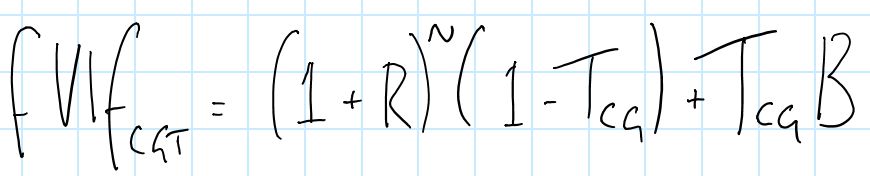
- Tax drag % = tax rate
- As the investment horizon increases: tax drag is unchanged, value of deferral increases
- As the investment return increases: tax drag is unchanged, value of deferral increases
Flashcard 8: Confirmation Bias
Answer: **Cognitive Error: Belief Perseverance**\
Evidence is sought or interpreted to support an original view.
Conseq: ignore info, hold too long, under diversify, concentration in employer stock
Mitigation: seek contrary views
Flashcard 9: Stage of Life
Answer: The normal progression is:
1. Foundation Phase - accumulation through job and savings. Long time horizon allows risk taking however often have little wealth which reduces ability.
2. Accumulation Phase - when earning rise financial assets can be accumulated resulting in higher ability to take risk.
3. Maintenance Phase - retirement. Preserving wealth and living off the portfolio return are important. Ability to bear risk will be declining but not low due to the fact life expectancy can be long.
4. Distribution Stage - assets exceed need so begin to distribute. Time horizon remains long, ability to bear risk can be high but depends on situation.
Flashcard 10: Tax Drag
Answer: Tax drag is the gain lost to taxes.
Tax Drag \$ = Gain With no Taxes - Gain With Taxes
Tax Drag % = Tax Drag \$ / Gain With no Taxes
Keywords: Investment Planning flashcards, medical flashcards, NEET PG preparation, USMLE Step 1 flashcards, Anki alternative, spaced repetition medical, Oncourse flashcards

