Approaches to index-based equity strategies CFA Flashcards - Medical Study Cards
Master Approaches to index-based equity strategies with Oncourse flashcards. These spaced repetition flashcards are designed for medical students preparing for NEET PG, USMLE Step 1, USMLE Step 2, MBBS exams, and other medical licensing examinations.
Approaches to index-based equity strategies Flashcard Deck - 8 Cards
Flashcard 1: Enhanced Indexing
Answer: Attempt to earn an active return while minimizing deviations in performance from the benchmark (tracking risk). Result in higher information rations than passive or activie strategies.
- Stock-based enhanced indexing - The manager underweights or overweights index stocks based on beliefs about the stocks' prospects.
- Derivatives-based enhanced indexing - The manager obtains equity exposure through derivatives (equitize cash). The manager can then attempt to generate excess return by altering the duration of the cash position.
Two limitation of enhanced indexing:
1. Successful managers will be copied and alpha will disappear unless they change their strategy.
2. Models obtained from historical data may not be applicable in the future.
Flashcard 2: Creating a Synthetic Index Fund
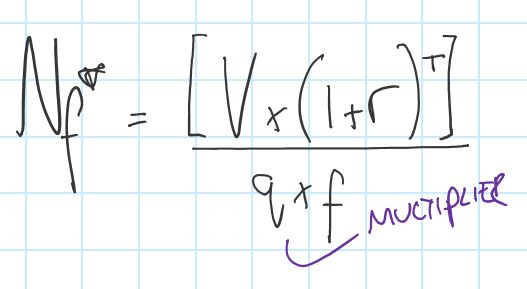
Answer: Calculate the number of futures contracts to represent the ending cash value (round to nearest whole):\
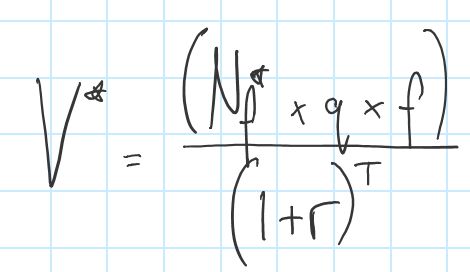
Estime the amount of cash that needs to be equitized:\
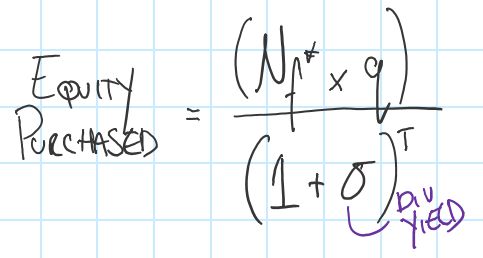
Effective number of shares:\
Flashcard 3: Approaches to Index Weighting
Answer: - Capitalization Weighted
- Price Weighted
- Equal Weighted
- Fundamental Weighted
Flashcard 4: Indexing an Equity Portfolio
Answer: - Full replication -Suitable for less than 1000 or large portfolios. Self balancing.
- Stratified Sampling - The manager seperates the stocks in an index using a structure of two or more dimensions. Within each cell the manager picks a few representative stocks and makes an investment in them equaling the total market cap for that cell.
- Optimization - Uses a factor model to match exposures of the fund. Accounts for the covariances between risk factors. Based on historical data, requires frequent rebalancing.
Flashcard 5: Fundamental Weighted Index
Answer: Use valuation metrics rather than market value to weight index constituents.
Advantages:
- Avoid problem of overweighting overvalued and underweighted undervalued
Disadvantages:
- Reflect index constuctors view on valuation which may be subjective
- May be less liquid as they don't reflect market cap
- Proprietary constuction methodology means they can't be used as benchmarks
Flashcard 6: Equity Strategies & Investors
Answer: If an investors IPS states that the investor is taxable, the asset allocation is more likely to favor passive management.
If an investor believes that the markets are efficient, he is likely to choose a passive strategy because he does not believe the returns of active management will justify the costs of research and trading.
When investing in large-cap stocks, indexing is suitable because these markets are usually informationally efficient. In small-cap markets, there may be more mispriced stocks, but the high turnover associated with active strategies increases transaction costs.
Flashcard 7: Equal-Weighted Index
Answer: Reflects the same initial investment in each security. Results in average of each securities return.
Pros:
- Places more emphasis on smaller cap securities compared to cap weighted. These may have a return advantage and/or provide better diversification.
- Better reflects how the market did (average return).
Cons:
- Biased to the performance of smaller issuers
- Requires constant rebalancing
Flashcard 8: Methods of Passive Equity Investing
Answer: - Index Mutual Funds
- Exchange Traded Funds
- Seperate or Pooled Accounts
- Equity Futures
- Equity Total Return Swap
Keywords: Approaches to index-based equity strategies flashcards, medical flashcards, NEET PG preparation, USMLE Step 1 flashcards, Anki alternative, spaced repetition medical, Oncourse flashcards

