Tail risk in credit portfolios CFA Flashcards - Medical Study Cards
Master Tail risk in credit portfolios with Oncourse flashcards. These spaced repetition flashcards are designed for medical students preparing for NEET PG, USMLE Step 1, USMLE Step 2, MBBS exams, and other medical licensing examinations.
Tail risk in credit portfolios Flashcard Deck - 10 Cards
Flashcard 1: Emerging Market Debt
Answer: Advantages of investing in EMD:
- Diversification
- Increased quality of EMD soverigns
- Increased resiliency
Risks associated with investing in EMD:
- Can be volatile, negatively skewed distributions
- Lack of transparency
- Lack of legal protection
- Lack of standardized covenants
- Political risk
Flashcard 2: %Δrelative value for change in credit spreads
Answer: %Δrelative value = −SDΔS
spread duration (SD) measures a portfolio’s percentage sensitivity to a 1% change in credit spreads (Δs)\
credit spreads (Δs) = yhigher yield − ygovernment
Flashcard 3: International Bond Excess Returns
Answer: Six potential sources of excess returns on international bonds are:
1. Market selection
2. Currency selection
3. Duration management
4. Sector selection
5. Credit analysis
6. Markets outside the benchmark
Flashcard 4: Bond Secular Changes
Answer: In all but the high yield market, intermediate-term and bullet maturity bonds have come to dominate the corporate bond market. Bullet maturities are not callable, putable or sinkable. The implications of this are:
- Securities with embedded options may trade at a premium due to scarcity.
- Credit managers seeking longer duration will pay a premium due to the tendency towards intermediate maturities.
Callable issues still dominate the high-yield segment.
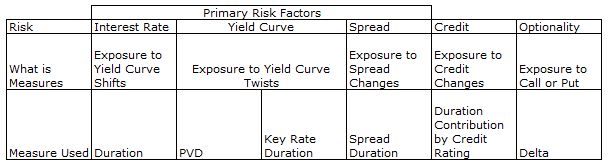
Flashcard 5: Bond Primary Risk Factors
Answer: 1. Duration
2. Key Rate Duration
3. Sector and Quality Percent
4. Quality Spread Duration Contribution
5. Sector Duration Contributions
6. Sector/coupon/maturity cell weights
7. Issuer exposure
Flashcard 6: Credit Analysis
Answer: Credit Analysis involves examining financial statements, bond documents, and trends in credit ratings. It could include:
- Capacityh to pay
- Quality of collateral
- Economic & political risk
Flashcard 7: Bond Relative Value Analysis
Answer: Refers to ranking fixed-income investments by sectors, structures, issuers and issues in terms of their expected performance during some fixed period of time.
- The top-down approach uses economy-wide projections to first allocate funds to different countries or currencies and then works down.
- The bottom-up approach starts at the bottom but identifying undervalued issues.
- Classic relative value analysis combines both the top-down and bottom-up approaches.
Involves total return analysis, liquidity analysis, spread analysis, sector analysis etc
Flashcard 8: Bond Cyclical Changes
Answer: Supply and demand analysis can be used to understand bond prices and resulting spread changes. Increases in the number of new corporate bond issues are sometimes associated with narrower spreads and relatively stong returns. A possible explanation for this is that the valuation of new issues validates the prices of outstanding issues.
In similar fashion, corporate bond returns sometimes decline when supply falls unexpectedly. An explanation for this occurrence is the loss of the validation provided by the primary markets.
Flashcard 9: Rationales for Secondary Bond Trades
Answer: - Yield/spread pickup - ignores additional risks
- Credit-upside trade - expecting rating upgrade, particularly at investment grade junction
- Credit-defense trades - expect credit downgrade
- Sector-rotation trades
- Yield curve-adjustment trades - move to long, short etc
- Straucture trades
- Cash flow reinvestment trades
Flashcard 10: Evaluating Credit Risk
Answer: Credit Risk exists when there is a possibility a counterparty to a transaction will not fulfil its responsibilities. Has two dimensions:
- Probability of default
- Amount of loss
Credit losses can be current or potential credit losses.
Cross-Default Provision- In most lending agreements a debtor is considered in default of all obligations if it defaults on any one of its obligations.
Keywords: Tail risk in credit portfolios flashcards, medical flashcards, NEET PG preparation, USMLE Step 1 flashcards, Anki alternative, spaced repetition medical, Oncourse flashcards

