Fixed-Income Active Management: Credit Strategies CFA Flashcards - Medical Study Cards
Master Fixed-Income Active Management: Credit Strategies with Oncourse flashcards. These spaced repetition flashcards are designed for medical students preparing for NEET PG, USMLE Step 1, USMLE Step 2, MBBS exams, and other medical licensing examinations.
Fixed-Income Active Management: Credit Strategies Flashcard Deck - 10 Cards
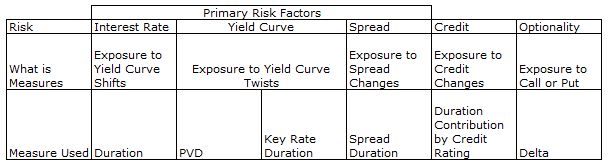
Flashcard 1: Bond Primary Risk Factors
Answer: 1. Duration
2. Key Rate Duration
3. Sector and Quality Percent
4. Quality Spread Duration Contribution
5. Sector Duration Contributions
6. Sector/coupon/maturity cell weights
7. Issuer exposure
Flashcard 2: Spread Duration
Answer: Spread Duration measures the sensitivity of non-Treasury issues to a change in their spread above Treasuries of the same maturity.
There are three spread-duration measures:
1. Nominal Spread - The spread between the nominal yields on a non-Treasury bonds and Treasuries
2. Zero-Volatility Spread - The spread that must be added to the Treasury spot rate curve to equal the market price
3. Option-Adjusted Spread - Determined using a binomial interest rate tree.
Flashcard 3: Spread Analysis
Answer: - Mean reversion - if the current spread is significantly higher than the historic mean, buy the sector.
- Quality-spread analysis - based on the spread differential between low and high quality credits.
- Percentage yield spread analysis - divides the yields on corporate bonds by the yields on treasuries with the same duration. Compared to historical ratio, if higher then buy.
Flashcard 4: Credit Analysis
Answer: Credit Analysis involves examining financial statements, bond documents, and trends in credit ratings. It could include:
- Capacityh to pay
- Quality of collateral
- Economic & political risk
Flashcard 5: Emerging Market Debt
Answer: Advantages of investing in EMD:
- Diversification
- Increased quality of EMD soverigns
- Increased resiliency
Risks associated with investing in EMD:
- Can be volatile, negatively skewed distributions
- Lack of transparency
- Lack of legal protection
- Lack of standardized covenants
- Political risk
Flashcard 6: Bond Relative Value Analysis
Answer: Refers to ranking fixed-income investments by sectors, structures, issuers and issues in terms of their expected performance during some fixed period of time.
- The top-down approach uses economy-wide projections to first allocate funds to different countries or currencies and then works down.
- The bottom-up approach starts at the bottom but identifying undervalued issues.
- Classic relative value analysis combines both the top-down and bottom-up approaches.
Involves total return analysis, liquidity analysis, spread analysis, sector analysis etc
Flashcard 7: Breakeven Spread Analysis
Answer: Breakeven Spread is the change in spread that would make the return on two bonds equal. Calculating breakeven requires:
- Making assumptions to calculate the initial return difference between two bonds
- Using duration to calculate the change in spread between two bonds that will result in a change in price that will offset the initial return difference
If the assumptions do not specify which bond will change in price and the two bonds are different, the higher duration is used.
Change in Price % = Duration x Change in Yield
Change in Yield = (Change in Price %) / (Duration)
May need to adjust change in price for length of the period. eg if the spread is 300bps then the change in price over 3 quaters would need to be 75bps (300/4) to offset the higher yield.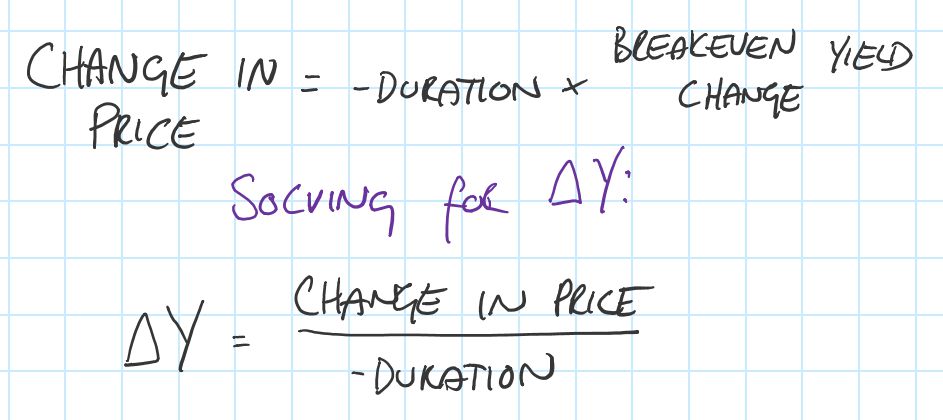
Flashcard 8: Bond Cyclical Changes
Answer: Supply and demand analysis can be used to understand bond prices and resulting spread changes. Increases in the number of new corporate bond issues are sometimes associated with narrower spreads and relatively stong returns. A possible explanation for this is that the valuation of new issues validates the prices of outstanding issues.
In similar fashion, corporate bond returns sometimes decline when supply falls unexpectedly. An explanation for this occurrence is the loss of the validation provided by the primary markets.
Flashcard 9: Rationales for Secondary Bond Trades
Answer: - Yield/spread pickup - ignores additional risks
- Credit-upside trade - expecting rating upgrade, particularly at investment grade junction
- Credit-defense trades - expect credit downgrade
- Sector-rotation trades
- Yield curve-adjustment trades - move to long, short etc
- Straucture trades
- Cash flow reinvestment trades
Flashcard 10: International Bond Excess Returns
Answer: Six potential sources of excess returns on international bonds are:
1. Market selection
2. Currency selection
3. Duration management
4. Sector selection
5. Credit analysis
6. Markets outside the benchmark
Keywords: Fixed-Income Active Management: Credit Strategies flashcards, medical flashcards, NEET PG preparation, USMLE Step 1 flashcards, Anki alternative, spaced repetition medical, Oncourse flashcards

