Portfolio Performance Evaluation CFA Flashcards - Medical Study Cards
Master Portfolio Performance Evaluation with Oncourse flashcards. These spaced repetition flashcards are designed for medical students preparing for NEET PG, USMLE Step 1, USMLE Step 2, MBBS exams, and other medical licensing examinations.
Portfolio Performance Evaluation Flashcard Deck - 10 Cards
Flashcard 31: Returns-Based Style Analysis
Answer: The returns on the manager's fund are regressed against the returns for various security indices. The regression coefficients, which represent the exposure, are constrained to be nonnegative and sum to one.
The security indices used in the regression should be mutually exclusive of one another, be exhaustive and represent distinct, uncorrelated sources of risk.
R2 measures style fit and one minus this indicates the amount unexplained by style and due to security seleciton.
Helps to determine if the manager's reported style and actual style are the same. A series of regressions can be used to check the style consistency of a manager.
Flashcard 32: Real Estate Benchmarks
Answer: National Council of Real Estate Investment Fiduciaries (NCREIF):
- Measures performance of direct real estate
- Value weighted index
- Value obtained infrequently (annually) through appraisal
- Results in downward biased volatility
- Methods developed to unsmooth the index
- Is not an investible index
National Association of Real Estate Trusts (NAREIT):
- Benchmark for indirect investments
- Market-cap-weighted index of all REITS (real time)
- Is an investible index
Flashcard 33: Style Indentification
Answer: Style can be identified through:
- Returns-Based Style Analysis
- Holdings-Based Style Analysis
Flashcard 34: Managed Futures Benchmarks
Answer: - Investible benchmarks exist for active derivative strategies
- Mount Lucus is trading rule based index for active momentum strategy
- CISDM CTA indices are available for systematic vs discretionary strategies
Flashcard 35: Holdings-Based Style Analysis
Answer: Involves evaluating the characteristics of the securities in the manager's portfolio:
- Value or growth
- Expected EPS growth rate
- Earnings volatility
- Industry representation
Advantages:
- Characterizes each security
- Can detect drift more quickly than returns based
Disadvantages:
- Requires subjective judgement to classify
- Requires more data
Flashcard 36: Benchmark Uses
Answer: - Reference point for a portion of a sponsor's portfolio
- Communicate expected risk and return
- Clearly specifying risk exposures
- Performance attribution
- Manager selection
- Marketing
- Compliance and regulatory
Flashcard 37: Benchmarks vs Indexes
Answer: A Benchmark is a reference point for evaluating portfolio performance.
An Index represents the performance of a specific group of securities.
Indexes are often used an benchmarks. However a valid benchmark should be:
- Specified in advance
- Appropriate
- Measurable
- Unambiguous with clearly defined securities and weights
- Reflective of the manager's current investment opinions
- Accountable: manager and client agree it is applicable
- Investable
Flashcard 38: Additive vs Compounding
Answer: Use the additive approach unless the question or facts cleary request compounding or refer to multi-period calculations or to path dependency issues. In those cases use compounding.
Flashcard 39: Benchmark Types
Answer: Asset based benchmarks are for managers who focus on matching or exceeding the return of the assets in the benchmark:
- Absolute return - Specify minimum return
- Manager universe or peer group
- Broad market index
- Investment style index
- Factor-based models
- Return-based models
- Custom
Flashcard 40: σ2(RDC)
Answer: 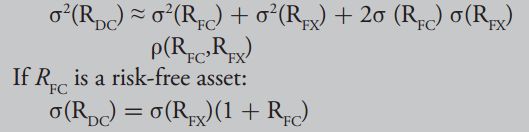
Keywords: Portfolio Performance Evaluation flashcards, medical flashcards, NEET PG preparation, USMLE Step 1 flashcards, Anki alternative, spaced repetition medical, Oncourse flashcards

