Options for targeted equity risk exposures CFA Flashcards - Medical Study Cards
Master Options for targeted equity risk exposures with Oncourse flashcards. These spaced repetition flashcards are designed for medical students preparing for NEET PG, USMLE Step 1, USMLE Step 2, MBBS exams, and other medical licensing examinations.
Options for targeted equity risk exposures Flashcard Deck - 10 Cards
Flashcard 1: Collars
Answer: - Combination of a protective put and covered call
- Cost of buying a put is reduced by selling a call option
- Provides downside protection at the expense of upside potential
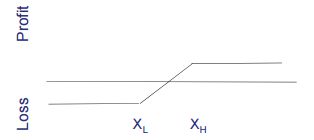
- Similar to Bull spread but hold the underlying
- Zero cost collar is where the call premium equals the put premium
Flashcard 2: Strategies to Modify Risk and Lower Hedging Costs
Answer: - Over or under hedge based on manager view
- Buy at-the-money put options - delta of -0.5, eliminates downside and retains upside. Highest initial cost.
- Buy out-of-the-money put options - delta smaller than 0.5, less cost but does not eliminate all of the downside.
- Risk reversal or coller - removes some downside and upside but lowers cost through premium income (selling call).
- Put spread - But OTM puts and sell puts further out of the money to reduce cost
- Seagull spread - put spread combined with selling a call
Can also use exotic options to reduce cost such as knock-in, knock-out and binary or digital options (pay a fixed amount).
Flashcard 3: Protective Puts
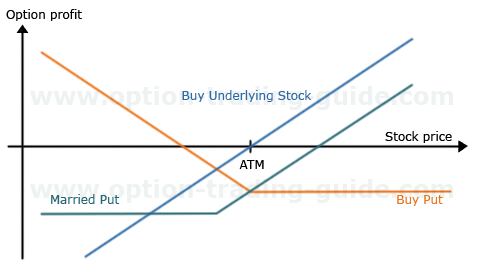
Answer: - Long Stock + Long Put
- Provides protections against decrease in value
- Requires upfront option cost
Flashcard 4: Basic Option Payoff Patterns
Answer: 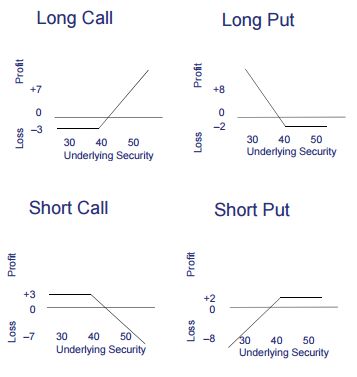
Flashcard 5: Gamma
Answer: Gamma = (change in Delta)/(change in Underlying)
- Measures the sensitivity of delta to a change in the underlying
- Highest when option is at the money/or near expiration
- When gammas are large, some delta hedgers choose to also gamma hedge
Flashcard 6: Delta Hedging
Answer: Delta Hedging is combining an option position with a position in the underlying asset to form a portfolio whose value does not change in reaction to changes in the underlying over short periods of time. Buy (sell) delta number of shares for each short (long) position.
- Delta is an approximation for small changes only
- Delta changes with time and with the price of the underlying
- Rounding causes imprecission
Deltacall = (Change in Call/Change in Spot)
Delta Hedges need to be constantly rebalanced
Flashcard 7: Gamma and the Risk of Delta
Answer: Gamme = (Change in Delta/Change in Spot)
- Larger the gamma, greater the risk
- Gamma is largest for at-the-money and/or near expiration
- Gamma hedge = position in underlying & position in two options
Flashcard 8: Interest Rate Cap
Answer: - Interest rate cap is a combination of interest rate calls
- Each option in a cap is a caplet
- Each caplet has same X but its own expiration date
- Cap seller makes payment if IR \< strike rate
- Payoff is determined on its expiration date but made on the next payment date
Flashcard 9: Interest Rate Collar
Answer: - A combination of a cap and a floor where the agent is long in one position and short in the other
- Attractive to a bank that has among its liabilities large deposits with floating interest rates
Flashcard 10: Vega and Volatility Risk
Answer: Vega = (Change in Option/Change in Vol of Underlying)
- At-the-money option has greatest Vega
- Volatility is unobservable so it is difficult to estimate Vega
- Delta is required to manage Vega risk jointly with delta & gamma
Keywords: Options for targeted equity risk exposures flashcards, medical flashcards, NEET PG preparation, USMLE Step 1 flashcards, Anki alternative, spaced repetition medical, Oncourse flashcards

