Capital Market Expectations, Part 2: Forecasting Asset Class Returns CFA Flashcards - Medical Study Cards
Master Capital Market Expectations, Part 2: Forecasting Asset Class Returns with Oncourse flashcards. These spaced repetition flashcards are designed for medical students preparing for NEET PG, USMLE Step 1, USMLE Step 2, MBBS exams, and other medical licensing examinations.
Capital Market Expectations, Part 2: Forecasting Asset Class Returns Flashcard Deck - 10 Cards
Flashcard 31: The growth rate in the aggregate market value of equity
Answer: growth rate of nominal GDP + change in the share of profits in GDP + change in P/E + dividend yield
growth rate of nominal GDP = growth of real GDP + inflation\
growth rate of real GDP = growth rate in the labor input + growth rate in labor productivity
Flashcard 32: **Risk premium approach to expected bond return**
Answer: 
Flashcard 33: Approaches to economic forecasting
Answer: **Econometric analysis**\
Disadvantages:
- The relationships can change.
**Economic indicators**\
Disadvantages:
- Forecasting results have been inconsistent/false.
- Indicators are revised frequently, which can make them appear to fit past business cycles better than they did when the data were first released.
**Checklist approach**\
Advantages:
- Flexible in mixing objective statistical analysis with judgment to incorporate changing relationships.
Disadvantages:
- Subjective.
- Time-consuming.
- Complexity must be limited due to manual process.
Flashcard 34: Annualized variance
Answer: annualized variance = daily variance × 252
Flashcard 35: **Grinold-Kroner model**
Answer: 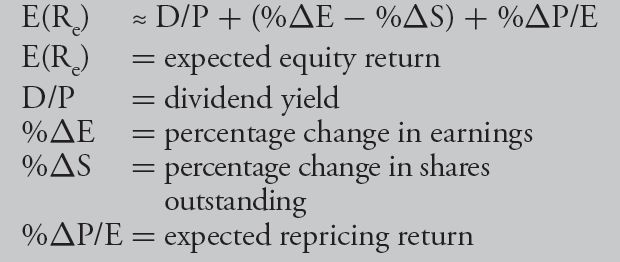\
E is in nominal term
Flashcard 36: Prudence bias
Answer: Forecasts are overly conservative to avoid the regret from making extreme forecasts that could end up being incorrect.
Flashcard 37: **Singer-Terhaar model**
Answer: 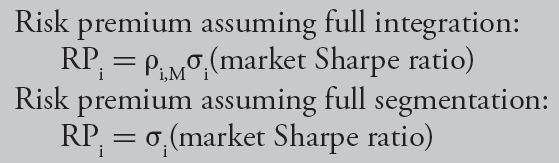\
For the emerging market, the illiquidity risk premium is added
**Weighted average risk premium**\

Flashcard 38: Shrinkage Estimates
Answer: Combining information in the sample VCV matrix with a target matrix (e.g., the factor-based VCV matrix) will result in more precise data and reduced estimation error.
Flashcard 39: Representativeness bias (2)
Answer: - Representativeness, or recency, bias is the tendency to overweight the importance of the most recent observations and information relative to a longer-dated or more comprehensive set of long-term observations and information.
- Return chasing is a common result of this bias
Flashcard 40: Black-Litterman
Answer: implied excess returns from a reverse optimization are adjusted to reflect the investor’s unique views, and then resolves for an EF.
Keywords: Capital Market Expectations, Part 2: Forecasting Asset Class Returns flashcards, medical flashcards, NEET PG preparation, USMLE Step 1 flashcards, Anki alternative, spaced repetition medical, Oncourse flashcards

