Capital Market Expectations, Part 2: Forecasting Asset Class Returns CFA Flashcards - Medical Study Cards
Master Capital Market Expectations, Part 2: Forecasting Asset Class Returns with Oncourse flashcards. These spaced repetition flashcards are designed for medical students preparing for NEET PG, USMLE Step 1, USMLE Step 2, MBBS exams, and other medical licensing examinations.
Capital Market Expectations, Part 2: Forecasting Asset Class Returns Flashcard Deck - 10 Cards
Flashcard 11: Grinold and Kroner
Answer: Takes the Gordon Growth model a step further by including a variable that adjusts for stock repurchases and changes in market valuations as represented by the P/E ratio.
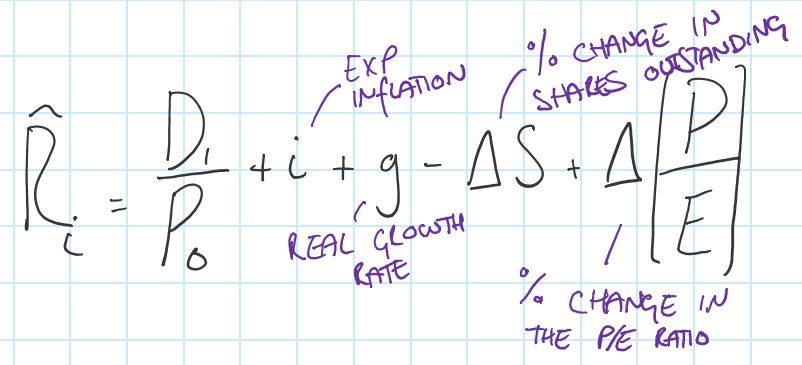
Can be grouped into three parts:
1. Expected income return: (D/P) - Delta(S). Repurchases increase cash paid to stockholders.
2. Expected nominal earnings growth: (i+g)
3. Repricing return: (Delta(P/E)).
Flashcard 12: 10-Year Moving Average P/E Ratio\
*Relative Equity Market Valuation*
Answer: The numerator of the P/10-Year MA(E) is the market price of the S&P 500 price index, and the denominator is the average of the previous ten years' reported real earnings. Both the numerator and the denominator are adjusted for inflation using the consumer price index.
The analyst compares its current value to its historical average to determine whether the market is over or underpriced. eg lower ratio than average indicates the index is overpriced.
Pros:
- Removes the effects of the business cycle and inflation
Cons:
- Accounting changes
- Another method of estimating past earnings might be appropriate
- Long periods of high or low P/E can persist
Flashcard 13: Economic Indicators\
*Economic Forecasting*
Answer: Are available from governments, international organisations (OECD) and private organizations. Analysts prefer leading indicators.
Advantages:
- Easy to understand
- Effectiveness verified by academic research
- Available from third parties so not time consuming
Disadvantages
- Not consistently accurate
- Can give false signals
Flashcard 14: The Fed Model\
*Relative Equity Market Valuation*
Answer: The Fed model assumes that the expected operating earnings yield on the S&P 500 (expected aggregate operating earnings divided by the current index level) should be the same as the yield on long-term US Treasuries.
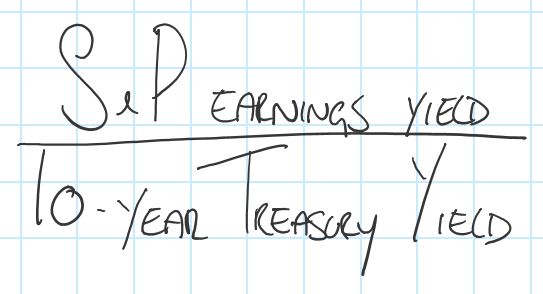
If the S&P earnings yield is higher than the Treasury yield, the interpretation is that the index value is too low relative to earnings and the index value should increase.
Pros:
- Easy to understand
- Consistent with DCF - higher discount rate (Treasury Yield) results in lower stock values
Cons:
- No equity risk premium considered
- Ignores earnings growth
- Compared real to nominal
Rather than assume the two yields should be equal, analysts watch the ratio of the two and evolutions of the ratio over time.
Flashcard 15: Statistical Tools\
*Capital Market Expectations*
Answer: - Projecting historical data - project the historical mean return, standard deviation and correlation for a data set into the future. Arithmetic mean used for single period averages, geometric mean for multiple periods.
- Shrinkage estimates - weighted averages of historical data and some other estimates where the weights and other estimates are defined by the analyst. Designed to reduce the influence of outliers.
- Time series analysis - forecasts a variable using previous values of itself and sometimes previous values of other variables
- Multifactor models - used to forecast returns and can also be used to forecast covariances
Flashcard 16: Risk Premium Approach\
*Capital Market Expectations*
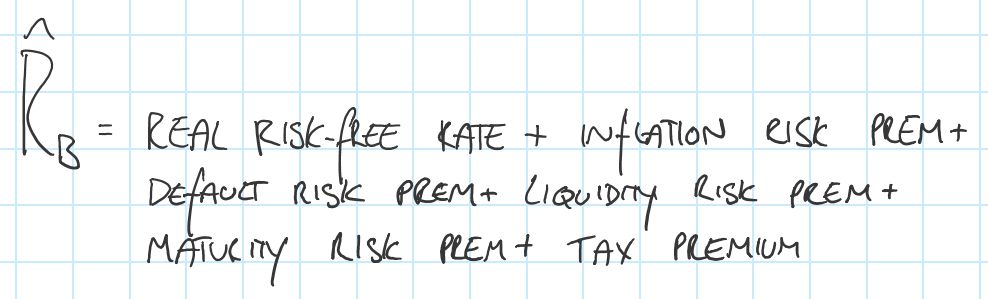
Answer: Sometimes referred to as the build-up approach. To determine the expected return for equities the analyst would build up a bond yield and add an equity risk premium.
To determine the expected return for bonds the analyst uses the real risk-free rate and risk premiums as follows:
Flashcard 17: The Yardeni Model\
*Relative Equity Market Valuation*
Answer: Is based on a variation of the constant growth dividend discount model.
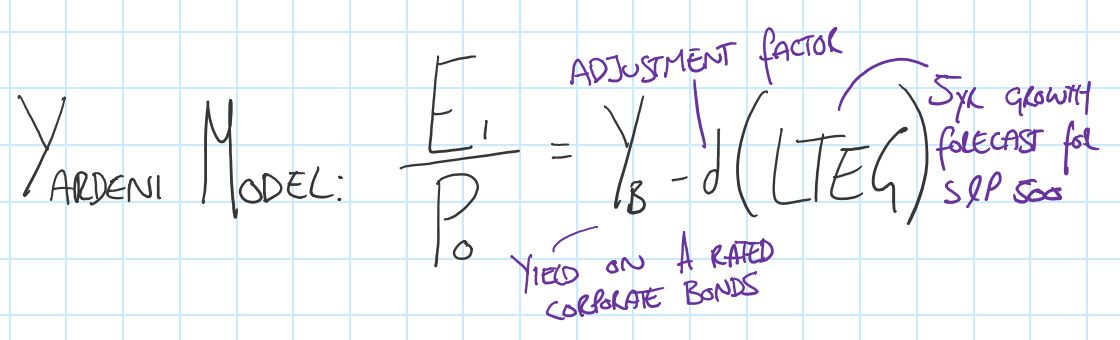
The earnings yield from the Yardeni model is compared to the market earnings yield. If the market is high compared to the Yardeni yield, equities are under-priced.
Pros:
- Incorporates equity risk by using corporate bond yields
- Includes earnings growth
Cons:
- True equity risk premium are higher than corporate bond risk premiums
- Earnings estimates can be wrong
- Assumes discount rate is constant
- d is a fudge factor
Flashcard 18: Econometric Models\
*Economic Forecasting*
Answer: Utilizes economic theory to formulate the forecasting model.
Advantages:
- Can be reused
- Complex enough to model real world conditions
- Can provide precise forecasts
Disadvantges:
- Time consuming to create
- Model may not always be applicable
- Better at forecasting expansions than recessions
Flashcard 19: Black-Litterman\
*Pros & Cons*
Answer: Pros:
- Starts with well diversified market portfolio so produces diversified portfolios
- Theoretically justified way to address sensitivity of input problem
- Reduces input bias as manager does not input expected returns but only selectively adjusts them
Cons:
- Complex
- Utilizes historical inputs
Flashcard 20: Discounted Cash Flow Models\
*Capital Market Expectations*
Answer: The advantage of these models is that they correctly emphasise future cash flows but they fail to account for current market conditions. Therefore more suited for long-term valuation.
- Gordon Growth Model
- Grinold and Kroner Model
Can also be applied to fixed income markets but a drawback is that it assumes that intermediate cash flows are invested at the yield to maturity.
Keywords: Capital Market Expectations, Part 2: Forecasting Asset Class Returns flashcards, medical flashcards, NEET PG preparation, USMLE Step 1 flashcards, Anki alternative, spaced repetition medical, Oncourse flashcards

