Emerging market fixed-income risks and country risk analysis CFA Flashcards - Medical Study Cards
Master Emerging market fixed-income risks and country risk analysis with Oncourse flashcards. These spaced repetition flashcards are designed for medical students preparing for NEET PG, USMLE Step 1, USMLE Step 2, MBBS exams, and other medical licensing examinations.
Emerging market fixed-income risks and country risk analysis Flashcard Deck - 10 Cards
Flashcard 1: Nominal Default Free Bonds\
*Economic Forecasting*
Answer: - Longer term investors can forecast a trend real rate of return and changes in the level of inflation
- Increasing inflation and real rates = shorten duration
- Decreasing inflation and real rates = lengthen duration
- Shorter term trading requires more focus on increases/decreases in economic activity and the affect on interest rates and bond prices
Flashcard 2: Monte Carlo Simulation\
*Pros & Cons*
Answer: Pros:
- Models path dependency issues
- Generates statistical probabilities of meeting or not meeting return objective
- Complements other approaches
Cons:
- Can be complex to implement
- Outputs only as accurate as inputs
Flashcard 3: **Singer-Terhaar model**
Answer: 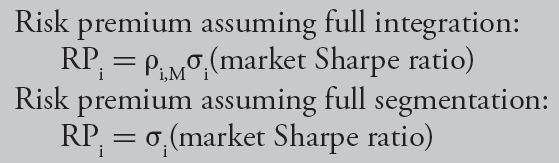\
For the emerging market, the illiquidity risk premium is added
**Weighted average risk premium**\

Flashcard 4: Approaches to economic forecasting
Answer: **Econometric analysis**\
Disadvantages:
- The relationships can change.
**Economic indicators**\
Disadvantages:
- Forecasting results have been inconsistent/false.
- Indicators are revised frequently, which can make them appear to fit past business cycles better than they did when the data were first released.
**Checklist approach**\
Advantages:
- Flexible in mixing objective statistical analysis with judgment to incorporate changing relationships.
Disadvantages:
- Subjective.
- Time-consuming.
- Complexity must be limited due to manual process.
Flashcard 5: Covariance (Long)
Answer: Cov(i,j)=Beta(i,1)\*Beta(j,1)\*Var(F1) + Beta(i,2)\*Beta(j,2)\*Var(F2) + (Beta(i,1)\*Beta(j,2)+(Beta(i,2)\*Beta(j,1))\*Cov(F1,F2)
Flashcard 6: Approaches to Economic Forecasting
Answer: 1. Econometric Models
2. Economic Indicators
3. Checklist Approach
Flashcard 7: Z-Scores
Answer: 5% = 1.65\
1% = 2.33
Flashcard 8: Covariance
Answer: 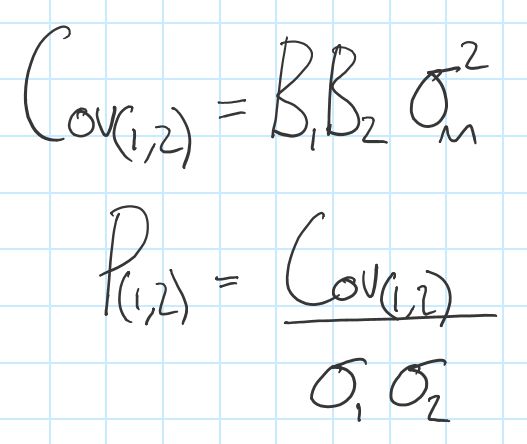
Flashcard 9: Commodities as an Inflation Hedge
Answer: Two factors affect whether a commodity is a good hedge against unexpected inflation: storability and demand relative to economic activity.
- Storable commodities have superior inflation hedging properties.
- Commodities that are most affected by the level of economic activity (energy, precious metals) tend to be better inflation hedges.
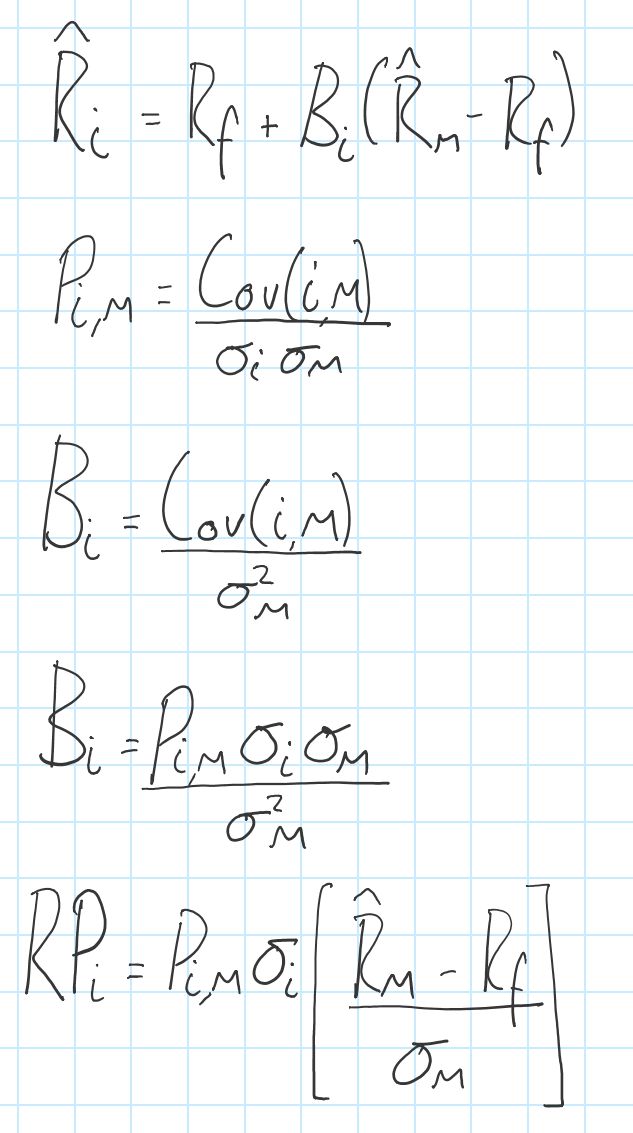
Flashcard 10: Financial Equilibrium Approach
Answer: The Financial Equilibrium Approach assumes that supply and demand in global asset markets are in balance. One such model is ICAPM:
Keywords: Emerging market fixed-income risks and country risk analysis flashcards, medical flashcards, NEET PG preparation, USMLE Step 1 flashcards, Anki alternative, spaced repetition medical, Oncourse flashcards

