The yield curve as an economic predictor CFA Flashcards - Medical Study Cards
Master The yield curve as an economic predictor with Oncourse flashcards. These spaced repetition flashcards are designed for medical students preparing for NEET PG, USMLE Step 1, USMLE Step 2, MBBS exams, and other medical licensing examinations.
The yield curve as an economic predictor Flashcard Deck - 9 Cards
Flashcard 1: Inventory and Business Cycle
Answer: Understanding the business cycle can help the analyst identify inflection points. In general, economic growth can be partitioned into two components:
1. Cyclical
2. Trend Growth
Cyclical analysis is made up of the Inventory Cycle and the Business Cycle. The former lasts for two to four years whereas the latter has a typical duration of nine to eleven years.
The inventory cycle is often measures using the inventory to sales ratio.
Flashcard 2: The Yield Curve\
*Fiscal and Monetary Policy*
Answer: Fiscal and monetary policies have the following impacts on yield curves:
- If both are stimulative, the yield curve is steep and the economy is likely to expand.
- If both are restrictive, the yield curve is inverted and the economy is likely to contract.
- If monetary is restrictive and fiscal is stimulative, the yield curve is flat and the economy is unclear.
- If monetary is stimulative and fiscal is restrictive, the yield curve is moderately steep and the economy is unclear.
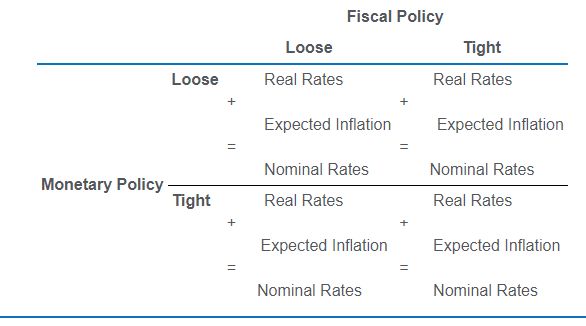
Flashcard 3: Effect of Persistent Policy Mix on the Average Level of Rates\
Answer: 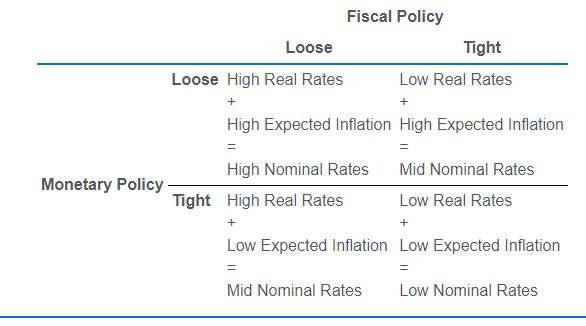
Flashcard 4: Slowdown\
*Business Cycle*
Answer: - Duration of a few months to a year or longer
- Declining confidence
- Inflation still rising
- Falling inventories
- Bond yields have peaked and may be falling
- Yield curve may invert
- Falling stock prices
Flashcard 5: Inventory Cycle
Answer: - Lasts 2 - 4 years
- In the up phase businesses are confident and are increasing production
- This boosts the ecnonomy due to overtime etc
- At some point there is an inflection (cause by monetary policy, shocks etc) and businesses start to view inventories as too high
- Businesses cut production and this slows the economy
- Measured through inventory/sales ratio
- Has been trending downwards due to "just in time" inventory management
Flashcard 6: Emerging Market Economies
Answer: Emerging markets offer high returns at the expense of high risk. They often require heavy investment and are dependent on borrowing.
Six questions investors should ask themselves before committing funds to these markets are:
1. Responsible fiscal and monetary policy? Deficit (G-T) to GDP ratio \< 4%.
2. Reasonable economic growth. Greater than population growth, at least 4%.
3. Stable currency values. Current account deficit to GDP \< 4%.
4. Highly levered? Debt levels > 50% may be overlevered.
5. Adequate liquidity? Foreign exchange reserves to pay at least one year of debt.
6. Stable political situation that supports long-term growth and economic stability.
Flashcard 7: Capital Flows Approach
Answer: Focuses on long-term capital flows such as those into equity investments or FDI.
Flashcard 8: Market Integration
Answer: As markets integrate and move from segmented (emerging) to integrated, the general progression is:
- Share prices rise - more investors, less risk
- Expected returns decline - higher prices, now depends on covariance with global market
- Volatility decreases - more information available, less political risk
- Diversification benefits can decline
- Market efficiency increase (lower transaction costs, higher liquidity)
- Lower capital costs, higher economic growth
Flashcard 9: Real Assets and Inflation
Answer: - Deflation reduces the value of real assets financed with debt. Common with property.
- When inflation is high the cash flows and returns from real assets are higher. Thus, real estate is a good inflation hedge.
Keywords: The yield curve as an economic predictor flashcards, medical flashcards, NEET PG preparation, USMLE Step 1 flashcards, Anki alternative, spaced repetition medical, Oncourse flashcards

