Capital Market Expectations, Part 1: Framework and Macro Considerations CFA Flashcards - Medical Study Cards
Master Capital Market Expectations, Part 1: Framework and Macro Considerations with Oncourse flashcards. These spaced repetition flashcards are designed for medical students preparing for NEET PG, USMLE Step 1, USMLE Step 2, MBBS exams, and other medical licensing examinations.
Capital Market Expectations, Part 1: Framework and Macro Considerations Flashcard Deck - 10 Cards
Flashcard 21: Late Upswing\
*Business Cycle*
Answer: - Confidence and employment are high
- Output gap eliminated, risk of overheating
- Inflation increases
- Rising bond yields
- Rising stock prices but increased risk and volatility
Flashcard 22: Savings and Investment Imbalances Approach
Answer: Starts with the concept that an economy must fund investment through savings. If investment is greater than domestic savings, then capital must flow into the country from abroad to finance the investment.
Flashcard 23: Government Structural Policies
Answer: Government structural policies can impact long-term growth rates in an economy. Four general guidelines:
1. The government should provide the infrastructure needed for growth and should interfere with the economy as little as possible.
2. A government should have a responsible fiscal policy
3. Should have tax policies that are transparent, consistent and not overly burdensome.
4. Should promote competition
Flashcard 24: Solow Residual
Answer: The change in TFP is the Solow Residual and can be determined by rearranging the Cobb-Douglas Production Function:

Flashcard 25: Checklist Approach\
*Economic Forecasting*
Answer: Analyst checks off a list of questions that should indicate future growth in the economy.
Advantages:
- Simple
- Flexible - Allows changes in the model over time
Disadvantages
- Requires subjective analysis
- May be time intensive
- May not be able to model complex relationships
Flashcard 26: Total Factor Productivity
Answer: TFP is the rate of managerial and technological innovation, measuring the ability of an economy to produce more real output for the same inputs of labour and capital.
An economy's TFP can change over time due to the following:
- Changing technology
- Changing restriction of capital and labour mobility
- Changing laws
- Depleting/discovering natural resources
Flashcard 27: Recession\
*Business Cycle*
Answer: - Duration of six months to a year
- Large declines in inventory
- Declining confidence and profits
- Inflation tops out
- Falling bond yields
- Stock prices increase during latter stages in anticipation of the end of the recession
Flashcard 28: Formulating Capital Market Expectations
Answer: To formulate capital market expectations, the analyst should use the following 7-step process:
1. Determing the specfic capital market expectations needed according to the investor's tax status, allowable asset classes and time horizon.
2. Investigate asset historical performance to identify drivers
3. Identify relevant valuation model
4. Collect the best data possible
5. Use experience and judgement to interpret current conditions
6. Formulate capital market expectations
7. Monitor performance and use it to refine the process
Flashcard 29: Availability bias
Answer: - Availability bias is an information-processing bias in which people take a mental shortcut when estimating the probability of an outcome based on how easily the outcome comes to mind.
- investors who personally experience an adverse event are likely to assign a higher probability to such an event occurring again.
Flashcard 30: Probability of a change in the Fed funds target rate
Answer: 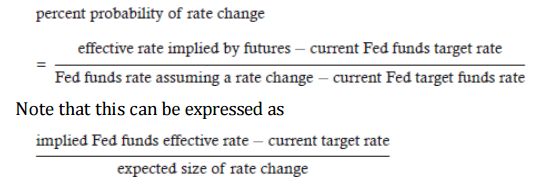
Keywords: Capital Market Expectations, Part 1: Framework and Macro Considerations flashcards, medical flashcards, NEET PG preparation, USMLE Step 1 flashcards, Anki alternative, spaced repetition medical, Oncourse flashcards

