Back
USMLE Study Plan: Build an Adaptive Plan with Oncourse AI
Create a USMLE study plan that adapts to your weak areas in real-time. Learn how Oncourse AI's adaptive daily planning targets gaps, optimizes retention, and builds an exam strategy that evolves with your progress.
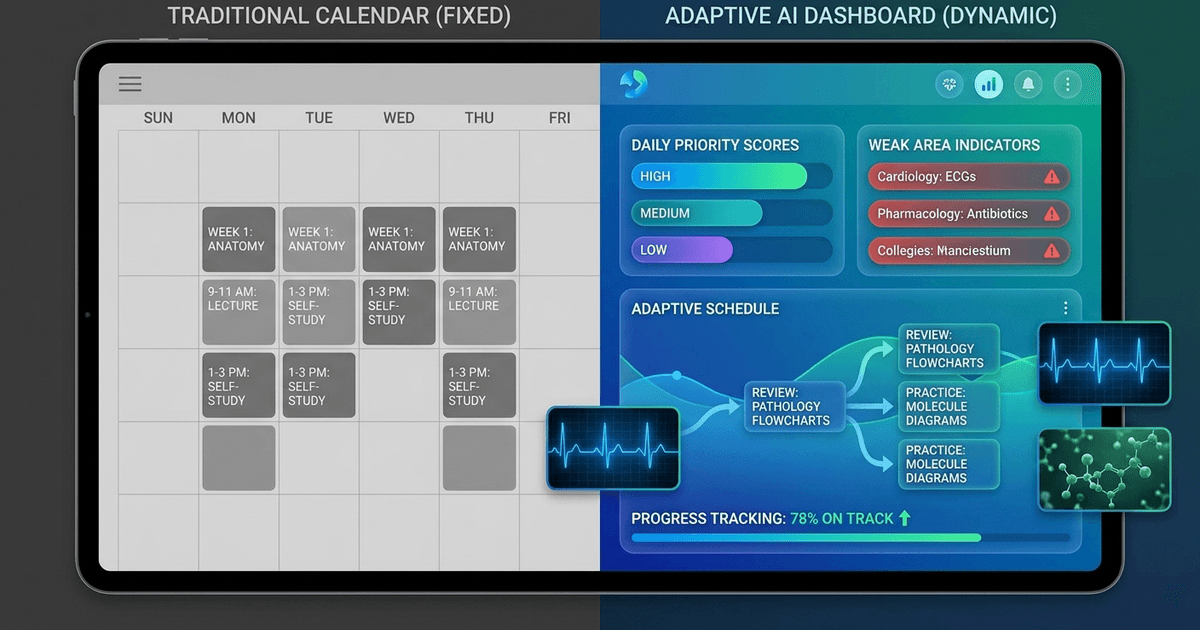
USMLE Study Plan: Build an Adaptive Plan with Oncourse AI
You probably started USMLE prep with a perfectly organized study schedule. Three months mapped out week by week. Cardiology on Mondays, pharmacology on Tuesdays, pathology on Wednesdays. It looked amazing on paper.
Then reality hit. You aced cardiology in week 2 but bombed your first pharmacology practice test. Your pathology scores improved, but now you cant remember basic cardiovascular physiology. Meanwhile, your rigid schedule keeps marching forward, allocating equal time to subjects you've mastered and topics where you're still struggling.
Here's what most USMLE students discover: static study plans don't match how your brain actually learns. You don't forget everything at the same rate. You don't need identical review frequencies. And you definitely don't benefit from treating every subject equally when your pharmacology accuracy is sitting at 52% while your anatomy scores hit 88%.
This is exactly why adaptive study planning exists — and why Oncourse AI's approach targets your actual weak areas instead of following a one-size-fits-all timeline.
Why Traditional USMLE Study Plans Fail
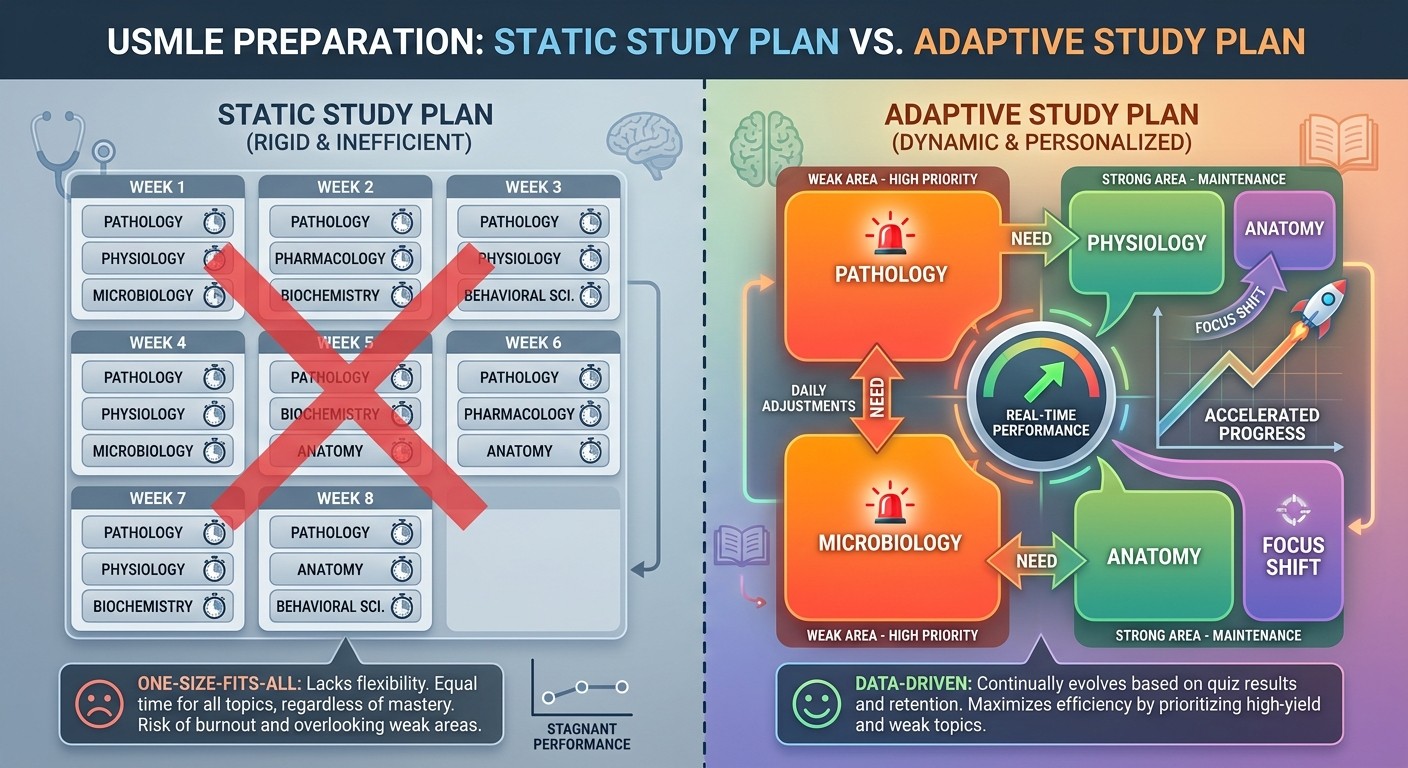
Most study guides treat every medical student identically. They assume you'll retain cardiology concepts for exactly 2 weeks, need pharmacology review every 3 days, and benefit from 90-minute blocks regardless of your mastery level.
But your brain creates unique neural pathways for each USMLE topic. You might remember complex pathophysiology cascades for months while forgetting simple drug classifications in days. You could excel at visual pattern recognition but struggle with mechanism-based questions.
Static schedules ignore these individual patterns completely.
The three fatal flaws of rigid USMLE planning:
1. Equal time allocation: Spending 2 hours on subjects you've mastered while weak areas get the same 2 hours
2. Fixed review cycles: Reviewing topics on predetermined dates rather than when you actually need reinforcement
3. No performance feedback: Continuing with the original plan even when your practice scores reveal glaring knowledge gaps
The result? You waste time on strengths while your weak areas remain weak — exactly what you can't afford on a high-stakes exam like the USMLE.
What Makes a Study Plan Truly Adaptive
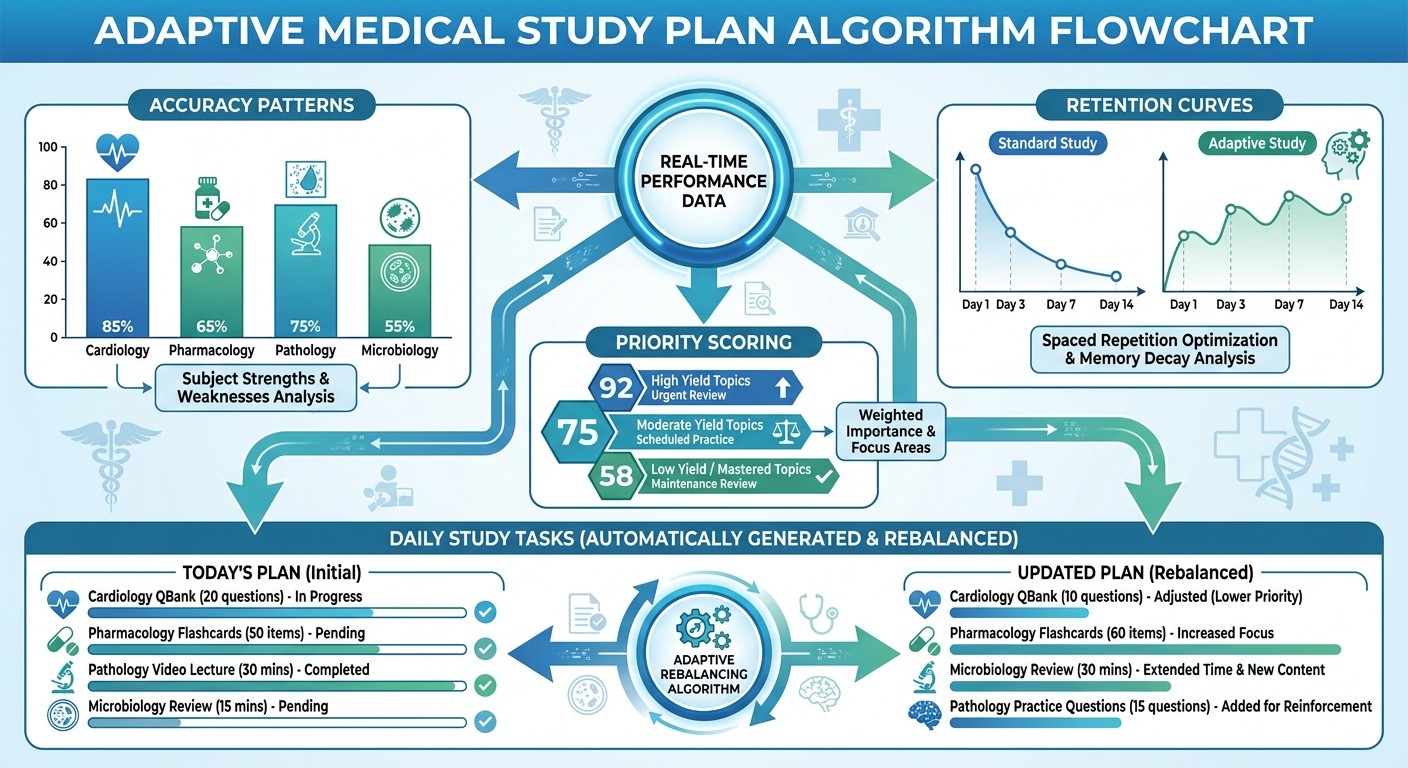
Real adaptive planning goes far beyond adjusting question difficulty based on your last practice test. It requires understanding the complex relationships between accuracy, retention timing, and subject-specific forgetting patterns — then optimizing all three simultaneously.
Oncourse AI's Adaptive Daily Plan operates on three core data streams that traditional schedules simply can't access:
Performance Pattern Recognition
The system tracks your accuracy across every USMLE domain, identifying not just broad weak areas but specific subtopics within those areas. If you're missing diabetic ketoacidosis questions but scoring well on diabetes complications, it prioritizes DKA concepts over general endocrine review.
This granular tracking means your study time gets allocated to the exact concepts causing problems — not entire subject categories.
Personal Forgetting Curves
Every topic you study develops a unique retention pattern based on your individual memory. Oncourse measures how quickly your accuracy drops for each subject when you don't review it, then schedules optimal review moments just before you'd normally start forgetting.
Some students retain pharmacology mechanisms for weeks but forget anatomy details in days. Others show the opposite pattern. Adaptive planning accounts for your specific retention profile.
Predictive Weakness Targeting
The most advanced feature: predicting what you're likely to forget tomorrow and proactively scheduling review to prevent that forgetting. Instead of reactive studying (reviewing what you got wrong yesterday), you get proactive reinforcement based on your learning patterns.
How Oncourse AI Rebuilds Your Schedule Daily
Every time you complete practice questions or review content, the adaptive algorithm rebalances your entire study plan in under 2 seconds. Here's the process:
Subject Priority Scoring
Each USMLE topic receives a priority score from 0-100 based on three weighted factors:
Performance gap (40% weight): How far below your target accuracy you currently score
Time decay (35% weight): How long since you last actively studied this topic
Exam relevance (25% weight): How heavily this subject appears on your target USMLE step
When you nail a cardiology practice block, that subject's priority drops immediately. When you struggle through pharmacology, that priority jumps to the top of tomorrow's plan.
Real-Time Task Generation
Based on priority scores, the system generates your daily task list automatically. High-priority subjects get more questions, longer review sessions, and additional spaced repetition. Lower-priority topics receive maintenance-level exposure to prevent forgetting without wasting time.
This isn't preset scheduling — it's dynamic reallocation based on what your performance data shows you need right now.
Building Your Adaptive USMLE Study Framework
Phase 1: Diagnostic Baseline (Week 1)
Start with comprehensive baseline testing across all USMLE domains. Take practice tests in cardiology, pharmacology, pathology, microbiology, and other core areas. This isn't about scoring well — it's about mapping your current knowledge landscape.
Oncourse AI automatically analyzes these baseline results to create your initial priority ranking. Subjects where you score below 60% become high-priority focus areas. Topics above 75% receive maintenance-level scheduling.
Phase 2: Adaptive Content Building (Weeks 2-8)
With your baseline established, the adaptive plan allocates study time based on performance gaps. Weak areas get intensive daily exposure through:
Targeted question blocks (40-60 questions per high-priority subject)
Focused content review for concepts you consistently miss
Spaced repetition scheduling optimized for your retention patterns
Rezzy AI tutor sessions become particularly valuable here — you can ask specific questions about concepts you're struggling with, getting personalized explanations that target your exact confusion points.
Phase 3: Integration and Mastery (Weeks 9-12)
As subjects move from weak to strong, the adaptive plan automatically reduces their daily allocation and increases cross-system integration questions. You'll start seeing cardiology-pharmacology combinations, pathology-microbiology connections, and other high-yield USMLE patterns.
The system continues tracking performance and adjusting daily tasks, but now the focus shifts from building knowledge to maintaining it while developing test-taking speed and accuracy.
Targeting Weak Areas Without Resource Overload
One major trap in USMLE prep: discovering weak areas and then drowning yourself in every available resource for those topics. Adaptive planning helps you avoid this by providing focused remediation paths.
The 3-Resource Rule
For each identified weak area, limit yourself to three key resources:
1. Primary question bank for active practice (your main QBank)
2. Targeted review material for concept reinforcement
3. Spaced repetition tool for long-term retention
Oncourse AI's Synapses game works particularly well as the spaced repetition component — it gamifies memory palace techniques and mnemonics specifically for medical concepts, helping you retain complex pathways and drug mechanisms that typically cause trouble.
Weak-Topic Review Loop
Instead of spending entire days on weak subjects, use a cycling approach:
Morning focus block: 60-90 minutes on your highest-priority weak area
Mixed practice: Questions combining strong and weak topics
Evening reinforcement: 30 minutes reviewing mistakes from the day
Spaced review: Previously weak topics that have improved
This prevents weak-area fatigue while ensuring consistent progress across all USMLE domains.
Weekly Planning Within Adaptive Framework
Even with adaptive daily planning, you need weekly structure to maintain momentum and track progress. Here's how to organize your weeks while letting the algorithm handle daily specifics:
Monday: Assessment and Adjustment
Complete a comprehensive practice test
Review performance across all subjects
Let Oncourse AI recalibrate your week's priorities
Plan high-level goals (not specific daily tasks)
Tuesday-Thursday: High-Intensity Study Days
Focus on algorithm-selected high-priority subjects
Complete daily question quotas (typically 40-80 questions)
Use active recall techniques for new content
Review and annotate mistakes immediately
Friday: Integration and Pattern Recognition
Mixed-subject question blocks
Cross-system connection practice
Clinical correlation exercises
Speed and accuracy drills
Weekend: Maintenance and Planning
Review previously mastered subjects to prevent forgetting
Light exposure to low-priority topics
Plan upcoming week's general structure
Rest and recovery
The key insight: let the adaptive algorithm determine what you study each day, but maintain consistent weekly patterns for sustainability.
Active Recall Integration with Adaptive Planning
Adaptive scheduling becomes exponentially more effective when combined with active recall techniques. Instead of passive review of weak topics, you need active engagement that creates lasting memory.
Question-First Approach
For each high-priority subject identified by the adaptive plan:
1. Start with questions, not content review
2. Identify specific gaps from wrong answers
3. Target review only the concepts you couldn't recall
4. Test again within 24-48 hours to confirm retention
This approach ensures your study time directly addresses performance gaps rather than reviewing concepts you already understand.
Spaced Retrieval Practice
Once you've improved in a weak area, the adaptive plan should schedule spaced retrieval:
Day 1: Initial learning and practice
Day 3: First retrieval attempt
Day 7: Second retrieval with mixed questions
Day 14: Third retrieval in timed conditions
Day 30: Long-term retention check
Oncourse's adaptive algorithm handles this scheduling automatically, but understanding the principle helps you recognize when the system is moving topics from active learning to maintenance mode.
Timing Adjustments and Flexibility
Real life doesn't follow perfect study schedules. You'll have exhausting clinical rotations, family obligations, and days when your brain simply won't cooperate. Adaptive planning must account for these realities.
Daily Time Flexibility
Instead of rigid hourly blocks, work with flexible time targets:
High-energy days: 6-8 hours of focused study
Medium-energy days: 4-5 hours with strategic breaks
Low-energy days: 2-3 hours on highest-priority topics only
Recovery days: Light review and spaced repetition only
The adaptive algorithm adjusts your daily task load based on available time while maintaining progress toward your exam date.
Progress-Based Timeline Adjustments
Traditional schedules stick to predetermined exam dates regardless of readiness. Adaptive planning uses performance metrics to suggest timeline modifications:
Ahead of schedule: Consider moving up your exam date
On track: Maintain current timeline with minor adjustments
Behind schedule: Extend preparation period or focus on highest-yield topics
This data-driven approach prevents the common mistake of taking the USMLE before you're truly ready.
How Oncourse AI Keeps Your Plan Actionable
The biggest challenge with any study plan isn't creating it — it's following it consistently. Oncourse AI's adaptive approach includes several features specifically designed to maintain momentum and prevent planning paralysis.
Daily Task Clarity
Instead of vague goals like "study cardiology," you get specific, achievable tasks:
Complete 45 cardiology questions focusing on arrhythmias
Review pharmacology mechanisms for 3 antihypertensive drug classes
Practice 20 pathology image recognition exercises
Complete spaced repetition for previously missed microbiology concepts
This specificity eliminates decision fatigue and keeps you moving forward consistently.
Progress Visualization
Seeing improvement in weak areas provides crucial motivation during long preparation periods. The adaptive plan tracks and displays:
Subject-level accuracy trends over time
Weak area improvement rates with projected mastery dates
Overall readiness scores based on comprehensive performance
Time efficiency metrics showing study effectiveness
These visual indicators help you trust the process during inevitable frustration periods.
Intelligent Break and Recovery
Adaptive planning recognizes signs of burnout before they derail your preparation:
Performance decline detection: Suggests rest when accuracy drops across multiple subjects
Cognitive load balancing: Alternates high-demand and maintenance tasks
Recovery period optimization: Maintains light exposure during breaks to prevent major knowledge loss
This prevents the boom-bust cycles that destroy many USMLE study attempts.
Frequently Asked Questions
How long does it take for adaptive planning to show results?
Most students see meaningful improvements in weak areas within 10-14 days of consistent adaptive studying. However, the algorithm begins optimizing your plan immediately from your first practice session — you don't need to wait weeks for it to "learn" your patterns.
Can I override the adaptive recommendations if I want to focus on specific topics?
Yes, but use this sparingly. The algorithm's recommendations are based on comprehensive performance data that's often more accurate than your subjective sense of what needs work. If you must override, do it for high-yield topics close to your exam date.
Does adaptive planning work for both USMLE Step 1 and Step 2 CK?
Absolutely. The core principles apply to both exams, though the specific content areas and question patterns differ. The algorithm adapts to whichever USMLE step you're targeting and adjusts priorities based on that exam's blueprint.
What happens if I miss several days of studying?
The adaptive plan automatically adjusts when you return, typically by increasing the priority of topics most likely to have decayed during your break. It also provides catch-up recommendations to minimize the impact of missed study time.
How does adaptive planning handle subjects I'm already strong in?
Strong subjects receive maintenance-level exposure to prevent forgetting while freeing up time for weak areas. The algorithm monitors these subjects to catch any decline in performance and can quickly re-prioritize if needed.
Should I still use a traditional study schedule alongside adaptive planning?
No — the two approaches work against each other. Traditional schedules force you to study predetermined topics regardless of your needs, while adaptive planning optimizes based on current performance. Choose one approach and commit to it fully.
---
Ready to build a USMLE study plan that actually adapts to your learning? Stop wasting time on rigid schedules that ignore your weak areas.
Prepare smarter with Oncourse AI — adaptive MCQs, spaced repetition, and AI explanations built for USMLE success. Download free on Android and iOS.