Back
USMLE Step 2 CK Study Plan 2026: Week-by-Week Schedule, High-Yield Resources and Score-Maximizing Strategy
Master USMLE Step 2 CK with this comprehensive 8-week study plan. Get week-by-week schedules, high-yield resources (UWorld, NBME, First Aid), score targets by specialty, and proven strategies for 250+ scores in 2026.
USMLE Step 2 CK Study Plan 2026: Week-by-Week Schedule, High-Yield Resources and Score-Maximizing Strategy
You are probably staring at your USMLE Step 2 CK exam date wondering how to cram 2+ years of clinical knowledge into a manageable study block. With Step 1 now pass/fail, Step 2 CK has become the primary numerical metric for residency applications — and the stakes have never been higher.
Step 2 CK tests your clinical decision-making across 318 questions in 16 blocks of ~20 questions each (as of May 2026). You have roughly 90 seconds per question to demonstrate mastery of Internal Medicine, Surgery, Pediatrics, OB/GYN, Psychiatry, Emergency Medicine, and Ethics. The passing score rose to 218 in July 2025, and competitive residencies now expect scores of 250+ to 270+ depending on specialty.
Most students dedicate 6-8 weeks for Step 2 CK preparation. This guide breaks down an 8-week intensive study plan that maximizes your score through systematic review, high-volume question practice, and strategic resource allocation. No fluff — just the exact week-by-week schedule that consistently produces 250+ scores.
What Step 2 CK Actually Tests
Step 2 CK evaluates three core competencies that matter for residency:
Clinical Knowledge: Pattern recognition for common presentations, differential diagnosis construction, and understanding of pathophysiology across all major specialties. Patient Management: Next-best-step decision making, treatment selection, and clinical reasoning under time pressure. This is where most points are won or lost. Clinical Decision-Making: Integration of history, physical exam findings, lab values, and imaging to reach appropriate management decisions. The exam rewards systematic thinking over memorization.
The content breakdown heavily weights Internal Medicine (~25% of questions), followed by Surgery (~15%), Pediatrics (~15%), OB/GYN (~12%), Psychiatry (~12%), Emergency Medicine (~10%), and Ethics/Biostatistics (~8%). Mastering IM gives you the biggest score boost per hour studied.
How Long to Study for Step 2 CK
Standard dedicated block: 6-8 weeks full-time (8+ hours daily) Minimum effective duration: 4 weeks (for students with strong clerkship grades) Maximum recommended: 10 weeks (diminishing returns beyond this point)
Your ideal timeline depends on your clerkship performance. If you consistently scored >80th percentile on shelf exams, 6 weeks is sufficient. If you struggled with clinical reasoning or scored <60th percentile on multiple shelves, plan for 8 weeks.
The key isn't cramming more content — it's drilling question patterns until clinical decision-making becomes automatic. Most 250+ scorers complete 2,500-3,500 practice questions during their dedicated block.
8-Week Step 2 CK Study Plan
Week 1: Diagnostic Assessment & Foundation Building
Goals: Establish baseline, identify weak systems, begin systematic review Daily Schedule (8-10 hours):
Morning (3 hours): 40 UWorld questions (random, timed)
Midday (2 hours): Review UWorld explanations thoroughly
Afternoon (2 hours): First Aid Step 2 CK system review based on weak areas
Evening (1-2 hours): OnlineMedEd videos for challenging concepts
Key Milestones:
Complete NBME Form 9 or 10 (baseline assessment)
Identify 3 weakest systems from UWorld performance
Complete 280 UWorld questions (40/day × 7 days)
Week 1 Strategy: Focus on understanding rather than speed. Read every UWorld explanation, including incorrect choices. Don't worry about scores yet — you're building pattern recognition.
Week 2: System-Focused Review
Goals: Target weak systems, increase question volume, establish rhythm Daily Schedule (9-10 hours):
Morning (3.5 hours): 50 UWorld questions (subject-specific blocks targeting weak areas)
Midday (2.5 hours): Detailed UWorld review + incorrect log creation
Afternoon (2 hours): Targeted First Aid reading + Amboss articles for difficult topics
Evening (1-2 hours): Oncourse's adaptive question bank for targeted weak-area practice
Key Milestones:
Complete 350 UWorld questions
Create comprehensive incorrect log
Review all Internal Medicine high-yield topics
Take practice NBME (Form 11 or 12) at week's end
Week 2 Insight: Oncourse's adaptive system adjusts difficulty based on your performance, so you can drill Surgery, OB/GYN, or Psychiatry weaknesses more intensively without wasting time on mastered topics.
Week 3: Pattern Recognition Development
Goals: Build speed, recognize common vignette patterns, integrate knowledge Daily Schedule (10 hours):
Morning (4 hours): 60 UWorld questions (mixed blocks, timed)
Midday (2.5 hours): UWorld review + pattern analysis
Afternoon (2 hours): Focused review of Ethics/Biostatistics (commonly neglected)
Evening (1.5 hours): Case-based practice using Oncourse's clinical reasoning explanations
Key Milestones:
Complete 420 UWorld questions (total: 1,050)
Master common IM presentations (chest pain, dyspnea, abdominal pain algorithms)
Complete Ethics/Biostatistics review
Achieve >65% accuracy on mixed UWorld blocks
Every Oncourse question includes structured explanations that mirror Step 2 CK's clinical vignette logic, helping you build the differential diagnosis mindset the exam rewards.
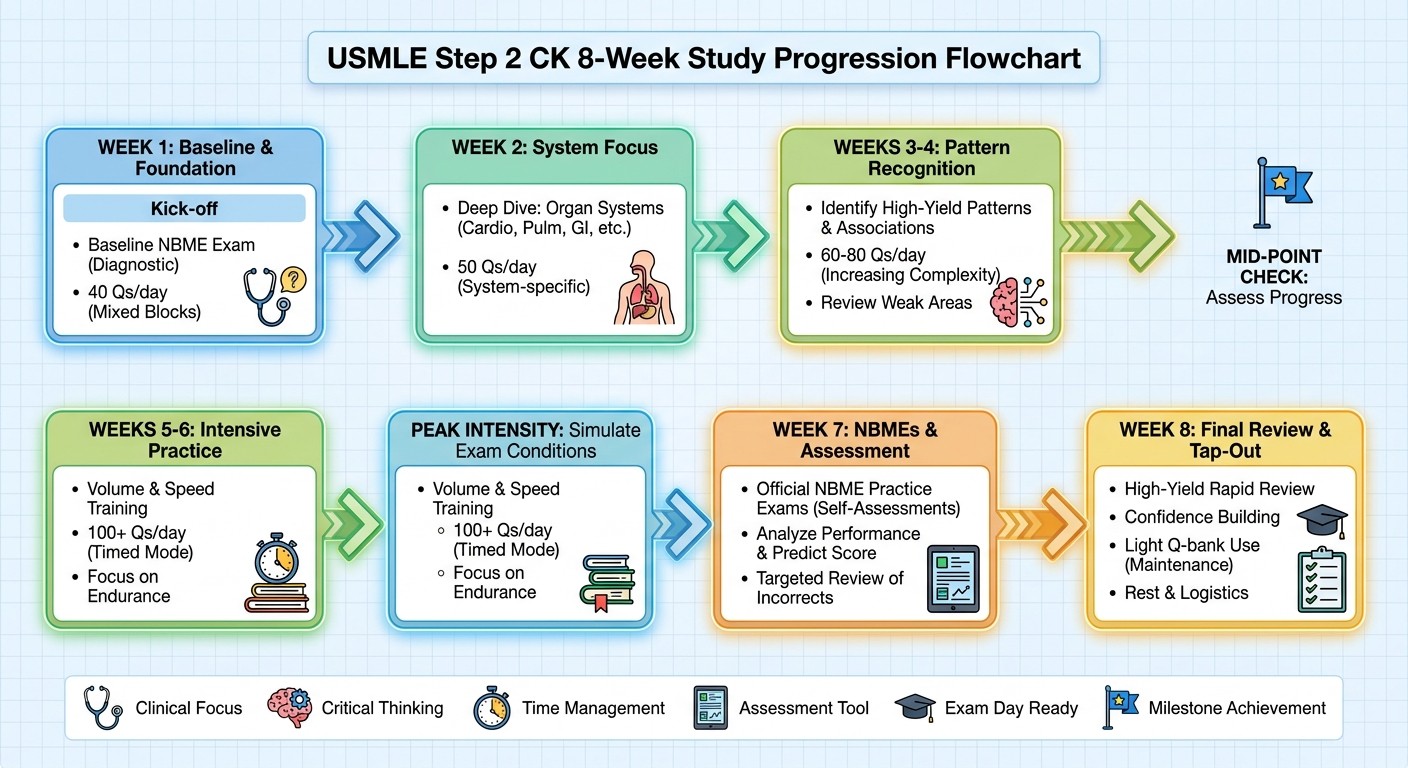
Week 4: High-Volume Practice
Goals: Build endurance, simulate exam conditions, increase accuracy Daily Schedule (10-11 hours):
Morning (4.5 hours): 80 UWorld questions (2 blocks of 40)
Midday (3 hours): Thorough review + concept reinforcement
Afternoon (2 hours): Second-pass review of previously incorrect questions
Evening (1.5 hours): Targeted weak-area drilling
Key Milestones:
Complete 560 UWorld questions (total: 1,610)
Take UWSA1 (UWorld Self-Assessment 1)
Achieve consistent >70% accuracy on timed blocks
Master all Surgery/OB-GYN high-yield presentations
Week 4 Reality Check: If you're scoring <65% on UWorld blocks or <230 on practice NBMEs, consider extending your dedicated period by 1-2 weeks. Better to delay than to underperform.
Week 5: Intensive Question Drilling
Goals: Peak performance preparation, advanced pattern recognition Daily Schedule (11 hours):
Morning (5 hours): 100 UWorld questions (simulate exam stamina)
Midday (3 hours): Detailed review + high-yield fact extraction
Afternoon (2 hours): Amboss questions for additional practice
Evening (1 hour): Review using Oncourse's progress analytics to identify final gaps
Key Milestones:
Complete 700 UWorld questions (total: 2,310)
Take NBME Form 13 (predictor assessment)
Achieve >75% accuracy on mixed blocks
Target score: >240 on practice exams
Oncourse tracks your performance by organ system and question type (diagnosis vs management vs treatment), so you can quantify readiness per system and allocate remaining study time to highest-impact gaps.
Week 6: Peak Practice Volume
Goals: Maximum question exposure, eliminate remaining weak spots Daily Schedule (11-12 hours):
Morning (5.5 hours): 120 UWorld questions (3 blocks)
Midday (3 hours): Comprehensive review + pattern consolidation
Afternoon (2 hours): Free 120 practice (NBME official questions)
Evening (1.5 hours): Final weak-area targeting
Key Milestones:
Complete 840 UWorld questions (total: 3,150)
Complete Free 120 assessment
Take UWSA2 (most predictive assessment)
Target score: >250 on practice exams
Week 6 Strategy: At this volume, you're not learning new facts — you're cementing recognition patterns and building test-taking endurance. Focus on speed and accuracy over novel information.
Week 7: Assessment Week
Goals: Calibrate readiness, identify final review priorities Daily Schedule (8-9 hours):
Morning (3 hours): 60 UWorld questions (maintain rhythm)
Midday (2 hours): UWorld review + incorrect analysis
Afternoon (3 hours): Complete 2-3 practice NBMEs (Forms available)
Evening (1 hour): Score analysis + final study plan adjustment
Key Milestones:
Take NBME Forms 15, 16, and Free 120 if not yet completed
Score analysis across all assessments
Create final week review priorities
Target: Consistent 250+ scores across assessments
Assessment Interpretation:
Ready to test: Consistent 250+ on last 3 assessments
Consider delay: Scores <240 or high variability (>15-point swings)
Proceed with confidence: Multiple assessments >260
Week 8: Final Review & Test Prep
Goals: Light review, maintain sharpness, optimize test-day performance Daily Schedule (6-7 hours):
Morning (2 hours): 40 UWorld questions (maintain timing)
Midday (1.5 hours): Review high-yield facts + incorrect log
Afternoon (2 hours): First Aid rapid review (systems-based)
Evening (1 hour): Relaxation + sleep optimization
Key Milestones:
Complete final UWorld questions (aim for 90% total completion)
Review all flagged/incorrect questions
Optimize sleep schedule (8+ hours nightly)
Finalize test-day logistics
Week 8 Mindset: You've done the work. Light review maintains sharpness without introducing new stress. Trust your preparation.
High-Yield Resources for Step 2 CK 2026
Essential Resources (Must-Have)
UWorld Step 2 CK QBank - $329
3,400+ questions with detailed explanations
Most predictive of actual exam performance
Use as primary learning tool, not just assessment
Target: Complete 85-95% of questions during dedicated block
NBME Practice Exams - $60 each
Forms 9, 10, 11, 12, 13, 15, 16 available
Most accurate score predictors
Use Forms 9-10 for baseline, 13-16 for final assessment
Free 120 questions (practice interface familiarization)
First Aid for Step 2 CK - $65
Concise, high-yield reference
Excellent for rapid review and fact checking
Use alongside UWorld, not as primary study source
Focus on algorithms and treatment protocols
Supplementary Resources (Strategic Add-Ons)
Amboss QBank + Library - $179
2,500+ additional questions
Integrated medical reference
Excellent explanations for complex topics
Use when UWorld explanations need reinforcement
OnlineMedEd (OME) - $397/year
Video-based learning platform
Strong for visual learners
Good for foundational gaps from clerkships
Focus on high-yield lectures (IM, Surgery basics)
Oncourse AI Platform - Free tier available
1 lakh+ practice questions across specialties
Adaptive question algorithms that target weak areas
Clinical reasoning explanations built for USMLE format
Progress tracking by system and question type
Resource Allocation Strategy
Resource | Weeks 1-2 | Weeks 3-4 | Weeks 5-6 | Weeks 7-8 |
|---|---|---|---|---|
UWorld | 40-50 Q/day | 60-80 Q/day | 100-120 Q/day | 40 Q/day |
NBME | Baseline (Form 9) | Progress (Form 11) | Assessment (Form 13) | Multiple forms |
First Aid | System review | Quick reference | Rapid review | Final facts |
Supplementary | Foundation building | Targeted gaps | Additional practice | Light review |
Budget-Conscious Approach: UWorld + NBMEs + First Aid ($500 total) covers 90% of what you need. Add other resources only if budget allows and specific gaps exist.
Score Targets by Specialty (2026 Data)
Understanding competitive score ranges helps set realistic targets and study intensity:
Highly Competitive (270+ target):
Dermatology (mean: 261)
Radiation Oncology (mean: 260)
Orthopedic Surgery (mean: 259)
Very Competitive (260+ target):
Radiology (mean: 256)
Emergency Medicine (mean: 256)
Anesthesiology (mean: 255)
Ophthalmology (mean: 258)
Competitive (250+ target):
Internal Medicine (mean: 251)
General Surgery (mean: 248)
Neurology (mean: 247)
Pediatrics (mean: 246)
Moderately Competitive (240+ target):
Family Medicine (mean: 245)
Psychiatry (mean: 244)
Physical Medicine & Rehabilitation (mean: 243)
Strategy: Aim for 75th-90th percentile of your target specialty. Higher scores never hurt, but diminishing returns occur above specialty-specific thresholds.
Common Mistakes That Kill Scores
Mistake 1: Not Completing UWorld
Many students get overwhelmed by UWorld's volume and leave 20-30% incomplete. Solution: Start UWorld from Day 1, even if you dont feel "ready." The questions teach you more than any textbook.
Mistake 2: Ignoring Biostatistics and Ethics
These topics account for 8-10% of questions but are often skipped. Solution: Dedicate Week 3 afternoon sessions specifically to biostat/ethics. The concepts are finite and high-yield.
Mistake 3: Not Reviewing Incorrect Questions
Simply doing questions without analysis wastes time. Solution: Maintain an incorrect log. Review all missed questions within 48 hours. Repeat incorrects during final week.
Mistake 4: Over-Relying on Passive Resources
Videos and reading create an illusion of knowledge without testing recall. Solution: 70% of study time should involve active question practice, not passive consumption.
Mistake 5: Neglecting Test-Taking Strategy
Step 2 CK rewards systematic clinical reasoning over pure knowledge. Solution: Develop consistent approaches to common presentations (chest pain algorithm, dyspnea workup, abdominal pain differential).
Final Week Strategy
Your final week makes or breaks your score. Follow this precise protocol:
Days 6-4 Before Exam:
Light question practice (20-40 questions daily)
Review incorrect log comprehensively
Take final practice NBME if >1 week since last assessment
Focus on high-yield facts, not new learning
Days 3-2 Before Exam:
Rapid First Aid review (major algorithms only)
Review biostatistics formulas and ethics frameworks
Optimize sleep (8+ hours nightly)
Avoid new material completely
Day Before Exam:
No studying beyond light fact review
Visit test center location and parking
Prepare exam-day materials (ID, confirmation, snacks)
Early bedtime (9-10 PM)
Test Day Morning:
Light breakfast (avoid heavy meals)
Arrive 30 minutes early
Quick mental review of test-taking strategies
Trust your preparation
Advanced Test-Taking Strategies
The 90-Second Rule: You have ~90 seconds per question. Use this framework:
1. Read question stem first (15 seconds)
2. Analyze vignette systematically (45 seconds)
3. Eliminate wrong answers (20 seconds)
4. Select best answer (10 seconds)
Clinical Reasoning Framework: For each vignette, ask:
What's the most likely diagnosis?
What's the next best step in management?
Are there any red flags or contraindications?
What would I do if this were my patient?
Common Trap Avoidance:
Don't pick the "textbook" answer — pick the "real-world" answer
Next best step ≠ most definitive test
Consider patient comfort, cost, and practicality
Trust common sense over exotic diagnoses
Frequently Asked Questions
How many practice questions should I complete?
Aim for 2,500-3,500 total questions during your dedicated block. This includes UWorld (~3,400), some Amboss questions, and practice NBMEs. More isn't always better if you're not reviewing thoroughly.
Should I do UWorld on tutor mode or timed mode?
Start with tutor mode for the first 500 questions, then switch to timed mode exclusively. Tutor mode builds understanding; timed mode builds exam stamina and decision-making speed.
When should I take my first practice NBME?
Take a baseline NBME within the first week of dedicated study. This establishes your starting point and helps identify weak systems for targeted review.
Is 6 weeks enough for Step 2 CK preparation?
6 weeks is sufficient if you performed well on clerkships (>75th percentile shelf scores). Students with weaker clinical foundations should plan for 8 weeks to allow adequate review time.
What if I'm not improving on practice tests?
If scores plateau after 4 weeks, analyze your study methods. Are you reviewing incorrects thoroughly? Are you learning from explanations or just reading them? Consider adjusting resource allocation or extending study period.
Should I memorize First Aid cover to cover?
No — use First Aid as a reference, not a primary study source. Focus on algorithms, treatment protocols, and diagnostic criteria. The bulk of learning should come from question practice with UWorld.
Prepare smarter with Oncourse AI — adaptive MCQs, spaced repetition, and AI explanations built for USMLE Step 2 CK. Download free on Android and iOS.