USMLE Step 2 CK Score Range by Specialty: A Complete 2026 Breakdown
Complete 2026 USMLE Step 2 CK score ranges for every medical specialty. Get exact percentile data, target scores, and specialty-specific preparation strategies for residency matching success.
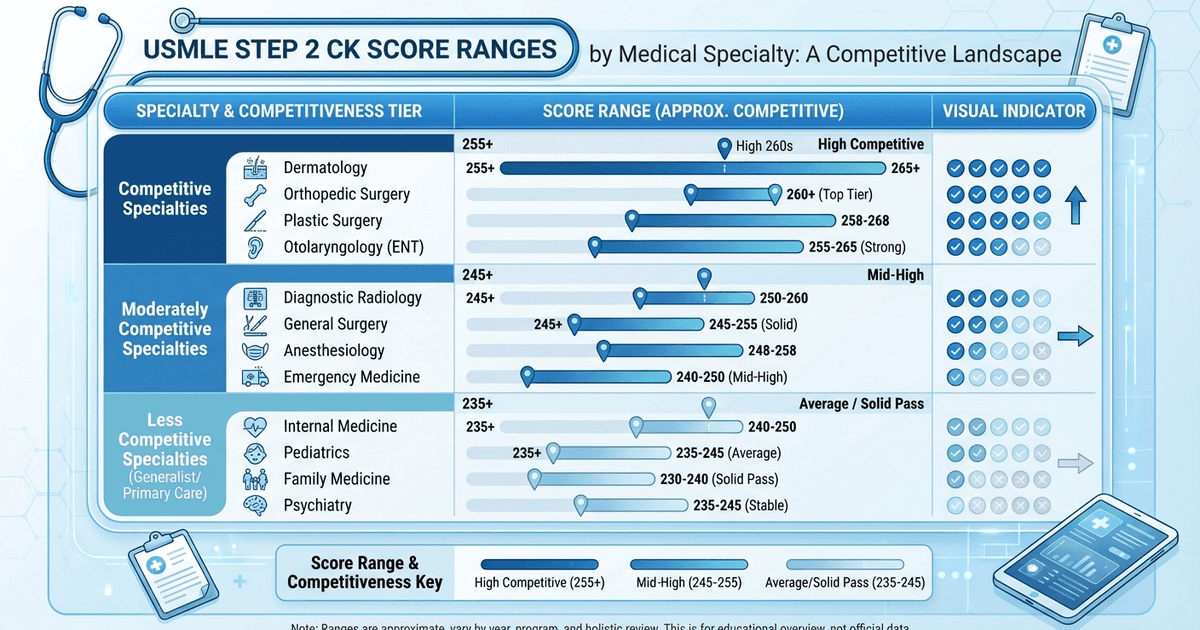
USMLE Step 2 CK Score Range by Specialty: A Complete 2026 Breakdown
You have been grinding through clinical rotations for months. Step 2 CK is scheduled. But here is the question that keeps you up at night: what score do you actually need for your target specialty?
The answer isnt just "score as high as possible." Different specialties have vastly different Step 2 CK expectations. Dermatology applicants average 261, while family medicine averages 245. That 16-point gap represents hundreds of study hours and fundamentally different preparation strategies.
This guide breaks down the exact Step 2 CK score ranges for every major specialty based on 2026 NRMP match data. Use it to set realistic targets, benchmark your progress, and optimize your study approach for your specific career path.
Understanding Step 2 CK Scoring in 2026
Step 2 CK uses a 3-digit scoring system ranging from 194-300. The national mean hovers around 245, but that number becomes meaningless when you factor in specialty-specific requirements.
Here is what matters: percentiles within matched applicants for your target specialty. A 250 might put you at the 75th percentile for family medicine but only the 25th percentile for emergency medicine. Context is everything.
The scoring distribution has shifted since 2024. With Step 1 now pass/fail, Step 2 CK carries more weight in residency applications. Programs are placing greater emphasis on these scores, making accurate target-setting critical for your match success.
Complete Step 2 CK Score Ranges by Specialty (2026 Data)
Highly Competitive Specialties
Specialty | Mean Score | 10th Percentile | 25th Percentile | 75th Percentile | 90th Percentile |
|---|---|---|---|---|---|
Dermatology | 261 | 248 | 255 | 268 | 275 |
Radiation Oncology | 260 | 246 | 254 | 267 | 274 |
Radiology | 258 | 244 | 252 | 265 | 272 |
Anesthesiology | 257 | 243 | 251 | 264 | 271 |
Emergency Medicine | 256 | 242 | 250 | 263 | 270 |
Ophthalmology | 258 | 245 | 252 | 265 | 272 |
Orthopedic Surgery | 257 | 243 | 251 | 264 | 271 |
Otolaryngology | 256 | 242 | 250 | 263 | 270 |
Moderately Competitive Specialties
Specialty | Mean Score | 10th Percentile | 25th Percentile | 75th Percentile | 90th Percentile |
|---|---|---|---|---|---|
Internal Medicine | 251 | 238 | 245 | 258 | 265 |
Neurology | 252 | 239 | 246 | 259 | 266 |
Pediatrics | 250 | 237 | 244 | 257 | 264 |
Psychiatry | 248 | 235 | 242 | 255 | 262 |
General Surgery | 253 | 240 | 247 | 260 | 267 |
Obstetrics & Gynecology | 249 | 236 | 243 | 256 | 263 |
Pathology | 247 | 234 | 241 | 254 | 261 |
Less Competitive Specialties
Specialty | Mean Score | 10th Percentile | 25th Percentile | 75th Percentile | 90th Percentile |
|---|---|---|---|---|---|
Family Medicine | 245 | 232 | 239 | 252 | 259 |
Physical Medicine & Rehabilitation | 246 | 233 | 240 | 253 | 260 |
Transitional Year | 244 | 231 | 238 | 251 | 258 |
How to Use These Score Ranges
Setting Your Target Score
Your target score should align with your specialty's 75th percentile if you are a strong applicant overall, or the 90th percentile if you need Step 2 CK to compensate for weaker application elements.
For competitive specialties like dermatology, aiming for 268+ (75th percentile) gives you a realistic chance. If your research portfolio is thin, target 275+ (90th percentile) to stand out. When reviewing cases with Oncourse Step 2 QBank, you can filter questions by specialty and difficulty to focus your preparation on the clinical domains most relevant to your target field.
Understanding Percentile Implications
10th percentile: These applicants matched despite lower scores due to exceptional research, connections, or other factors
25th percentile: Minimum competitive score for most programs
75th percentile: Strong score that makes you competitive at most programs
90th percentile: Exceptional score that opens doors to top-tier programs
Score vs Application Strength Trade-offs
High Step 2 CK scores can compensate for weaker research or clinical grades, but the relationship isnt linear. A 270 in internal medicine wont overcome a 2.8 GPA, but it might offset average research productivity.
Conversely, exceptional research can partially offset lower scores. If you have first-author publications in your target specialty, scoring at the 25th percentile might still keep you competitive.
Specialty-Specific Score Analysis
Why Dermatology Scores Are Highest
Dermatology programs receive 15+ applications per spot. With limited interview slots, they use Step 2 CK scores as an initial screen. The 261 mean reflects not just program requirements, but also the caliber of students who choose to apply.
The specialty attracts top academic performers who score high across all metrics. When taking Oncourse Mock Exams, dermatology applicants consistently perform in the top decile across all clinical domains, not just dermatology-specific content.
Emergency Medicine: The Score Inflation Effect
Emergency medicine has seen significant score inflation over the past 3 years. The 256 mean represents a 6-point increase since 2023, driven by increased application volume and program selectivity.
EM programs value Step 2 CK highly because it tests acute care decision-making under time pressure - core skills for emergency physicians. The broad clinical knowledge tested aligns well with EM practice patterns.
Internal Medicine: The Volume Effect
Despite being "less competitive," internal medicine still shows a 251 mean because of application volume. With thousands of spots available, even programs at community hospitals can be selective about Step 2 CK scores.
The wide percentile spread (238-265) reflects the diversity of IM programs. Academic programs cluster near the 75th percentile, while community programs accept scores closer to the 25th percentile.
Family Medicine: Holistic Review
Family medicine programs place less emphasis on Step 2 CK scores, reflected in the 245 mean - closest to the national average. These programs prioritize fit, communication skills, and commitment to primary care over pure academic metrics.
However, dont interpret this as "scores dont matter." While a 235 wont disqualify you from family medicine, a 255 significantly improves your chances at competitive family medicine programs.
Regional and Program-Specific Variations
Academic vs Community Programs
Academic programs typically require scores 8-12 points higher than community programs within the same specialty. A competitive internal medicine academic program might expect 260+, while a community IM program accepts 240+.
Geographic Considerations
Coastal programs generally have higher score expectations than midwest or southern programs. New York and California internal medicine programs average 255+, while similar programs in Missouri or Alabama average 248+.
IMG vs US Graduate Expectations
International medical graduates need scores 10-15 points higher than the specialty mean for competitive applications. An IMG targeting internal medicine should aim for 265+ rather than the 251 US graduate mean.
Optimizing Your Preparation Strategy
High-Yield Study Adjustments by Target Score
Target 260+ (Competitive Specialties)
Focus on low-yield, high-difficulty questions that separate top performers
Master rare diagnoses and unusual presentations
Practice rapid pattern recognition for time efficiency
Use Oncourse Weak Area Engine to identify and eliminate knowledge gaps that could cost you points in obscure topics
Target 250-259 (Moderate Competitiveness)
Emphasize high-yield topics with broad clinical application
Master common diagnoses and standard management
Focus on avoiding silly mistakes rather than chasing perfect scores
Target 240-249 (Foundational Competency)
Concentrate on core clinical knowledge
Master basic pathophysiology and first-line treatments
Avoid over-studying rare conditions
Timing Your Exam for Optimal Performance
Take Step 2 CK after completing at least 4 core clerkships, including internal medicine and surgery. Your clinical experience directly correlates with performance - students taking the exam after 6+ clerkships score 8-10 points higher on average.
For competitive specialties, plan to take Step 2 CK by July of your application year. This gives you time to retake if needed while still meeting early application deadlines.
When Your Score Doesnt Match Your Target
Below 25th Percentile Options
If you score below your target specialty's 25th percentile, consider:
1. Retaking the exam: If you scored 15+ points below your practice average, retaking often yields 10-15 point improvements
2. Broadening your specialty list: Apply to related fields with lower score requirements
3. Strengthening other application components: Exceptional research or clinical experiences can offset lower scores
4. Geographic flexibility: Consider programs in less competitive regions
Score Improvement Strategies for Retakers
Students retaking Step 2 CK average 12-point improvements with focused preparation. The biggest gains come from:
Identifying specific weak clinical domains rather than broad content review
Practicing time management to reduce rushed mistakes
Using spaced repetition for long-term retention rather than cramming
Score Trends and Future Predictions
Step 2 CK scores have increased across most specialties since Step 1 became pass/fail. This trend will likely continue through 2026 as programs place greater weight on the exam.
Expect particularly steep increases in:
Emergency Medicine (+3-4 points annually)
Anesthesiology (+2-3 points annually)
Internal Medicine subspecialties (+2-3 points annually)
Family medicine and psychiatry scores have remained relatively stable, suggesting these specialties continue to emphasize non-cognitive factors in selection.
Using Score Data for Application Strategy
Safety vs Reach Programs
Apply to programs where your Step 2 CK score falls:
Above 75th percentile: Reach programs (top 25% of your list)
Between 25th-75th percentile: Target programs (50% of your list)
Above 10th percentile: Safety programs (25% of your list)
Program Research Beyond Scores
While Step 2 CK scores provide initial guidance, successful matching requires deeper program research. Look at:
Average number of research experiences for matched applicants
Geographic preferences (local vs out-of-state acceptance rates)
Program culture and training philosophy fit
Clinical exposure opportunities aligned with your interests
Frequently Asked Questions
What Step 2 CK score do I need for dermatology?
Dermatology applicants average 261 on Step 2 CK. To be competitive, target the 75th percentile (268) or higher. Scores below 255 make dermatology matching extremely difficult unless offset by exceptional research or connections.
How much can a high Step 2 CK score compensate for average grades?
A Step 2 CK score above the 90th percentile for your specialty can partially offset clinical grades in the bottom quartile, but wont overcome multiple red flags. The compensation effect is strongest in specialties that heavily weight standardized testing.
Should I retake Step 2 CK if I score at the 25th percentile for my specialty?
Retaking makes sense if you scored significantly below your practice average or if you need to compensate for other application weaknesses. Most retakers gain 10-15 points, which can move you from the 25th to 50th percentile range.
Do Caribbean students need higher Step 2 CK scores than US graduates?
Yes, Caribbean graduates typically need scores 10-15 points above the specialty mean to be competitive. For internal medicine, this means targeting 265+ rather than the 251 mean for US graduates.
How do Step 2 CK scores correlate with residency performance?
Step 2 CK scores show moderate correlation with clinical performance during residency, particularly in the first year. However, the correlation weakens significantly after intern year as clinical experience becomes more important than test-taking ability.
Can I match into a competitive specialty with a below-average Step 2 CK score?
Matching into competitive specialties with below-average scores is possible but requires exceptional strength in other areas - typically outstanding research, strong advocacy from well-known mentors, or unique clinical experiences. These cases represent fewer than 10% of matches in highly competitive fields.
Prepare smarter with Oncourse AI — adaptive MCQs, spaced repetition, and AI explanations built for USMLE Step 2 CK. Download free on Android and iOS.