Back
USMLE Step 1 Mnemonics: Build Faster Recall Loops with Oncourse AI Probe
Master USMLE Step 1 mnemonics with active recall testing. Learn to build memory hooks for biochemistry, microbiology, and pharmacology facts that stick under pressure.
USMLE Step 1 Mnemonics: Build Faster Recall Loops with Oncourse AI Probe
You are staring at a biochemistry pathway with 14 enzyme names, knowing that Step 1 will test at least 3 of them. Your brain is already overflowing with drug mechanisms, bacterial virulence factors, and anatomical landmarks. The traditional approach — reading, highlighting, hoping it sticks — isn't cutting it anymore.
USMLE Step 1 has 280 questions. You get 94 seconds per question, including reading time. When that timer starts ticking and you need to recall whether it's "phosphofructokinase" or "pyruvate kinase" that's rate-limiting in glycolysis, passive recognition isn't enough. You need active, instant recall.
This is where mnemonics become your secret weapon — but only when you build them into proper recall loops. A mnemonic without active testing is just a clever sentence that you'll forget under pressure. The real magic happens when you convert weak facts into memorable hooks, then repeatedly test them under time constraints until they become automatic.
What Step 1 Mnemonics Are Actually Good For
Not every medical fact needs a mnemonic. Step 1 mnemonics work best for volatile, high-yield lists that appear frequently but are easy to jumble under pressure. Think:
Biochemistry enzyme sequences: Rate-limiting steps, cofactor requirements, deficiency diseases. When you're deciding between pyruvate dehydrogenase complex components, "Tender Loving Care" (TPP, Lipoic acid, CoA) saves precious seconds. Microbiology organism clusters: "SHiNE my SKiS" for encapsulated bacteria (Streptococcus pneumoniae, Haemophilus influenzae, Neisseria meningitidis, Escherichia coli K1, Salmonella, Klebsiella, group B Strep) becomes essential when you're trying to remember which bugs cause meningitis in asplenic patients. Pharmacology drug classes: Beta-blocker names, side effect profiles, contraindications. "ABCD" for ACE inhibitor side effects (Angioedema, Blood pressure drop, Cough, Decreased GFR) prevents costly mix-ups. Anatomy nerve pathways: Cranial nerve functions, brachial plexus branches, dermatomes. These show up repeatedly across different question stems.
The pattern? These are facts you absolutely know but might fumble under time pressure. Mnemonics give you a reliable retrieval path when your working memory is maxed out.
When Mnemonics Fail (And Why Most Students Get This Wrong)
Here's where most Step 1 students mess up: they collect mnemonics like Pokemon cards, writing them in margins and hoping they'll magically stick. They dont test them.
A mnemonic is only as strong as your ability to recall it under pressure. If you can remember "Some Say Marry Money" perfectly while sitting calmly with your notes but draw a blank during a timed question block, the mnemonic has failed its primary job.
The three mnemonic failure modes:
1. Passive storage: You know the mnemonic but cant activate it when needed
2. Incomplete encoding: You remember the first few letters but lose the sequence halfway through
3. Context mismatch: The mnemonic works in isolation but falls apart when embedded in a complex clinical vignette
This is why successful Step 1 students dont just learn mnemonics — they build them into active recall loops. In Oncourse's Probe game, when you're given a clue about "rate-limiting enzyme in glycolysis" and have 15 seconds to respond, your mnemonic either fires instantly or it doesn't. That pressure-testing is what makes the difference.
Building Mnemonics for Volatile Step 1 Facts
The best Step 1 mnemonics aren't the ones you find online — they're the ones you build yourself for your specific weak spots. Here's the systematic approach:
1. Identify Your Volatile Facts
Look at your recent question blocks. Which facts do you "know" but keep getting wrong? These are perfect mnemonic candidates. Common patterns:
Drug names within the same class (beta-blockers, antibiotics)
Enzyme deficiency diseases and their presentations
Anatomical structures in the same region
Lab value patterns for different conditions
2. Build Personal Connections
The most memorable mnemonics use personal references, humor, or visual imagery. Instead of memorizing "Reteplase, Alteplase, Streptokinase" for thrombolytics, create: "RASh decisions dissolve clots" — linking to something that makes you smile or creates a mental image.
3. Test Under Time Pressure
Here's the critical step most students skip. After creating a mnemonic, immediately test it:
Set a 30-second timer
Write down the mnemonic prompt
Recall all items without looking
Check accuracy
If you cant nail it in 30 seconds, the mnemonic needs work. When practicing with Synapses — Oncourse's concept linking game — you're essentially doing this but with the added pressure of connecting related terms, which strengthens the mnemonic by building multiple retrieval paths.
High-Yield Biochemistry Mnemonics That Actually Work
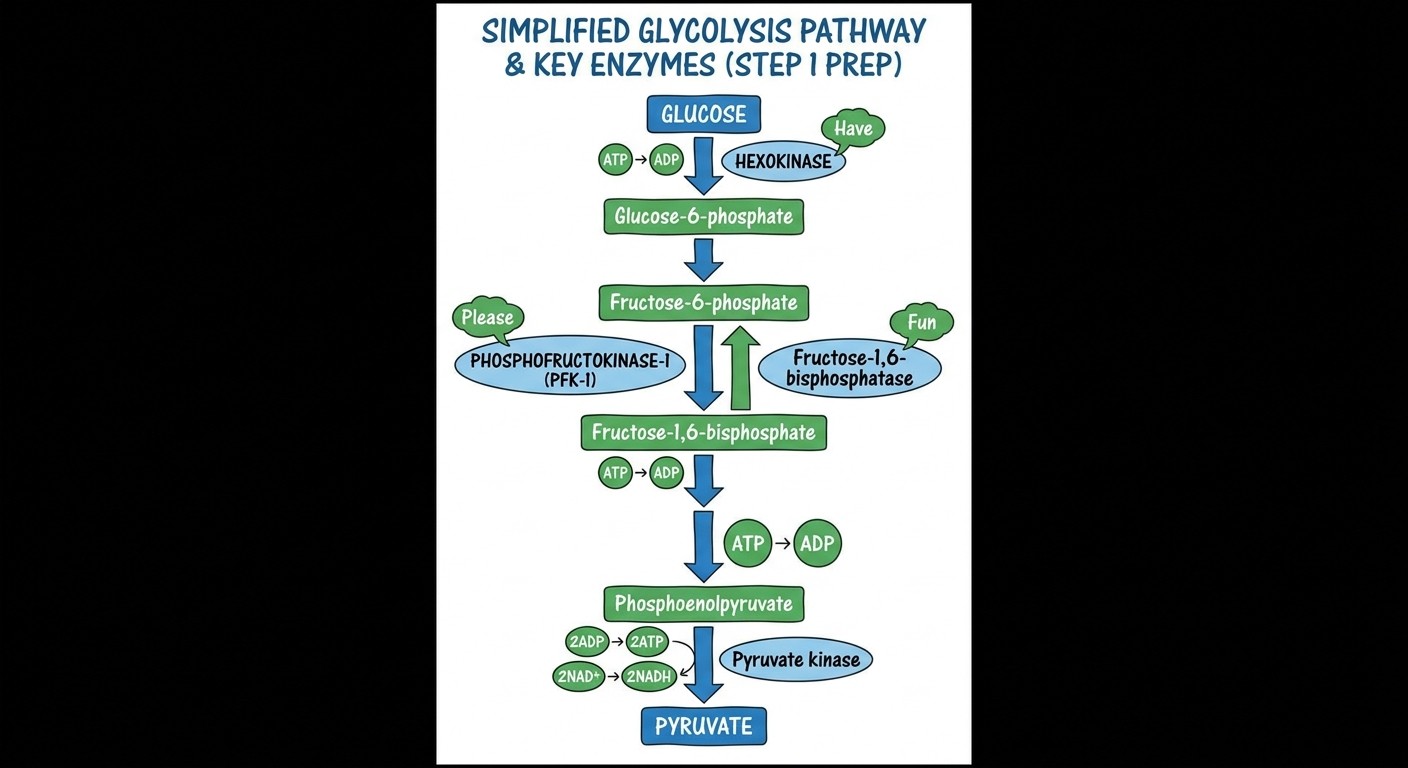
Glycolysis Rate-Limiting Enzymes: "Please Have Fun" (Phosphofructokinase-1, Hexokinase/Glucokinase, Fructose-1,6-bisphosphatase). Test this by covering the pathway diagram and forcing recall. Electron Transport Complexes: "Nice Cats Sleep Dogs" (NADH dehydrogenase, Cytochrome bc1, Succinate dehydrogenase, Cytochrome oxidase). The key is testing this when you're looking at a question about oxidative phosphorylation defects. Amino Acid Classifications: For essential amino acids, "PVT TIM HALL" (Phenylalanine, Valine, Threonine, Tryptophan, Isoleucine, Methionine, Histidine, Arginine, Leucine, Lysine). But dont just memorize it — use it when you see a protein deficiency question and need to identify which amino acids cant be synthesized.
The pattern here is specificity. These arent just cute memory tricks — they're retrieval tools for exact Step 1 scenarios you'll encounter.
Microbiology Mnemonics for Step 1 Pattern Recognition
Microbiology is where mnemonics shine brightest on Step 1. The exam loves testing organism clusters, and getting them wrong cascades into missing multiple questions.
Catalase-Positive Bacteria: "SPACE" (Staphylococcus, Pseudomonas, Aspergillus, Candida, E. coli). When you see a question about chronic granulomatous disease and neutrophil function, this mnemonic instantly narrows your thinking to organisms that can survive in catalase-deficient environments. Urease-Positive Organisms: "PUNK" (Proteus, Ureaplasma, Nocardia, Klebsiella). Essential for UTI questions and kidney stone formation scenarios. Spore-Forming Bacteria: "BC" (Bacillus, Clostridium). Simple but crucial when you're thinking about heat resistance or anaerobic infections.
The key with microbiology mnemonics is connecting them to clinical presentations. When Oncourse's Mnemonic Challenge presents you with a case of post-surgical wound infection in an anaerobic environment, "BC" should immediately trigger "spore-former" → "Clostridium" → "gas gangrene or tetanus."
Pharmacology Mnemonics for Drug Recall
Pharmacology mnemonics need to be action-oriented because Step 1 tests mechanisms, not just names.
Beta-Blocker Names: "AMEN PAL" (Atenolol, Metoprolol, Esmolol, Nadolol, Propranolol, Acebutolol, Labetalol). But more importantly, link this to selectivity: "AMEN" are cardioselective (beta-1), "PAL" are non-selective. ACE Inhibitor Side Effects: "ABCD" (Angioedema, Blood pressure drop, Cough, Decreased GFR). Test this by covering drug side effect tables and forcing recall when you see hypertension management questions. CYP450 Inducers: "Queen Barb's Chronic Pill Smoking" (Quinidine, Barbiturates, Carbamazepine, Phenytoin, Smoking). Critical for drug interaction questions.
The difference between mediocre and excellent pharmacology recall is speed. When you see a question about drug interactions, you need these mnemonics to fire within seconds, not after 30 seconds of mental searching.
Testing Your Mnemonic with Active Recall
Here's where most students fail: they create mnemonics but never stress-test them. Active recall under pressure is what converts a mnemonic from a study aid into an exam weapon.
The 3-Layer Testing Protocol: Layer 1: Isolated Recall (30 seconds)
Cover your notes
Write the mnemonic prompt
Recall all items in order
Check accuracy immediately
Layer 2: Context Integration (60 seconds)
Take a practice question involving the mnemonic
Force yourself to use the mnemonic to eliminate options
Time how long it takes to activate
Layer 3: Pressure Simulation (15 seconds)
Use active recall tools that mirror exam pressure
Probe Game is perfect here — when you get a clue about "organisms causing meningitis in asplenic patients," "SHiNE my SKiS" needs to fire immediately
Layer 3 is where the magic happens. Most students never reach this level, which is why their mnemonics fail during actual test conditions.
Connecting Mnemonics to Spaced Review
A mnemonic without spaced repetition is like a muscle you never exercise — it atrophies quickly. The goal is to automate recall so deeply that the mnemonic activates before you consciously think about it.
The Integration Workflow:
1. Create mnemonic for weak fact
2. Test immediately (active recall)
3. Add to spaced repetition system
4. Review at increasing intervals (1 day, 3 days, 1 week, 2 weeks)
5. Test under pressure conditions regularly
Oncourse's flashcard system uses spaced repetition algorithms to automatically schedule your mnemonic reviews. When you mark "ABCD for ACE inhibitor side effects" as a card, the system ensures you see it at optimal intervals for long-term retention.
But here's the crucial part: dont just review the mnemonic passively. Each review should include active retrieval — covering the answer and forcing recall before checking. The goal is to make the mnemonic so automatic that it becomes your first response, not your backup plan.
Prioritizing Weak Systems in Your Final 30 Days
With one month left before Step 1, your mnemonic strategy needs surgical precision. You dont have time to build mnemonics for everything — focus on systems where you're consistently losing points.
The Weak System Protocol: Week 1: Diagnostic phase
Take subject-specific question blocks
Track which systems generate the most missed questions
Identify volatile facts within those systems
Build 3-5 high-impact mnemonics per weak system
Week 2: Testing phase
Integrate new mnemonics into daily practice
Use Probe game for pressure testing
Review spaced repetition cards focusing on new mnemonics
Take mixed question blocks to test integration
Week 3: Automation phase
New mnemonics should fire within 10 seconds
Focus on context switching — using mnemonics within complex vignettes
Eliminate any mnemonics that still require conscious effort
Week 4: Maintenance phase
Light review of established mnemonics
Trust your automated recall
Focus on exam-day execution rather than building new memory aids
The key insight: most students try to build mnemonics too late or for too many topics. Better to have 10 rock-solid mnemonics that fire instantly than 50 half-remembered memory aids that fail under pressure.
Common Mnemonic Mistakes on Step 1
Mistake 1: Collecting Without Testing
Students save dozens of mnemonics from different sources but never pressure-test them. Result: they know the mnemonic exists but cant activate it during the exam.
Fix: Every mnemonic must pass the 15-second recall test under pressure before you trust it. Mistake 2: Generic Over Personal
Using mnemonics created by others without personalizing them. Generic mnemonics often dont connect to your specific memory patterns.
Fix: Modify every mnemonic to include personal references or humor that resonates with you. Mistake 3: No Context Integration
Practicing mnemonics in isolation but never within actual question contexts.
Fix: Always test mnemonics using real Step 1 questions or pressure simulation tools. Mistake 4: Overbuilding
Creating mnemonics for facts that are better learned through understanding or repetition.
Fix: Only build mnemonics for volatile, high-yield lists that you consistently mix up. Mistake 5: Neglecting Spaced Review
Building mnemonics during dedicated study but not reviewing them systematically.
Fix: Integrate every mnemonic into your spaced repetition system with active recall testing.
Frequently Asked Questions
How many mnemonics should I have for Step 1?
Aim for 15-25 rock-solid mnemonics rather than 100 half-remembered ones. Each mnemonic should cover 4-8 high-yield facts that you consistently miss. Quality and automation matter more than quantity.
Should I use visual or word-based mnemonics?
Use whatever connects best to your memory style, but make it vivid and personal. Visual mnemonics (linking "SHiNE my SKiS" to an actual image of shining skis) often stick better because they create multiple retrieval pathways.
When should I start building mnemonics for Step 1?
Start during your dedicated study period when you can identify your specific weak patterns. Building mnemonics too early (during preclinical years) often means creating memory aids for facts that will become automatic through repetition.
How do I know if a mnemonic is working?
Test it under time pressure. If you can recall all items within 15 seconds when seeing the prompt during a timed question block, it's working. If it takes longer or you miss items, the mnemonic needs refinement.
Can mnemonics replace understanding?
Never. Mnemonics are retrieval tools, not learning shortcuts. Use them for facts you already understand but keep mixing up. They help you recall that ACE inhibitors cause cough, but you still need to understand why (bradykinin accumulation).
Should I use the same mnemonics as my classmates?
Personal mnemonics work better because they connect to your unique memory patterns. If you find a great mnemonic online, modify it with personal references to make it stick better.
Prepare smarter with Oncourse AI — adaptive MCQs, spaced repetition, and AI explanations built for USMLE Step 1. Turn your weak facts into memorable mnemonics, test them with Probe's active recall pressure, and automate them through daily review. Download free on Android and iOS.