Back
USMLE Active Recall: Turn Every Missed Question Into a Review Loop with Oncourse AI
Master USMLE Step 1 and Step 2 CK with systematic active recall. Learn to categorize missed questions, create targeted retrieval prompts, use spaced repetition, and track weak areas with AI-powered analytics.
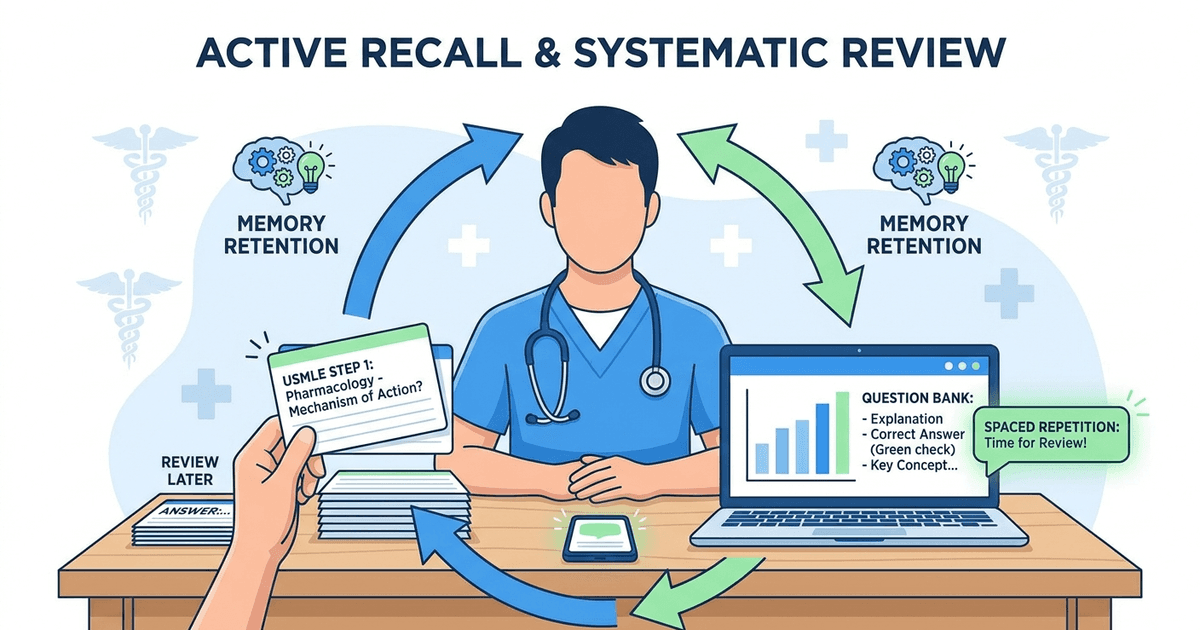
USMLE Active Recall: Turn Every Missed Question Into a Review Loop with Oncourse AI
You've just finished a 40-question USMLE block. 27 correct, 13 wrong. Your immediate impulse? Read through the explanations and move on to the next block. But here's the uncomfortable truth: you're wasting 60% of your learning potential.
Every missed question contains a pattern that will show up again on exam day. The difference between students who plateau at 220 and those who break 250 isn't the number of questions they do—it's what they do with the ones they get wrong. Most students treat explanations like Netflix episodes. They consume passively, feel satisfied, then forget within 48 hours.
USMLE active recall changes this completely. Instead of reading explanations, you're going to build a systematic review loop that converts every miss into durable memory. This isn't about working harder. It's about making sure each question failure becomes impossible to repeat.
What Active Recall Actually Means for USMLE Prep
Active recall means forcing your brain to produce information from memory without cues. For USMLE Step 1 and Step 2 CK, this translates to a specific workflow: see a clinical vignette, generate your reasoning path out loud, commit to an answer, then verify your logic against the explanation.
Most students do this backwards. They read a stem, immediately check answer choices, eliminate obviously wrong options, then guess between two remaining choices. When they're wrong, they read the explanation and think "oh yeah, that makes sense." This creates an illusion of learning without actual retention.
True USMLE active recall works differently:
1. Read the stem completely before looking at choices
2. Generate your diagnosis and reasoning out loud or in writing
3. Predict the answer type (diagnosis, next step, mechanism, etc.)
4. Commit to your choice and note your confidence level
5. Only then check if you're correct
The magic happens in steps 2 and 3. When you force yourself to produce a complete reasoning chain before seeing options, you're testing what you actually know versus what feels familiar. This exposes the real gaps in your knowledge—gaps that would otherwise hide behind recognition-based guessing.
For Step 1, this might mean stating: "This sounds like diabetic ketoacidosis based on the polyuria, polydipsia, and altered mental status. I'd expect to see anion gap metabolic acidosis with ketonuria. Next step would be serum or urine ketones." For Step 2 CK: "Middle-aged woman with crushing chest pain radiating to the jaw and nausea—this is STEMI. Need immediate ECG and serial troponins, then likely to cath lab."
When you get it wrong, you have a precise diagnosis of where your reasoning broke down. When you get it right but weren't confident, you know you need to strengthen that pathway. Both become targets for your review loop.
Why Rereading Explanations Isn't Enough
Rereading feels productive because it's easy and gives you that "aha" moment. But recognition isn't recall. On exam day, you won't get to reread explanations—you need to pull correct reasoning from memory under time pressure.
Research on the testing effect shows that retrieval practice (active recall) produces 50% better long-term retention than repeated study. For USMLE prep, this means the questions you actively review stick 1.5x longer than the ones you passively read about.
The problem with explanation-heavy review is that it creates fluency illusions. You read about diabetic ketoacidosis management and think "I know this now." But knowing it in context of reading about it isn't the same as recognizing it in a new vignette three weeks later. Active recall tests whether you can actually access that knowledge when you need it.
Here's what happens in your brain during active recall versus passive reading:
Passive explanation reading: Your brain recognizes patterns and feels satisfied. Information goes into short-term storage with weak retrieval pathways. Most details fade within 72 hours. Active recall practice: Your brain struggles to retrieve information, strengthening neural pathways through what's called "desirable difficulty." The harder you work to remember something, the stronger the memory becomes. Details that survive this process get encoded in long-term memory with strong retrieval cues.
For USMLE prep, this distinction is critical. Exam questions test your ability to retrieve and apply knowledge in novel situations, not your ability to recognize information you've seen before.
How to Categorize Your Missed Questions
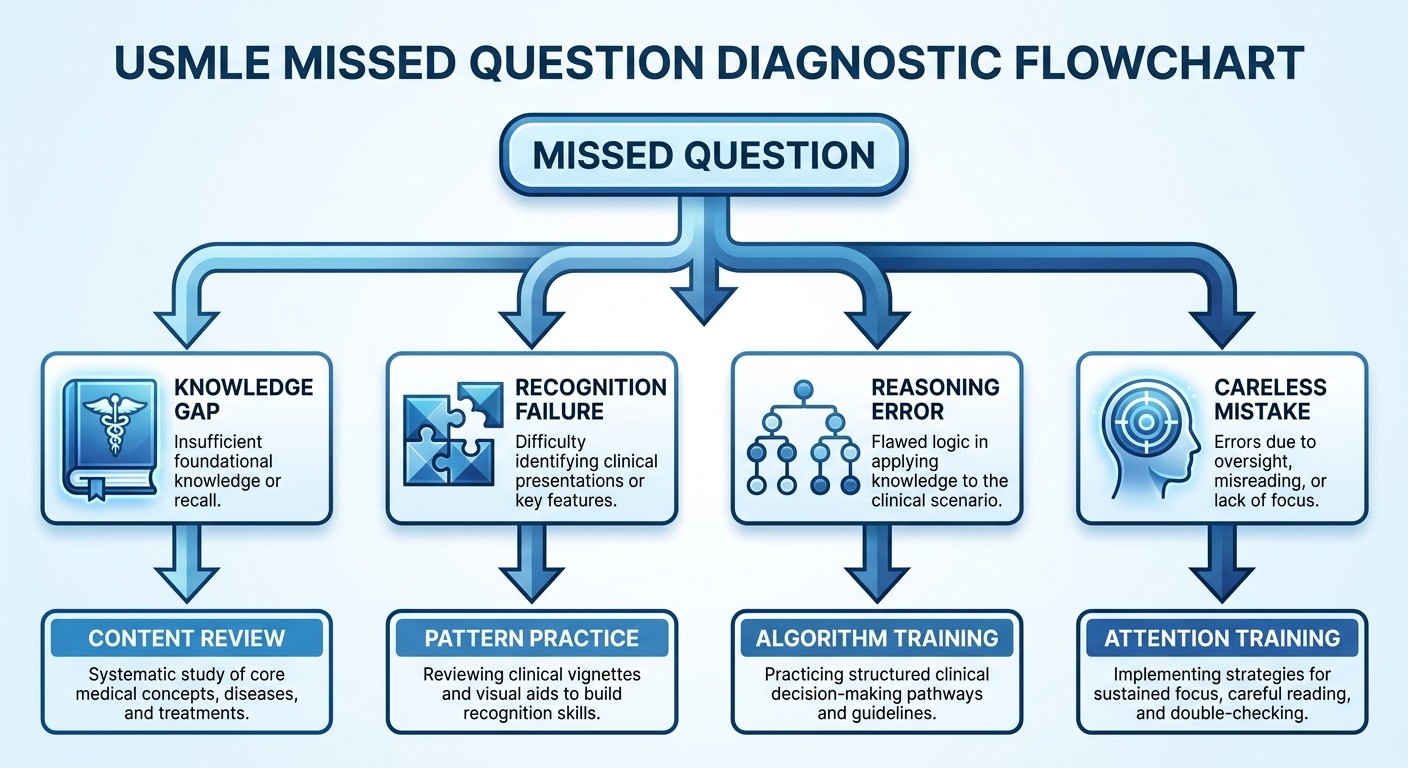
Not all misses are created equal. Before you can fix a problem, you need to diagnose what type of problem it is. Every missed USMLE question falls into one of four categories:
1. Knowledge Gaps
You genuinely didn't know the content. For Step 1, this might be not knowing that Wilson disease causes Kayser-Fleischer rings. For Step 2 CK, not knowing that first-line treatment for bacterial meningitis is ceftriaxone plus vancomycin.
Recognition signal: You read the explanation and learn something completely new. Fix: Content review followed by spaced retrieval practice.
2. Recognition Failures
You know the individual facts but didn't connect them to reach the diagnosis. You know what diabetic ketoacidosis is, you know the lab values, but you didn't recognize the clinical presentation in the vignette.
Recognition signal: You read the explanation and think "I should have gotten that." Fix: Pattern practice and differential drills using Synapses for rapid recall.
3. Reasoning Errors
You made the wrong logical connection. You correctly identified the disease but chose the wrong next step, or picked the right intervention but for the wrong indication.
Recognition signal: Your factual knowledge is correct but your clinical decision-making pathway was off. Fix: Algorithm practice and "why wrong" analysis with Explanation Chat.
4. Careless Mistakes
You knew the correct answer but misread the stem, reversed a concept, or made a simple error under time pressure.
Recognition signal: You immediately know the right answer when you reread the question. Fix: Attention training and test-taking strategy adjustment.
Each category requires a different remedy. Knowledge gaps need content study. Recognition failures need pattern exposure. Reasoning errors need pathway practice. Careless mistakes need attention training.
Most students try to fix everything with more content review. This works for Category 1 but makes Categories 2-4 worse by adding cognitive load without improving the actual problem.
Turn Missed Questions Into Retrieval Prompts
Once you've categorized a miss, your next step is converting it into active recall material. This isn't about copying explanations—it's about creating targeted retrieval prompts that test the specific pathway you got wrong.
For each missed question, create 2-3 retrieval prompts using this framework:
The Clinical Trigger Prompt
Format: "When you see [key clinical features], think [diagnosis/mechanism]" Example from Step 1: "When you see a young male with lens dislocation, aortic regurgitation, and tall stature, think Marfan syndrome (fibrillin-1 defect)" Example from Step 2 CK: "When you see sudden chest pain with unequal blood pressures in arms, think aortic dissection (need immediate CT angiography)"
The Next Step Algorithm Prompt
Format: "For [clinical scenario], the next best step is [action] because [reasoning]" Example: "For suspected pulmonary embolism with intermediate pretest probability, next step is CT pulmonary angiogram because D-dimer isn't specific enough to rule out PE in intermediate-risk patients"
The Differentiation Prompt
Format: "How do you distinguish [A] from [B]?" Example: "How do you distinguish bacterial from viral meningitis? Bacterial has higher opening pressure >300, glucose <40, protein >200, neutrophil predominance"
The key is making these prompts specific enough to test the exact reasoning you missed, but general enough to apply to similar future questions. If you missed a question about diabetic ketoacidosis management, don't create a prompt about that exact patient. Create one about DKA management principles that would help you with any DKA question.
Using Oncourse AI's Rezzy, you can generate additional retrieval prompts by asking: "Create 3 active recall questions testing the key concepts from this explanation." Rezzy understands weak topics and provides learning-science backed insights, making it particularly effective for generating prompts that target your specific knowledge gaps.
How Spaced Repetition Supports Active Recall
Active recall gets information into your memory. Spaced repetition keeps it there. For USMLE prep, this means scheduling your retrieval prompts at scientifically optimized intervals to prevent forgetting.
The forgetting curve shows that without reinforcement, you'll forget 50% of newly learned information within 24 hours and 90% within a week. Spaced repetition fights this by scheduling reviews just before you would forget, strengthening memory each time.
The optimal spacing pattern for USMLE content follows an expanding interval:
Day 1: Learn new content through active recall
Day 3: First review (catches early forgetting)
Day 7: Second review (consolidates into medium-term memory)
Day 14: Third review (moves to long-term storage)
Day 30: Fourth review (establishes durable retention)
Day 60+: Maintenance reviews as needed
For missed USMLE questions, this translates to a specific workflow. When you create retrieval prompts from today's misses, schedule them for review in your flashcard system using spaced intervals. Each time you successfully recall the information, the interval extends. Each time you struggle or get it wrong, the interval resets.
The magic happens at the struggle points. When you can't quite remember something during a spaced review, your brain works harder to retrieve it, strengthening the memory pathway. Easy recalls don't build strong memories—difficult ones do.
Oncourse AI integrates this through automatic spaced repetition scheduling. Based on your performance pattern, the system determines when you're likely to forget each concept and surfaces it for review just in time. This removes the mental overhead of manual scheduling while ensuring optimal retention curves.
Use Weak-Area Analytics to Guide Your Daily Focus
Most students spread their review time equally across all topics. This is like watering a garden by giving every plant the same amount regardless of whether it's thriving or dying. Your study time should flow toward your weakest areas, not your strongest ones.
Weak-area analytics solve this by tracking your performance across all USMLE domains and automatically identifying where you need the most work. Instead of guessing which topics to review, you get data-driven priorities.
Here's how it works in practice:
Performance tracking: Every question you answer feeds into a system that measures your accuracy by topic, subtopic, and question type. Instead of just seeing "78% correct," you see "92% on cardiovascular physiology, 61% on renal pathology, 45% on endocrine pharmacology." Gap identification: The system identifies not just which topics you're missing, but which specific concepts within those topics. Instead of "work on cardiology," you get "focus on heart failure management algorithms and arrhythmia interpretation." Priority scheduling: Your weak areas automatically get more practice questions, more spaced review prompts, and more frequent exposure. Strong areas get maintained with lighter review.
Using Oncourse AI's weak-topic analytics, you can see exactly which USMLE domains need attention. The system tracks patterns across 47 medical specialties, identifying specific subtopics where you struggle. For example, if you're consistently missing diabetic ketoacidosis questions, the system recognizes this pattern and prioritizes DKA-related content in your Daily Plan.
This approach is particularly powerful for Step 2 CK preparation, where clinical decision-making spans multiple specialties. Instead of rotating through all specialties equally, you focus extra time on emergency medicine if that's where your scores are lowest, or pediatrics if you're consistently missing child-specific management questions.
The key insight: your study time is limited, so it should flow toward maximum return on investment. Weak-area analytics ensure every hour you spend studying targets your actual gaps, not your perceived weaknesses or favorite subjects.
Build a Daily Review Loop During Dedicated Study
During dedicated USMLE preparation, your daily routine should center around the active recall review loop. This isn't something you do occasionally—it's the foundation of every study day.
Here's the optimal daily sequence:
Morning Block (90 minutes)
0-60 minutes: Timed question block (40-80 questions depending on your pace)
60-75 minutes: Immediate classification of each miss (knowledge/recognition/reasoning/careless)
75-90 minutes: Create retrieval prompts for Category 1 and 2 misses
Afternoon Deep Dive (60 minutes)
Content gaps: Address Category 1 misses with focused review
Pattern practice: Use Synapses for Category 2 recognition failures
Algorithm drilling: Work through Category 3 reasoning pathways
Evening Consolidation (45 minutes)
Spaced review: Clear today's scheduled flashcard reviews
Weak area targeting: Extra practice in domains flagged by analytics
Next-day planning: Preview tomorrow's focus areas based on performance trends
End-of-Day Reflection (15 minutes)
Performance analysis: What patterns emerged in today's misses?
Strategy adjustment: Do you need more content review or more question practice?
Goal setting: Tomorrow's specific targets based on weak areas
The key is treating this as a loop, not a linear process. Today's misses become tomorrow's review targets. Tomorrow's misses refine the next day's priorities. Over time, this creates a self-improving system where your study time automatically flows toward your greatest needs.
Oncourse AI's Daily Plan automates much of this scheduling. The system analyzes your daily performance, identifies emerging weak areas, and adjusts tomorrow's plan accordingly. If you missed three nephrology questions today, tomorrow's plan will include extra kidney physiology review and related spaced repetition cards.
This daily loop approach typically shows results within 2-3 weeks. Students report that questions they missed in Week 1 become automatic by Week 3, freeing up mental energy to tackle new weak areas. The compound effect builds momentum as your knowledge base solidifies.
Common Mistakes That Kill the Review Loop
Even students who understand active recall principles often sabotage their progress with these systematic errors:
Mistake #1: Creating Too Many Flashcards
The Problem: Making 5-10 cards per missed question, thinking more is better. Why It Backfires: Card overload leads to review fatigue and superficial processing. The Fix: Maximum 2-3 targeted prompts per miss. Quality over quantity.
Mistake #2: Reviewing Misses Immediately
The Problem: Reading explanations right after getting a question wrong. Why It Backfires: No retrieval difficulty, so information doesn't stick. The Fix: Wait 15-30 minutes before reviewing explanations. Let your brain work.
Mistake #3: Skipping Confident Wrongs
The Problem: Only reviewing questions you knew you got wrong. Why It Backfires: Confident mistakes reveal dangerous knowledge gaps that feel solid but aren't. The Fix: Review every incorrect answer, especially ones that surprised you.
Mistake #4: Abandoning the System During Weak Performance
The Problem: When scores drop, reverting to passive content review. Why It Backfires: Performance dips are often caused by weak retrieval pathways, not knowledge gaps. The Fix: Double down on active recall when scores plateau or drop.
Mistake #5: Generic Retrieval Prompts
The Problem: Creating vague flashcards like "What causes chest pain?" Why It Backfires: Overly broad prompts don't test specific reasoning pathways. The Fix: Make prompts specific enough to test exactly what you missed.
The most dangerous mistake is inconsistency. Students start the review loop, see initial improvement, then gradually drift back to passive studying when the workload increases. Active recall requires sustained effort, but the returns compound dramatically over time.
If you catch yourself making any of these mistakes, course-correct immediately. The review loop only works when executed consistently and precisely. Sloppy implementation gives you all the work with none of the benefits.
Advanced Integration: Using AI to Optimize Your Review Loop
Traditional flashcard systems require manual card creation and scheduling. AI-powered platforms like Oncourse can automate and optimize both processes, making your review loop more effective with less manual overhead.
Here's how AI enhances each component:
Automatic prompt generation: Instead of manually creating retrieval prompts, Rezzy can analyze your missed questions and generate targeted active recall questions. Ask: "Turn this explanation into 3 retrieval practice questions" and get scientifically designed prompts that test the specific pathways you missed. Dynamic spacing optimization: Rather than fixed intervals (3 days, 7 days, etc.), AI adjusts spacing based on your actual performance patterns. If you consistently struggle with endocrine topics, those cards appear more frequently until mastery is achieved. Weakness pattern recognition: AI can identify patterns you might miss. If you're getting questions wrong because you consistently confuse drug mechanisms, the system recognizes this pattern and generates additional mechanism-focused practice. Explanation depth control: Through Explanation Chat, you can request deeper explanations for concepts you're still struggling with, or quick refreshers for topics you mostly understand. The AI calibrates explanation depth to your knowledge level.
The key advantage is personalization at scale. Traditional review methods treat all students the same. AI-powered review adapts to your specific pattern of strengths and weaknesses, creating a completely individualized learning path.
For USMLE preparation, this means your review loop becomes increasingly efficient over time. Instead of spending equal time on all your misses, the system identifies which types of errors are most common for you and adjusts accordingly. If you frequently miss next-step questions, you'll get more algorithm practice. If you struggle with pathophysiology, you'll see more mechanism-focused explanations.
Track Your Progress: Metrics That Matter
Not all progress metrics are created equal. Raw question counts and percentages can be misleading. Focus on these four indicators of genuine improvement:
1. Confidence-Accuracy Alignment
What to track: Whether your confidence level matches your performance Why it matters: Well-calibrated confidence means you know what you know and know what you don't know Target: >80% alignment between confidence and correctness
2. Category Distribution of Misses
What to track: Percentage of misses in each category (knowledge/recognition/reasoning/careless) Why it matters: Shows whether you're making progress on your specific weak points Target: Steady decrease in Category 1 (knowledge gaps), stable or improving Categories 2-4
3. Spaced Review Success Rate
What to track: Percentage of flashcards you correctly recall on the first attempt Why it matters: Indicates whether information is transferring to long-term memory Target: >85% success rate on mature cards (>30 days old)
4. Weak Area Recovery Time
What to track: How quickly identified weak areas show improvement Why it matters: Demonstrates system effectiveness and learning efficiency Target: Noticeable improvement within 10-14 days of focused practice
Traditional metrics like "questions per day" or "overall percentage correct" can actually be counterproductive. They encourage quantity over quality and don't distinguish between different types of learning progress.
The most important metric is consistency. Students who maintain their review loop daily for 4+ weeks typically see 15-25 point score improvements, regardless of their starting level. Students who practice sporadically rarely see substantial gains, even if they study more total hours.
Frequently Asked Questions
How long should I spend reviewing each missed question?
Spend 3-5 minutes per miss during initial review: 30 seconds to categorize the error type, 2-3 minutes to create retrieval prompts, and 1-2 minutes for immediate content gap filling if needed. Lengthy explanation reading is usually counterproductive.
Should I review correct answers I guessed on?
Yes, treat lucky guesses exactly like incorrect answers. If you weren't confident in your reasoning pathway, you need to strengthen that connection. Guessed correct answers often indicate recognition failures that will cause problems on similar future questions.
How many new flashcards should I create per day during dedicated study?
Target 10-20 new retrieval prompts daily from missed questions. More than 25 leads to review backlog; fewer than 10 suggests you're not doing enough question practice or not converting misses effectively into active recall material.
What if my overall percentage keeps dropping despite using active recall?
This is normal during the first 2-3 weeks as the system exposes previously hidden knowledge gaps. Focus on your weak-area analytics and confidence-accuracy alignment rather than raw percentages. Scores typically rebound strongly after initial dips.
How do I balance new content learning with missed question review?
Use a 60/40 split: 60% of study time on new material and current question practice, 40% on spaced review of previous misses and weak areas. As exam day approaches, gradually shift toward 30/70, emphasizing retention over new learning.
Should I redo missed questions, and if so, when?
Yes, but not immediately. Schedule missed questions for re-testing after 7-14 days. If you get them right with confidence, they're resolved. If you still struggle or guess, treat them as fresh misses and restart the review loop.
Take Action: Start Your Review Loop Today
Reading about active recall won't improve your USMLE scores. Implementing it systematically will. Your review loop starts with today's question session.
After your next practice block, resist the urge to immediately read explanations. Instead, spend 30 seconds categorizing each miss, then create 2-3 targeted retrieval prompts before diving into content review. Schedule these prompts for spaced review and track which categories of misses are most common for you.
Most importantly, commit to consistency. The review loop only works with daily implementation. Students who maintain this system for 30+ days typically see substantial score improvements. Those who start and stop see minimal gains despite similar effort levels.
Prepare smarter with Oncourse AI — adaptive MCQs, spaced repetition, and AI explanations built for USMLE success. Our platform turns your missed questions into Rezzy explanations, Synapses recall practice, spaced flashcard review, weak-topic analytics, and Daily Plan optimization. Download free on Android and iOS.