UPSC CMS Study Plan 2026: 90-Day Revision Strategy, Mock Tests and Weak Areas
Complete 90-day UPSC CMS study plan for 2026 with phase-wise revision strategy, mock test schedule, and systematic weak area identification for medical officer exam preparation.
UPSC CMS Study Plan 2026: 90-Day Revision Strategy, Mock Tests and Weak Areas
You probably opened this article because you're staring at exactly 90 days before UPSC CMS 2026, wondering if it's even possible to crack this exam with just three months left. The good news? Ninety days is plenty if you know exactly what to prioritize and what to ignore.
UPSC CMS 2026 has 1,358 medical officer vacancies across Central Health Services. That's more opportunities than most medical entrance exams combined. But here's what makes CMS different – it rewards clinical thinking over rote memorization. The exam on August 2, 2026, tests whether you can think like a practicing medical officer, not just recall textbook definitions.
Most candidates waste their 90 days trying to cover everything equally. Paper I has 120 questions where general medicine dominates with 80% weightage. Paper II splits equally between surgery, gynecology, and preventive medicine. Smart candidates spend 60% of their time on Paper I subjects, not 50%.
This roadmap eliminates that confusion. Every week has clear targets. Every mock test has a purpose. Every weak area gets systematic attention before it costs you marks.
UPSC CMS Exam Pattern: Understanding Your Battlefield
The UPSC CMS pattern determines your entire preparation strategy. You're tackling 240 multiple-choice questions across two papers, each worth 250 marks with 1/3 negative marking that can destroy careless candidates.
Paper I Structure:
General Medicine: 96 questions (80% of paper)
Pediatrics: 24 questions (20% of paper)
Duration: 2 hours (60 seconds per question)
Morning session: 9:30 AM to 11:30 AM
Paper II Distribution:
Surgery: 40 questions
Gynecology & Obstetrics: 40 questions
Preventive & Social Medicine: 40 questions
Duration: 2 hours
Afternoon session: 2:00 PM to 4:00 PM
The mathematics is brutal but clear. General medicine alone contributes 40% of your total score across both papers. Surgery and gynecology together match that weightage. This means your time allocation must be strategic, not democratic.
Use the 60-25-15 rule: 60% time for Paper I subjects (heavy on general medicine), 25% for clinical subjects in Paper II, and 15% for preventive medicine. Equal time distribution is a luxury you cant afford in 90 days.
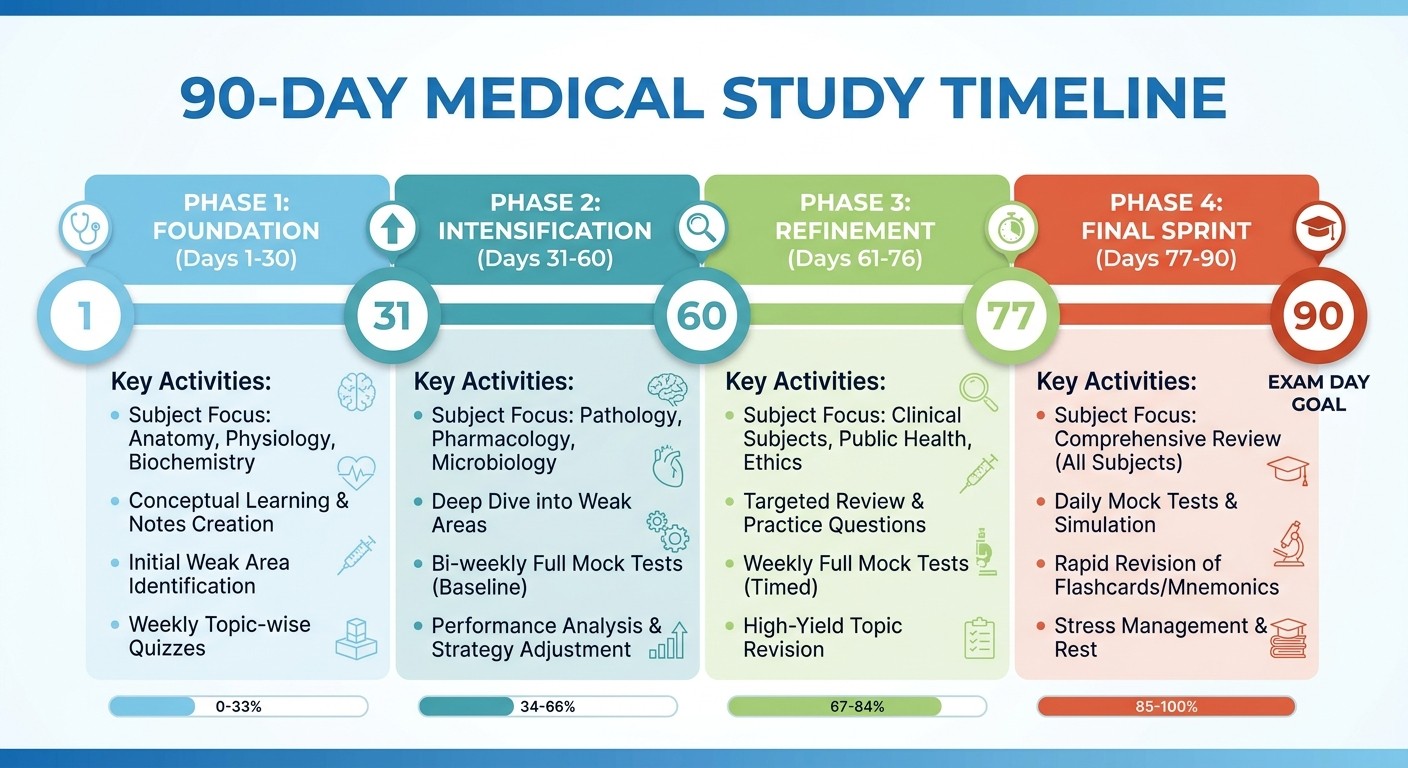
90-Day Phase Structure: Your Complete Roadmap
Foundation Phase (Days 1-30): Core Knowledge Building
Week 1-2: Paper I Dominance
Days 1-4: Cardiovascular medicine (MI protocols, heart failure, arrhythmias)
Days 5-8: Respiratory system (pneumonia guidelines, COPD management, pleural effusions)
Days 9-12: Endocrinology (diabetes complications, thyroid emergencies, adrenal disorders)
Days 13-14: Infectious diseases (malaria, dengue, tuberculosis per latest NTEP guidelines)
Start each system with pathophysiology foundations, then clinical scenarios, diagnostics, and management protocols. When you're reviewing cardiology cases, use Oncourse's Explanation Chat feature to ask follow-up questions about ECG interpretation or drug interactions that textbooks dont explain clearly.
Week 3: Pediatrics Foundation
Days 15-18: Growth and development milestones, nutritional disorders
Days 19-21: Pediatric emergencies (dehydration, poisoning, seizures)
Week 4: Surgery Basics + Mock Analysis
Days 22-25: Surgical principles, wound healing, fluid management
Days 26-28: Mock Test 1 (Paper I focus) + detailed error analysis
Days 29-30: Weak area remediation based on mock results
Intensification Phase (Days 31-60): Mixed Practice and Refinement
Week 5-6: Paper II Clinical Subjects
Days 31-35: General surgery (GI emergencies, hernias, trauma management)
Days 36-42: Gynecology essentials (menstrual disorders, infertility, contraception)
Week 7: Obstetrics Deep Dive
Days 43-49: High-risk pregnancy, labor complications, emergency procedures
During this phase, practice identifying clinical patterns quickly. For complex obstetrics scenarios, Rezzy AI tutor helps clarify management protocols when you encounter conflicting treatment approaches in different textbooks. Week 8: Preventive Medicine + Second Mock
Days 50-54: Epidemiology, biostatistics, national health programs
Days 55-56: Mock Test 2 (Full-length both papers)
Days 57-60: Comprehensive error analysis and weak-area targeting
Refinement Phase (Days 61-76): Mock-Heavy Practice
Week 9-10: Mock Test Intensive
Days 61-63: Mock Test 3 (Paper II focus)
Days 64-66: Mock Test 4 (Mixed practice)
Days 67-70: Error pattern analysis across all mocks
Days 71-76: Targeted practice on consistently weak topics
This phase focuses on converting knowledge into exam performance. After each mock, analyze not just wrong answers but also questions where you guessed correctly. Those lucky guesses reveal knowledge gaps.
Final Sprint (Days 77-90): Revision and Fine-tuning
Week 11-12: High-Yield Revision
Days 77-83: Rapid revision of high-yield topics using flashcards
Days 84-87: Mock Tests 5 and 6 under strict exam conditions
Days 88-90: Final review, formula consolidation, exam strategy refinement
Mock Test Strategy: Quality Over Quantity
Most candidates take too many mocks without analyzing them properly. Your 90-day timeline allows for 6-8 quality mocks with thorough analysis, not 20 rushed attempts.
Mock Test Schedule:
Week | Mock Focus | Duration | Analysis Time |
|---|---|---|---|
4 | Paper I only | 2 hours | 3 hours |
8 | Full-length both papers | 4 hours | 4 hours |
9 | Paper II only | 2 hours | 3 hours |
10 | Mixed practice | 4 hours | 4 hours |
11 | Full exam simulation | 4 hours | 2 hours |
12 | Final practice | 4 hours | 1 hour |
Mock Analysis Framework:
1. Error Categorization: Knowledge gaps vs application errors vs silly mistakes
2. Time Analysis: Questions taking >90 seconds need strategy adjustment
3. Subject Performance: Track accuracy trends across all topics
4. Elimination Success: How often did you narrow down to 2 options?
5. Confidence Correlation: Were you confident about wrong answers?
Use Oncourse's Daily Plan feature to automatically schedule follow-up practice based on your mock performance. If cardiology questions consistently trip you up, the system allocates more cardiology flashcards and targeted MCQs to your daily routine without manual planning.
Weak Area Identification and Repair
Weak areas kill more dreams than difficult questions. The key is systematic identification and targeted repair, not just "studying harder."
Identification Methods: Topic-Based Analysis:
After each mock or practice session, track performance by:
Subject (Medicine, Surgery, Pediatrics, etc.)
System (Cardiology, Respiratory, GI, etc.)
Question type (Clinical scenario, direct recall, calculation)
Difficulty level (Easy questions missed = knowledge gaps, Hard questions missed = normal)
Pattern Recognition:
Consistently wrong in specific subjects = concept gaps
Right concepts but wrong applications = practice deficit
Time pressure errors = speed issues
Overconfident wrong answers = false knowledge
Repair Strategies: For Knowledge Gaps:
Create 2-3 page summaries for consistently weak topics. Focus on high-yield facts, not comprehensive coverage. If pharmacology keeps tripping you up, make drug classification tables instead of reading entire chapters.
For Application Errors:
Practice 20-30 similar clinical scenarios from your weak area. If you keep missing MI management questions, drill different MI presentations until pattern recognition becomes automatic.
For Speed Issues:
Time yourself on weak-subject question blocks. Start with no pressure, then gradually reduce time limits. Use elimination techniques aggressively – wrong options often have obvious flaws.
Use Oncourse's accuracy and topic filters to practice exclusively from your weak areas. Instead of random MCQ practice, you can drill down to just "Cardiology questions where accuracy <70%" for targeted improvement.
Daily Study Schedule Examples
Your daily routine depends on whether you're a working intern or dedicating full-time to preparation.
Full-Time Aspirant Schedule (8-10 hours/day)
Morning Block (6:00 AM - 10:00 AM): 4 hours
6:00-7:30: New topic study (high-concentration time)
7:30-8:00: Breakfast and notes review
8:00-10:00: MCQ practice (50 questions with explanations)
Evening Block (2:00 PM - 6:00 PM): 4 hours
2:00-4:00: Second topic or weak area targeting
4:00-4:30: Break and light revision
4:30-6:00: Flashcard review and mnemonics
Night Block (7:00 PM - 9:00 PM): 2 hours
7:00-8:00: Previous day revision
8:00-9:00: Mock test analysis or error review
Working Intern Schedule (4-5 hours/day)
Early Morning (5:00 AM - 7:00 AM): 2 hours
5:00-6:00: High-yield topic study
6:00-7:00: Rapid MCQ practice (30 questions)
Evening (8:00 PM - 11:00 PM): 3 hours
8:00-9:30: Main study session
9:30-10:30: Weak area practice using filtered question banks
10:30-11:00: Flashcard revision before sleep
The Daily Plan feature automatically adjusts these schedules based on your performance trends. If you consistently score low in preventive medicine during evening sessions, it suggests switching that subject to high-energy morning slots.
Subject-Wise High-Yield Focus
Not all topics deserve equal attention in your 90-day timeline. Focus on these high-yield areas that appear repeatedly:
Paper I Priorities:
General Medicine (80% focus):
- Cardiology: MI management, arrhythmias, heart failure
- Respiratory: Pneumonia protocols, TB treatment, pleural diseases
- Endocrinology: Diabetes complications, thyroid emergencies
- Infectious diseases: Malaria, dengue, viral hepatitis
- Gastroenterology: GI bleeding, liver diseases, IBD
Pediatrics (20% focus):
- Growth milestones and nutritional disorders
- Immunization schedule (latest updates)
- Pediatric emergencies and poisoning
Paper II Priorities:
Surgery: Emergency procedures, trauma management, GI surgery
Gynecology: Menstrual disorders, contraception, infertility
Obstetrics: High-risk pregnancy, labor complications
Preventive Medicine: National health programs, epidemiology basics
Common Mistakes to Avoid
Time Allocation Errors:
Dont spend equal time on all subjects. General medicine deserves 40% of your preparation time, not 20%.
Mock Test Mistakes:
Taking mocks without analysis is wasted time. Spend 1.5-2 hours analyzing every hour of mock testing.
Perfectionism Trap:
Trying to master every topic to 100% leaves you weak everywhere. Aim for 80% mastery in high-yield topics rather than 50% everywhere.
Last-Minute Panic:
Dont start new topics in the final 2 weeks. Those 14 days are for consolidation and confidence building, not learning.
Ignoring Negative Marking:
Practice aggressive elimination. If you cant eliminate at least one option confidently, skip the question. The 1/3 negative marking is unforgiving.
Week-by-Week Action Plan
Weeks 1-4: Foundation Building
Week 1: General medicine core systems (cardiovascular, respiratory)
Week 2: Endocrinology and infectious diseases
Week 3: Pediatrics fundamentals and growth milestones
Week 4: Surgery basics + First mock test and analysis
Weeks 5-8: Clinical Integration
Week 5: General surgery and trauma management
Week 6: Gynecology essentials and contraception
Week 7: Obstetrics and high-risk pregnancies
Week 8: Preventive medicine + Full-length mock
Weeks 9-11: Performance Optimization
Week 9: Mock-heavy practice with Paper II focus
Week 10: Mixed practice and pattern recognition
Week 11: Final mocks under exam conditions
Week 12: Exam Readiness
Days 85-87: Light revision of formulas and high-yield facts
Days 88-89: Final mock and confidence building
Day 90: Rest, admin tasks, and mental preparation
Advanced Mock Test Analysis Techniques
Beyond basic right/wrong analysis, use these advanced techniques:
Error Heat Map:
Track which combinations consistently trip you up. If you miss cardiology + clinical scenario questions but nail cardiology + direct questions, you need more case-based practice.
Confidence Calibration:
Rate your confidence (1-5) before checking answers. High confidence + wrong answer = dangerous false knowledge that needs immediate correction.
Elimination Success Rate:
Track how often you successfully eliminate 2+ options. If this rate is below 70%, you need better elimination strategies, not more content knowledge.
Time Pressure Performance:
Compare accuracy in first 60 questions vs last 60 questions. Declining performance indicates stamina issues or poor time management.
When analyzing performance patterns, Rezzy AI tutor can help identify why certain question types consistently challenge you. Instead of generic explanations, you get personalized insights about your specific reasoning gaps.
Technology Integration for Better Results
Daily Planning Automation:
Rather than manually planning each day's topics, use Oncourse's Daily Plan to automatically sequence lessons → flashcards → practice questions based on your weak areas. If Monday's mock shows cardiology weakness, Tuesday's plan automatically includes more cardiology content.
Smart Practice Filtering:
Instead of random question practice, filter by accuracy levels and topics. Practice exclusively from "Surgery questions <65% accuracy" to address specific gaps rather than reinforcing what you already know.
Explanation Deep Dives:
When you encounter confusing explanations, use the Explanation Chat feature to ask follow-up questions like "Why is option C wrong in this MI scenario?" or "What's the difference between these two drug mechanisms?" This helps clarify doubts immediately instead of carrying confusion forward.
Final Month Strategy
Your last 30 days should feel different from the previous 60. No new topics, no comprehensive reading – just targeted reinforcement and pattern recognition.
Week 9-10: Mock Intensive Phase
Take 2-3 mocks per week with mandatory 2-hour analysis sessions. Focus on questions where you eliminated to 2 options but chose wrong – these represent your best improvement opportunities.
Week 11-12: Consolidation Phase
Rapid revision using flashcards and summary notes only. If you dont have summary notes by Week 11, you've been studying wrong. Create them now or use pre-made high-yield resources.
Final Week: Confidence Building
Light revision, admin preparation (admit card, exam center route), and maintaining routine. Avoid heavy study sessions that can create pre-exam fatigue.
Frequently Asked Questions
How many mocks should I take in 90 days?
Take 6-8 quality mocks with thorough analysis rather than 15-20 rushed attempts. Each mock needs 1.5-2 hours of analysis time to be valuable.
Can I crack CMS without coaching in 90 days?
Yes, if you follow a systematic plan and use quality resources. The exam tests clinical thinking that MBBS graduates already possess – you just need targeted practice and pattern recognition.
What if I'm consistently weak in preventive medicine?
PSM has predictable question patterns. Focus on national health programs, epidemiology formulas, and disease surveillance rather than trying to cover all public health topics comprehensively.
How do I manage time pressure during the actual exam?
Practice timed question blocks regularly. Aim to complete each paper in 100 minutes, leaving 20 minutes for review. Skip questions where you cant eliminate at least one option confidently.
Should I revise MBBS textbooks or use MCQ-focused resources?
For a 90-day timeline, focus on MCQ-based learning with targeted concept revision only for consistently weak areas. Comprehensive textbook reading is a luxury you cant afford.
What's the minimum accuracy needed in mocks to clear CMS?
Aim for 65-70% accuracy in mocks to account for exam pressure and luck factors. With 1/3 negative marking, accuracy matters more than attempting all questions.
This 90-day roadmap transforms overwhelming syllabus into manageable daily actions. Every week builds on the previous one. Every mock test serves a purpose. Every weak area gets systematic attention.
Remember – UPSC CMS rewards clinical thinking over memorization. Your MBBS training already gave you the foundation. These 90 days just help you apply it efficiently under exam conditions.
Prepare smarter with Oncourse AI — adaptive MCQs, spaced repetition, and AI explanations built for UPSC CMS. Download free on Android and iOS.