UKMLA Spaced Repetition: A Revision Strategy for AKT Guidelines and Weak Areas
Master UKMLA AKT revision using evidence-based spaced repetition. Learn optimal intervals, weak area targeting, and guideline recall strategies for 2026 exam success.

UKMLA Spaced Repetition: A Revision Strategy for AKT Guidelines and Weak Areas
You have 200 single-best-answer questions across two papers. One minute and twelve seconds per question. The MLA Content Map lists 430 conditions you could face. Your finals knowledge covers 60-70% of this — the remaining 30-40% is where spaced repetition becomes your secret weapon.
UKMLA spaced repetition isn't just about reviewing flashcards. It's a systematic approach to cementing guideline details, strengthening weak specialties, and building the rapid recall you need when Paper 1 throws acute medicine scenarios and Paper 2 tests chronic disease management under time pressure.
The learning science is clear: information reviewed at strategic intervals creates stronger neural pathways than cramming. For UKMLA, this means better recall of NICE guidelines, cleaner decision-making in ethics scenarios, and confident answers in your historically weak areas.
The Science Behind Spaced Repetition for Medical Learning
Spaced repetition leverages the forgetting curve identified by Hermann Ebbinghaus in 1885. When you learn new medical information — say, the updated hypertension thresholds or sepsis management protocols — your brain begins forgetting immediately. Without review, you lose 50% within the first hour and 90% within a week.
The solution isn't more study time. It's strategic timing.
A 2024 meta-analysis of 14 studies with over 21,000 medical learners found that spaced repetition produced significantly better performance on objective knowledge tests compared to standard study methods. The effect size was substantial — equivalent to moving from the 50th percentile to the 78th percentile on medical exams.
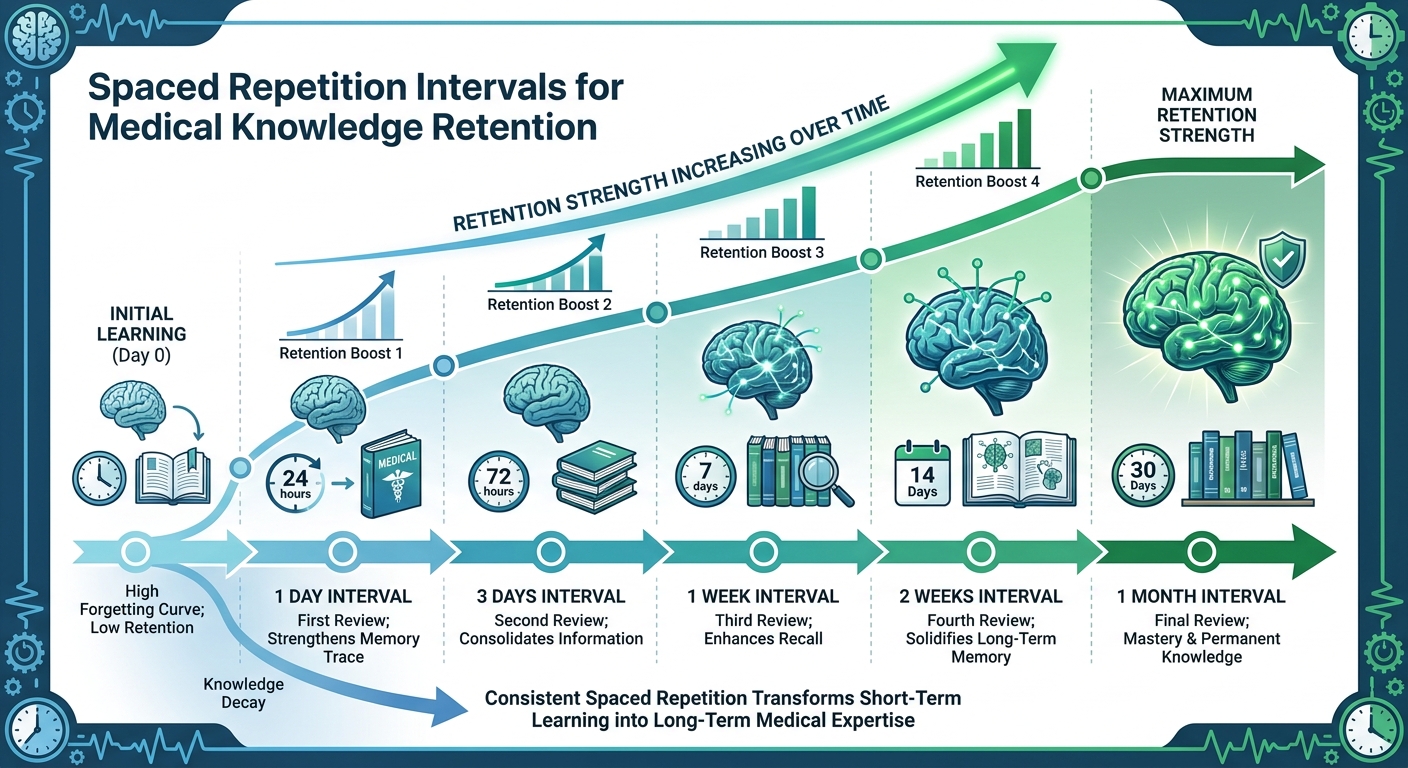
The optimal intervals follow a predictable pattern:
- First review: Within 24 hours of initial learning
- Second review: 3 days later
- Third review: 1 week later
- Fourth review: 2 weeks later
- Fifth review: 1 month later
For UKMLA preparation, this translates to systematic review cycles that strengthen both your strong areas and systematically address weak specialties.
Mapping UKMLA Spaced Repetition to the Content Map
The GMC MLA Content Map is your finite syllabus. Every AKT question maps to a specific presenting complaint and clinical condition from this official blueprint. This makes spaced repetition highly targeted — you know exactly what to review.
Content Map Structure for Revision
The 2026 update expanded the map to 430 conditions across specialized domains:
High-frequency specialties (60-70% of AKT questions):- Emergency and acute care
- General practice and primary care
- Medicine core systems (cardiology, respiratory, gastroenterology)
- Surgery and surgical specialties
- Child health and paediatrics
- Mental health and psychiatry
- Women's health and obstetrics/gynaecology
- Dermatology
- ENT
- Ophthalmology
- Ethics and professional practice
Identifying Your UKMLA Weak Areas
Before implementing spaced repetition, you need accurate weak area identification. This goes beyond "I'm bad at cardiology" to specific presenting complaints and management algorithms.
Week 1-2: Diagnostic Assessment
Start with a full-length AKT mock to baseline your knowledge. Don't focus on the score — focus on the pattern analysis:
- Specialty-specific accuracy: Which domains scored below 65%?
- Question type patterns: Are you missing acute management, chronic disease protocols, or ethics scenarios?
- Guideline gaps: Which NICE, BNF, or CKS references do you consistently miss?
Week 3-4: Granular Gap Analysis
Take specialty-specific question blocks in your three weakest domains. For each incorrect answer, categorize the miss:
1. Knowledge gap: Never learned the concept
2. Recall failure: Knew it once but forgot
3. Application error: Knew the facts but applied incorrectly
4. Guideline outdated: Using old protocols
This categorization determines your spaced repetition priorities. Knowledge gaps need immediate learning followed by standard intervals. Recall failures jump straight into the review cycle. Application errors need contextual practice, not just flashcard review.
Implementing Spaced Repetition for AKT Content
Daily Review Structure
Morning session (30 minutes):- Review flashcards due for spaced repetition
- Focus on high-yield facts: drug doses, diagnostic criteria, first-line treatments
- Prioritize cards from your three weakest specialties
- Practice 30-50 timed questions across mixed specialties
- Create new flashcards from incorrect answers
- Schedule immediate review for new cards (tomorrow's pile)
- Light review of cards marked "difficult" during morning session
- Preview tomorrow's scheduled content without deep study
Spaced Repetition Card Creation
Effective UKMLA flashcards target specific recall patterns the exam tests:
Front: "42-year-old presents with chest pain and ST elevation in leads II, III, aVF. First-line management?" Back: "Inferior STEMI → Dual antiplatelet therapy (aspirin 300mg + clopidogrel 300mg) + atorvastatin + primary PCI within 120 minutes if available"This format mirrors AKT question stems and includes the specific management details you need rapid access to under exam conditions.
Weekly Weak Area Intensification
Every week, dedicate one 3-hour block to your currently weakest specialty. This isn't passive reading — it's active creation of spaced repetition materials:
1. Hour 1: Review UKMLA emergency and acute care lessons for missed concepts
2. Hour 2: Practice 50 questions in that specialty using targeted question banks
3. Hour 3: Convert missed questions into flashcards with proper spaced repetition scheduling
Dermatology consistently appears as a weak area for many students. The Visual pattern recognition games like Synapses help you build the concept clusters that make dermatology conditions stick — linking visual presentations with treatment pathways in a way that pure flashcard review can't achieve.
Guidelines and Protocol Integration
UKMLA tests applied knowledge of current UK guidelines. Your spaced repetition system must include systematic review of:
NICE Guidelines Priority Areas
Cardiovascular disease:- Hypertension thresholds (updated 2019): 140/90 mmHg clinic, 135/85 ambulatory
- Heart failure management algorithms
- Acute coronary syndrome protocols
- Type 2 diabetes first-line: metformin + lifestyle
- HbA1c targets: 48 mmol/mol (6.5%) for most adults
- SGLT-2 inhibitor and GLP-1 positioning in treatment pathways
- Depression stepped care approach
- Anxiety management without benzodiazepine dependence
- Capacity assessment frameworks
BNF Integration Strategy
Create dedicated flashcard sets for high-yield prescribing information:
- Drug doses: First-line antibiotics for common infections
- Contraindications: Key drug interactions tested on AKT
- Monitoring requirements: Warfarin, lithium, metformin protocols
Access current BNF guidance and NICE Clinical Knowledge Summaries directly rather than relying on outdated textbooks.
Clinical Decision Rules
AKT frequently tests clinical decision tools. Create spaced repetition cards for:
Wells score (DVT/PE probability):- Active cancer, paralysis, recent surgery, calf swelling >3cm
- Score interpretation and next steps
- Congestive heart failure, hypertension, age ≥75, diabetes, stroke/TIA history
- Anticoagulation thresholds
- Respiratory rate ≥22, altered mentation, systolic BP ≤100
- Sepsis bundle timing requirements
Mock Test Integration and Review Cycles
Spaced repetition works best when integrated with regular mock practice, not as a separate study method.
Monthly Mock Cycles
Week 1: Full AKT mock (Paper 1 + Paper 2 back-to-back) Week 2: Targeted specialty mocks in your three weakest areas Week 3: Ethics and professional practice focus with general practice scenarios Week 4: Mixed practice with immediate spaced repetition card creationMock Debrief Protocol
After each mock, spend equal time reviewing as you did taking it:
1. Immediate review (30 minutes): Note correct answers you weren't confident about
2. Deep analysis (60 minutes): Create flashcards from all incorrect answers
3. Pattern recognition (30 minutes): Identify recurring mistake themes
4. Scheduling (15 minutes): Add new cards to spaced repetition queue
Advanced Spaced Repetition Techniques
Interleaving for Better Retention
Don't batch review by specialty. Mix cardiac, respiratory, and dermatology flashcards in each session. This forces your brain to actively discriminate between similar conditions — exactly what AKT questions test.
A typical morning review might include:
- Heart failure management (cardiology)
- Asthma vs COPD differentials (respiratory)
- Eczema treatment ladders (dermatology)
- Depression screening tools (psychiatry)
This interleaving improves transfer to exam conditions where you don't know the specialty in advance.
Elaborative Interrogation
For complex guidelines, create flashcards that ask "why" not just "what":
Standard card: "First-line treatment for uncomplicated UTI in women?" Elaborative card: "Why is trimethoprim preferred over nitrofurantoin for uncomplicated UTI in women over 65?"The elaborative version forces deeper processing and creates stronger memory traces for guideline rationale.
Dual Coding for Visual Learners
Combine text-based flashcards with visual elements:
- ECG rhythm strips for cardiology cards
- Rash photos for dermatology protocols
- Flow charts for diagnostic algorithms
Troubleshooting Common Issues
Plateau Effect After 4-6 Weeks
If your mock scores stop improving despite consistent spaced repetition:
1. Increase difficulty: Focus on explaining concepts to others
2. Add context: Practice questions under timed conditions
3. Vary formats: Mix multiple choice with short answer self-testing
Overwhelming Card Volume
If daily reviews exceed 45 minutes:
1. Ruthless pruning: Delete cards you consistently answer correctly
2. Merge similar concepts: Combine related flashcards
3. Prioritize by exam weight: Focus 70% of time on high-frequency topics
Weak Area Persistence
If certain specialties remain weak despite targeted review:
1. Change learning modality: Switch from text to visual or audio
2. Seek alternative explanations: Use multiple resources for the same concept
3. Practice application: Focus on how concepts appear in questions, not isolation
8-Week UKMLA Spaced Repetition Schedule
Weeks 1-2: Foundation and Baseline
- Complete diagnostic AKT mock
- Create initial flashcard set (200-300 cards) from weak areas
- Establish daily review routine
- Focus on knowledge gaps over application
Weeks 3-4: Expansion and Refinement
- Increase daily question practice to 40-50 SBAs
- Add guideline-specific flashcards (NICE, BNF protocols)
- Weekly specialty deep-dives in weakest areas
- Practice child health and infectious diseases systematically
Weeks 5-6: Integration and Application
- Full mock every 4-5 days
- Focus spaced repetition on application errors, not knowledge gaps
- Interleave specialties in daily reviews
- Target Paper 2 content: ethics, communication, chronic disease
Weeks 7-8: Performance Optimization
- Maintain spaced repetition for high-yield facts only
- Prioritize timed practice over new card creation
- Final review cycles for consistently difficult cards
- Taper new learning, focus on reinforcement
Frequently Asked Questions
How many flashcards should I create for UKMLA revision?
Start with 200-300 cards covering your weakest specialties, then add 10-15 new cards weekly from mock practice. Most successful students maintain 400-600 active cards by exam time. Quality matters more than quantity — focus on high-yield, AKT-specific content.
Should I use pre-made flashcard decks or create my own?
Create your own cards from your specific mistakes and weak areas. Pre-made decks don't target your individual gaps. However, use them as templates for format and question style, then customize the content to your needs.
How do I balance spaced repetition with other revision methods?
Allocate 30% of daily study time to spaced repetition, 50% to timed question practice, and 20% to guidelines review. Spaced repetition supports the other methods — it doesn't replace them.
What if I fall behind on my spaced repetition schedule?
Don't try to catch up by doing all overdue cards in one session. Reset your intervals: mark overdue cards as "difficult" and they'll appear more frequently. Consistency matters more than perfection.
How do I know if spaced repetition is working?
Track three metrics: mock scores should improve 3-5 percentage points weekly, flashcard accuracy should exceed 85%, and you should feel more confident about previously weak specialties during timed practice.
Is spaced repetition enough for UKMLA preparation?
No — it's one component of comprehensive preparation. You need timed question practice, mock exams, guidelines review, and clinical reasoning development. Spaced repetition strengthens recall; other methods develop application and exam technique.
Spaced repetition transforms scattered knowledge into reliable recall under exam pressure. For UKMLA, where 72 seconds per question demands instant access to guidelines and protocols, systematic review cycles give you the confidence to trust your preparation when it matters most.
Prepare smarter with Oncourse AI — adaptive MCQs, spaced repetition, and AI explanations built for UKMLA success. Download free on Android and iOS.