UKMLA High-Yield Topics: Turn the Syllabus Into Daily Adaptive Practice
Transform the UKMLA content map into a daily adaptive practice plan. Learn which high-yield topics to prioritize, how to rotate weak areas, and use performance data for smarter exam prep in 2026.
UKMLA High-Yield Topics: Turn the Syllabus Into Daily Adaptive Practice
You are staring at the UKMLA content map — 430 conditions sprawled across six clinical domains. Thats 430 potential question stems, 2,150 potential answer choices, and exactly zero guidance on which ones matter most for your AKT sitting.
Static checklists dont work. Generic study schedules dont work. Cramming through PassMedicine in order of appearance definitely doesnt work.
The candidates who pass the UKMLA AKT in 2026 aren't using passive revision. They're turning their weak-area performance into daily adaptive practice schedules. They know exactly which high-yield topics to hit today, which to rotate back tomorrow, and which are already exam-ready.
This isnt about working harder. Its about practice data replacing guesswork.
The UKMLA Content Map Reality Check
The GMC expanded the UKMLA content map from 311 conditions to 430 for 2026. That means more breadth, more depth, and more ways to get caught unprepared.
But here's what the pass data shows: 20 clinical areas account for roughly 60% of AKT questions. Master these, and you've built your foundation. Miss these, and all the niche knowledge in the world wont save your score.
The UKMLA High-Yield 20:
1. Acute Coronary Syndromes — STEMI/NSTEMI protocols, troponin interpretation, GRACE scoring
2. Hypertension Management — NICE NG136 pathways, age-specific first-line choices
3. Type 2 Diabetes — Metformin positioning, SGLT2 inhibitors, HbA1c targets
4. Heart Failure — Four pillars therapy, HFrEF vs HFpEF, referral criteria
5. Asthma & COPD — Stepwise treatment, exacerbation management, oxygen prescribing
6. Community-Acquired Pneumonia — CURB-65 scoring, severity-based antibiotics
7. Stroke & TIA — FAST recognition, thrombolysis criteria, secondary prevention
8. Sepsis Recognition — NEWS2 scoring, Sepsis Six bundle, antibiotic timing
9. Pre-eclampsia — Diagnostic criteria, labetalol protocols, magnesium sulfate
10. Depression Management — NICE stepped care, SSRI first-line, referral triggers
The remaining 10 span prescribing safety, consent/capacity, safeguarding, cancer referral pathways, AKI management, childhood vaccination, ectopic pregnancy, epilepsy, atrial fibrillation, and Mental Health Act sections.
These aren't randomly chosen. They're the topics that appear consistently across AKT sittings, regardless of paper version or sitting month.
Why Daily Adaptive Practice Beats Static Study Plans
Traditional UKMLA prep follows a predictable pattern: work through each system sequentially, complete question banks in order, hope for the best. The problem? Your weak areas stay weak while you waste time reinforcing topics you already know.
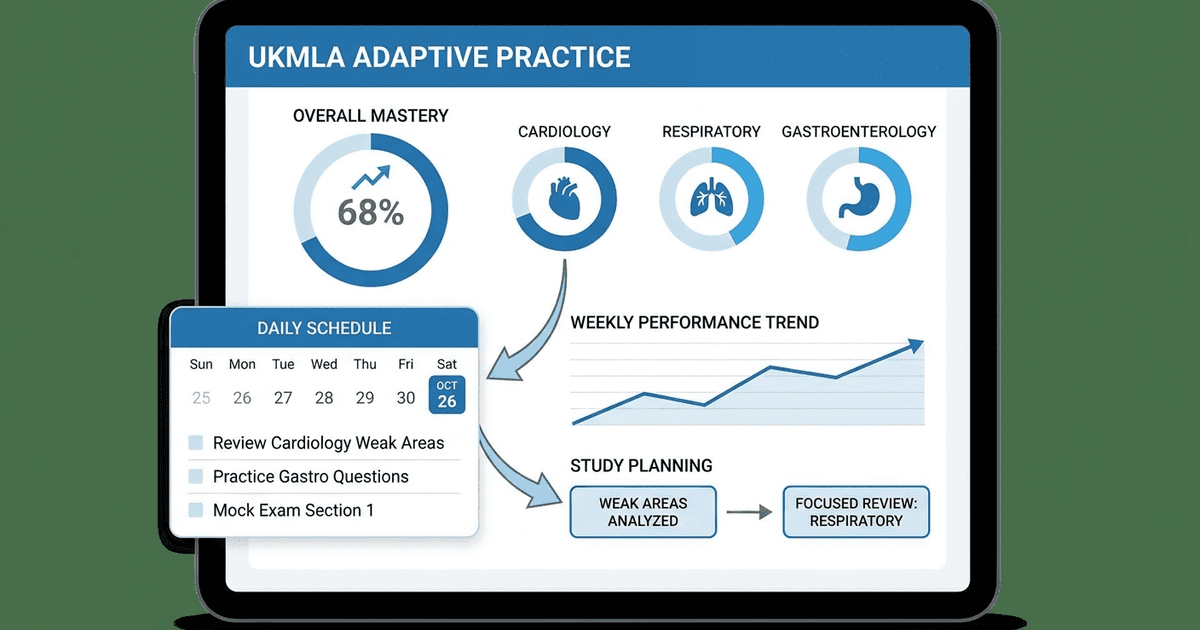
Adaptive practice flips this. Instead of following a predetermined schedule, your daily study plan adjusts based on yesterday's performance data.
Struggled with heart failure management yesterday? Today's Adaptive Daily Plan routes more cardiac scenarios your way. Nailed respiratory questions consistently? Those rotate out of daily focus and into spaced repetition cycles.
The system works because it mirrors how the AKT actually tests you — not through systematic coverage, but through unpredictable combinations that expose genuine knowledge gaps.
Traditional Approach:
Week 1: Cardiovascular (regardless of current competency)
Week 2: Respiratory (regardless of performance data)
Week 3: Gastroenterology (regardless of weak areas)
Adaptive Approach:
Today: 40% cardiac (weakness identified), 30% prescribing (moderate gaps), 20% mental health (spaced repetition), 10% mixed review
Tomorrow: Adjusts based on today's performance
AKT-Relevant High-Yield Systems Breakdown
The UKMLA AKT doesn't test systems in isolation. Clinical vignettes blend multiple specialties, requiring integrated knowledge across domains. Here's how to prioritize within each high-yield system:
Medicine Core Systems
Cardiovascular (highest yield):
Acute coronary syndromes, heart failure, hypertension management
ECG interpretation for common arrhythmias (AF, VT, heart blocks)
Risk stratification tools (QRISK, CHA2DS2-VASc)
Practice with UKMLA medicine core systems lessons covering these exact scenarios with UK-specific management pathways. Respiratory (consistent appearance):
Asthma stepwise therapy, COPD management, pneumonia severity scoring
Oxygen prescribing, NIV criteria, pulmonary embolism workup
Endocrine (diabetes focus):
Type 2 diabetes management algorithm, HbA1c targets
Thyroid function interpretation, osteoporosis prevention
Adrenal insufficiency recognition
Emergency & Acute Care
This domain carries disproportionate weight because it tests decision-making under pressure — exactly what the AKT scenario format emphasizes.
Must-know presentations:
Sepsis recognition and management (NEWS2, Sepsis Six)
Major trauma assessment, anaphylaxis protocols
Acute kidney injury staging and initial management
The UKMLA emergency and acute care lessons provide structured coverage of these time-critical scenarios. High-yield procedures:
Central line indications, chest drain insertion criteria
Intubation decision-making, basic life support algorithms
Prescribing & Patient Safety
This crosses all clinical domains and appears in 15-20% of AKT questions. Its also where candidates lose marks through simple errors.
Prescribing safety priorities:
Drug interactions (warfarin, lithium, methotrexate)
Renal/hepatic dose adjustments
Pregnancy prescribing, monitoring requirements
Our prescribing and ethics lessons cover these exact scenarios with NICE-aligned guidance.
Building Your Daily Topic Rotation System
Static study plans break down because they don't respond to your evolving competency. Adaptive rotation systems adjust daily practice based on performance patterns.
The 3-Tier Rotation Model: Tier 1 (Daily Focus - 50% of practice time):
Topics scoring <60% accuracy over the past week. These get intensive question practice, targeted reading, and concept reinforcement.
Tier 2 (Regular Rotation - 30% of practice time):
Topics scoring 60-75% accuracy. These appear every 2-3 days to prevent decay while avoiding over-practice.
Tier 3 (Spaced Maintenance - 20% of practice time):
Topics scoring >75% consistently. These appear weekly to maintain competency without wasting time.
Sample Adaptive Schedule (Week 3 of prep): Monday:
20 cardiac questions (Tier 1 weakness)
12 prescribing scenarios (Tier 1 weakness)
8 respiratory mixed (Tier 2 maintenance)
Tuesday:
18 mental health cases (Tier 1 weakness)
15 emergency medicine (Tier 2 rotation)
7 diabetes management (Tier 3 spaced review)
The specific allocation adjusts based on Sunday's performance analysis. Cardiac improves to 70%? It drops to Tier 2 rotation. Mental health stays at 55%? It remains Tier 1 daily focus.
Weak-Area Analytics That Actually Work
Most question banks give you basic percentages. Thats not enough for adaptive practice. You need granular analytics that identify why you're missing questions and what to target next.
Performance Dashboard Metrics: Topic-Level Accuracy Trending:
Track 7-day rolling averages for each high-yield topic. Look for stagnation patterns — topics that plateau at 65-70% often need concept reinforcement, not more questions.
Question Type Analysis:
Are you missing "most likely diagnosis" questions or "next best management" questions? Different error patterns require different interventions.
Time-Per-Question Tracking:
Slow topics (>90 seconds average) often indicate knowledge gaps. Fast but incorrect topics suggest pattern recognition errors.
Our Performance Dashboard tracks exactly these metrics, showing which UKMLA topics are exam-ready and which need another practice loop.
Weak Area Identification Triggers:
Set automatic flags for topics meeting any of these criteria:
<60% accuracy over 20+ questions
Declining trend over 5+ consecutive days
>120 seconds average response time
Missing same question type repeatedly (diagnosis vs management vs investigation)
When a topic gets flagged, the system routes additional practice questions your way until performance improves above threshold.
Practice Question Strategy for UKMLA Success
Random question practice doesnt work for the UKMLA AKT. The exam uses clinical vignettes that test integrated reasoning, not isolated recall. Your practice strategy needs to match this format.
Adaptive Question Routing:
Instead of working through questions sequentially, let performance data drive question selection. The Question Bank uses adaptive routing to serve questions based on your current competency gaps.
Struggling with stroke management? The system serves more stroke scenarios until you demonstrate consistent competency. Strong on diabetes? Those questions appear less frequently, making room for weak areas.
Clinical Scenario Integration:
UKMLA questions don't test single facts. They present clinical scenarios requiring multi-step reasoning:
1. History interpretation
2. Examination finding significance
3. Investigation selection/interpretation
4. Management pathway decision
5. Safety-netting considerations
Practice questions need to mirror this complexity. Look for scenarios that blend multiple specialties — diabetes with concurrent heart failure, pneumonia in COPD patients, depression with physical comorbidities.
Practice UKMLA general practice questions for exactly these integrated scenarios. Performance-Based Question Difficulty:
As your competency improves, question difficulty should increase automatically. Easy questions build confidence but don't prepare you for AKT complexity. Adaptive systems serve harder variants as your accuracy improves.
Start with straightforward presentations (classic chest pain = ACS). Progress to atypical presentations (elderly diabetic with silent MI). Advance to complex cases (ACS with concurrent renal impairment affecting treatment choices).
Optimizing Your Revision Cadence
Revision timing matters as much as content selection. The UKMLA AKT tests retention under pressure, not cramming capacity. Your revision cadence should reflect spaced repetition principles adapted to exam timelines.
The 3-Phase Revision Model: Phase 1: Foundation Building (Weeks 1-8)
Focus on high-yield topics daily
Target weak areas aggressively
Build broad knowledge base across all domains
Phase 2: Integration & Practice (Weeks 9-12)
Shift to mixed topic scenarios
Increase timed practice frequency
Focus on decision-making speed
Phase 3: Maintenance & Fine-Tuning (Weeks 13-16)
Light revision of weak areas only
Full-length timed mocks
Preserve energy for exam day
Spaced Repetition for UKMLA:
Strong topics: Review every 7-10 days
Moderate topics: Review every 3-4 days
Weak topics: Review daily until improvement
The key is adjusting these intervals based on performance data, not following fixed schedules. A topic that improves from 55% to 75% accuracy can immediately shift to longer review intervals.
Mental Health Integration: Mental health topics appear across 15% of AKT questions but require consistent reinforcement due to complex legislation and evolving guidelines. Build these into daily practice rather than cramming during dedicated psychiatry weeks.
Frequently Asked Questions
How many UKMLA high-yield topics should I focus on daily?
Focus on 3-4 high-yield topics per day, with 2 from your weakest areas and 1-2 from spaced repetition. More topics dilute focus; fewer topics miss coverage gaps. Adjust based on your performance data — if youre consistently scoring 70%+ on a topic, rotate it out for maintenance review.
Which UKMLA topics appear most frequently on the AKT?
Cardiovascular (ACS, heart failure, hypertension), respiratory (asthma, COPD, pneumonia), and prescribing safety appear in 40-50% of questions. Emergency presentations, diabetes management, and mental health legislation each appear in 10-15% of questions. Focus your daily practice on these areas first.
How long should I spend on weak UKMLA topics each day?
Spend 60-70% of your practice time on topics scoring <70% accuracy. This typically means 45-60 minutes daily on weak areas, 20-30 minutes on moderate topics, and 10-15 minutes on strong topic maintenance. Adjust weekly based on performance trends.
When should I move from daily practice to exam-mode revision?
Switch to exam-mode practice when you're scoring 75%+ consistently on high-yield topics. This usually happens around week 10-12 of preparation. Before this point, focus on building knowledge through targeted practice rather than timed mocks.
How do I track which UKMLA topics are exam-ready?
Set clear thresholds: >80% accuracy over 30+ questions, <75 seconds average response time, and stable performance over 7 days. Topics meeting all three criteria are exam-ready. Topics missing any criterion need continued daily practice.
What if I keep getting the same UKMLA topic wrong repeatedly?
Switch from question practice to concept review. Read the NICE guideline directly, watch procedural videos, or complete structured lessons on that topic. Return to question practice once you understand the underlying concepts. Sometimes you need knowledge building, not more practice.
---
Transform static UKMLA preparation into adaptive daily practice with performance-driven scheduling. Instead of hoping you've covered everything, you'll know exactly which topics are exam-ready and which need targeted work.
Prepare smarter with Oncourse AI — adaptive MCQs, spaced repetition, and AI explanations built for UKMLA success. Download free on Android and iOS.