UKMLA CPSA Preparation: Clinical Reasoning, Station Practice and Revision Strategy for 2026
Master UKMLA CPSA with proven clinical reasoning frameworks, structured station practice loops, and targeted revision strategies. Learn differential diagnosis approach, communication skills, and mock practice techniques for 2026 exam success.

UKMLA CPSA Preparation: Clinical Reasoning, Station Practice and Revision Strategy for 2026
You are staring at 18 OSCE stations. Each one lasts 8 minutes. You have a standardized patient, an examiner watching every move, and a marking scheme that weighs communication skills as heavily as clinical knowledge.
Welcome to the UKMLA CPSA — where knowing the right diagnosis means nothing if you cant explain it to Mrs. Smith in a way that makes her feel heard and safe.
The 2026 CPSA isnt testing whether you memorized Harrison's. Its testing whether you can think through uncertainty, communicate under pressure, and make patients feel like humans instead of textbook cases. And heres the thing most candidates miss: you dont prepare for this by reading more. You prepare by practicing stations until your clinical reasoning becomes as automatic as breathing.
This guide breaks down exactly how to build that automatic response — from structured reasoning loops to targeted revision strategies that actually stick when the timer starts counting down.
What the UKMLA CPSA Actually Tests
The CPSA evaluates four core competencies, each weighted equally in your final score:
Data Gathering: Can you ask the right questions and perform focused examinations that actually help narrow your differential? This isnt about following a template checklist — its about adaptive questioning based on your evolving clinical picture. Clinical Reasoning: Can you synthesize history, examination, and investigations into logical differentials and evidence-based management plans? The 2026 format emphasizes managing uncertainty and knowing when to escalate rather than forcing premature closure. Communication Skills: Can you explore patient ideas, concerns, and expectations while explaining complex medical information in accessible language? Safety-netting and shared decision-making are now explicit marking criteria. Professional Behavior: Can you maintain empathy and rapport while handling difficult conversations, ethical dilemmas, and time pressure? This includes recognizing your limitations and demonstrating appropriate escalation decisions.
The key insight: candidates with perfect clinical knowledge but poor communication fail. Candidates with solid (not flawless) knowledge who communicate brilliantly pass. The marking scheme reflects UK clinical reality where patient-centered communication determines outcomes as much as diagnostic accuracy.
Why Clinical Reasoning Practice Beats Passive Reading
Traditional CPSA preparation focuses on memorizing station scripts and disease presentations. This approach fails because real CPSA stations test adaptive thinking, not recall. You might know the textbook presentation of acute coronary syndrome, but can you adjust your approach when the patient presents with atypical chest pain, anxiety about their job, and concerns about medication costs?
Clinical reasoning develops through repeated practice with uncertainty. Each station presents incomplete information that you must navigate systematically. The Calgary-Cambridge framework provides structure, but your reasoning must be flexible enough to handle curveballs.
Here's where case-based practice becomes essential. Working through scenarios that mirror CPSA complexity trains your brain to recognize patterns while staying open to alternative possibilities. Oncourse's Clinical Rounds provides exactly this type of case-based reasoning practice, presenting real patient scenarios where you must work through differential diagnosis and management decisions in a station-style format.
The Station Practice Loop: Your Repeatable Framework
Every CPSA station — whether history-taking, examination, or communication — follows the same underlying structure. Master this loop and you can handle any scenario:
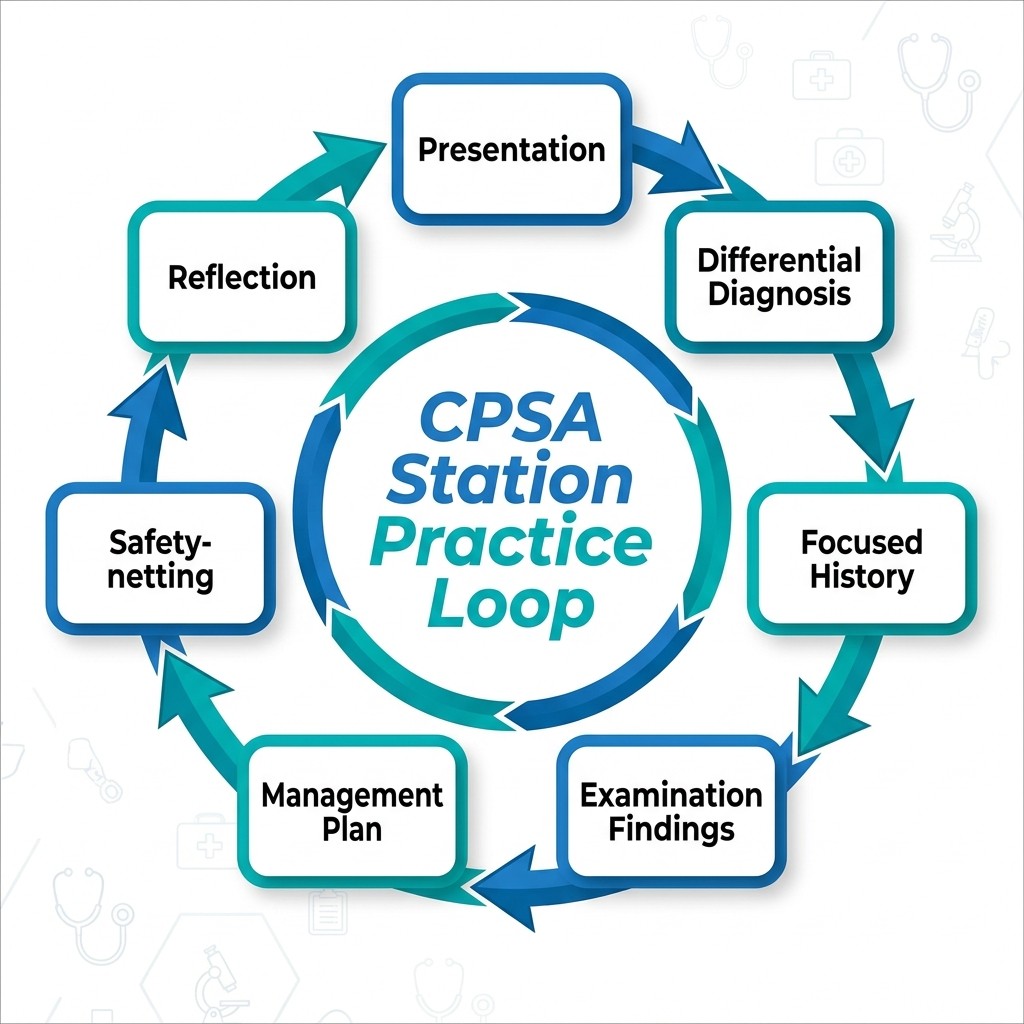
1. Presentation Analysis (30 seconds)
Read the scenario and immediately generate 3-4 differential diagnoses. Dont commit to one — hold multiple possibilities simultaneously. Ask yourself: "What are the serious conditions I cant miss?" and "What are the common conditions that fit this pattern?"
2. Differential-Driven History (3-4 minutes)
Your questions should systematically rule in or rule out your differentials. Start with open-ended exploration ("Tell me about your chest pain"), then move to focused questions that discriminate between possibilities ("Does the pain change with position?").
Red flag questions come first. Screen for serious conditions before exploring common ones. Use ICE (Ideas, Concerns, Expectations) to understand the patient's perspective — this often provides diagnostic clues and always improves communication scores.
3. Targeted Examination (2-3 minutes)
Examine based on your differential, not a generic template. If you suspect heart failure, focus on cardiovascular signs and fluid status. If you suspect anxiety, include relevant mental state examination components.
Explain what you're doing and why. "I'm going to listen to your heart because chest pain can sometimes indicate heart problems" shows clinical reasoning while maintaining patient rapport.
4. Synthesis and Management (1-2 minutes)
Synthesize findings into a clear differential diagnosis. Present this to the patient: "Based on what you've told me and my examination, I think the most likely explanation is X, but I also want to rule out Y."
Explain investigations and management in patient-friendly language. Link recommendations to their specific concerns. "You mentioned worrying about your heart — these blood tests will check for heart problems and give us a clearer picture."
5. Safety-Netting (1 minute)
Every consultation must end with explicit safety-netting. Tell them what to watch for, when to return, and what to do if symptoms worsen. Make this specific: "If your chest pain becomes severe, especially if it spreads to your arm or jaw, go to A&E immediately. Otherwise, see your GP if it isnt improving in 2-3 days."
6. Reflection (After station)
This is where improvement happens. Ask yourself: What knowledge gaps did I identify? What communication challenges arose? How could I have managed time better? Was my reasoning process clear and logical?
When practicing with Clinical Rounds, this reflection phase helps consolidate learning from each case scenario.
Reviewing Each Station: The Four Gap Analysis
After every practice station, categorize your performance gaps into four buckets:
Knowledge Gaps
Missing clinical facts, guidelines, or procedural steps. These require targeted study. If you missed signs of heart failure, review the UKMLA cardiology lessons and practice identifying key findings.
Use Rezzy to clarify complex explanations and reasoning when you encounter unfamiliar concepts. The AI tutor can break down why certain clinical decisions make sense and help you understand the logic behind guidelines.
Reasoning Gaps
Logical errors in differential diagnosis or management planning. You might know the facts but struggle to connect them systematically. These gaps improve through case-based practice and structured reasoning exercises.
Communication Gaps
Difficulty explaining concepts clearly, exploring patient concerns, or managing difficult conversations. These require practice with real people, not just books. Record yourself explaining common conditions and listen for clarity, empathy, and structure.
Time-Pressure Gaps
Knowing what to do but running out of time. These gaps require practiced prioritization. You need to identify which elements are essential versus nice-to-have for each station type.
Most candidates focus only on knowledge gaps. But communication and time-pressure gaps often determine pass/fail outcomes. Address all four systematically.
Combining AKT Knowledge with CPSA Station Practice
Your AKT preparation provides the clinical foundation, but CPSA requires applying that knowledge in patient interactions. Heres how to bridge the gap:
Link Every Fact to Patient Communication: When studying heart failure management, dont just memorize ACE inhibitor dosing. Practice explaining to a patient why they need this medication, what side effects to watch for, and how it will help their symptoms. Practice Guidelines in Context: NICE guidelines provide excellent management frameworks, but CPSA requires explaining these recommendations to patients with specific concerns and circumstances. Practice adapting guideline recommendations for different patient scenarios. Use Case-Based Learning: Instead of studying diseases in isolation, work through patient presentations that integrate multiple conditions. Real patients have comorbidities, social concerns, and competing priorities that require sophisticated reasoning.
Your daily practice sessions should include both knowledge acquisition and application practice. Spend 60% of your time on structured AKT review and 40% on case-based CPSA-style reasoning.
Weekly Revision Plan: Building Systematic Competence
Weeks 1-4: Foundation Phase
AKT Review (60 minutes daily): Focus on high-yield topics using UKMLA lessons. Prioritize emergency presentations, common conditions, and prescribing safety.
Station Practice (45 minutes, 3x weekly): Basic history-taking and examination stations. Focus on structure and time management rather than complex scenarios.
Communication Skills (30 minutes, 2x weekly): Practice ICE exploration, explaining common diagnoses, and basic counseling scenarios with study partners.
Weeks 5-8: Integration Phase
Mixed Practice (90 minutes daily): Combine AKT questions with immediate CPSA application. After answering questions about chest pain, practice taking a chest pain history.
Mock Stations (2 hours weekly): Full-length practice sessions with timing and feedback. Include all station types: history, examination, communication, procedures.
Weak Area Focus: Use analytics to identify struggling topics. If cardiovascular reasoning is weak, spend extra time on cardiology cases and examination practice.
Weeks 9-12: Mastery Phase
Full Mock OSCEs (3 hours weekly): Complete 18-station circuits with realistic timing and breaks. Practice under exam conditions.
Communication Refinement (45 minutes, 3x weekly): Advanced scenarios including breaking bad news, consent discussions, and ethical dilemmas.
Case-Based Reasoning (60 minutes daily): Complex, multi-system presentations requiring diagnostic uncertainty management.
Final 90/60/30/14/7 Day Strategy
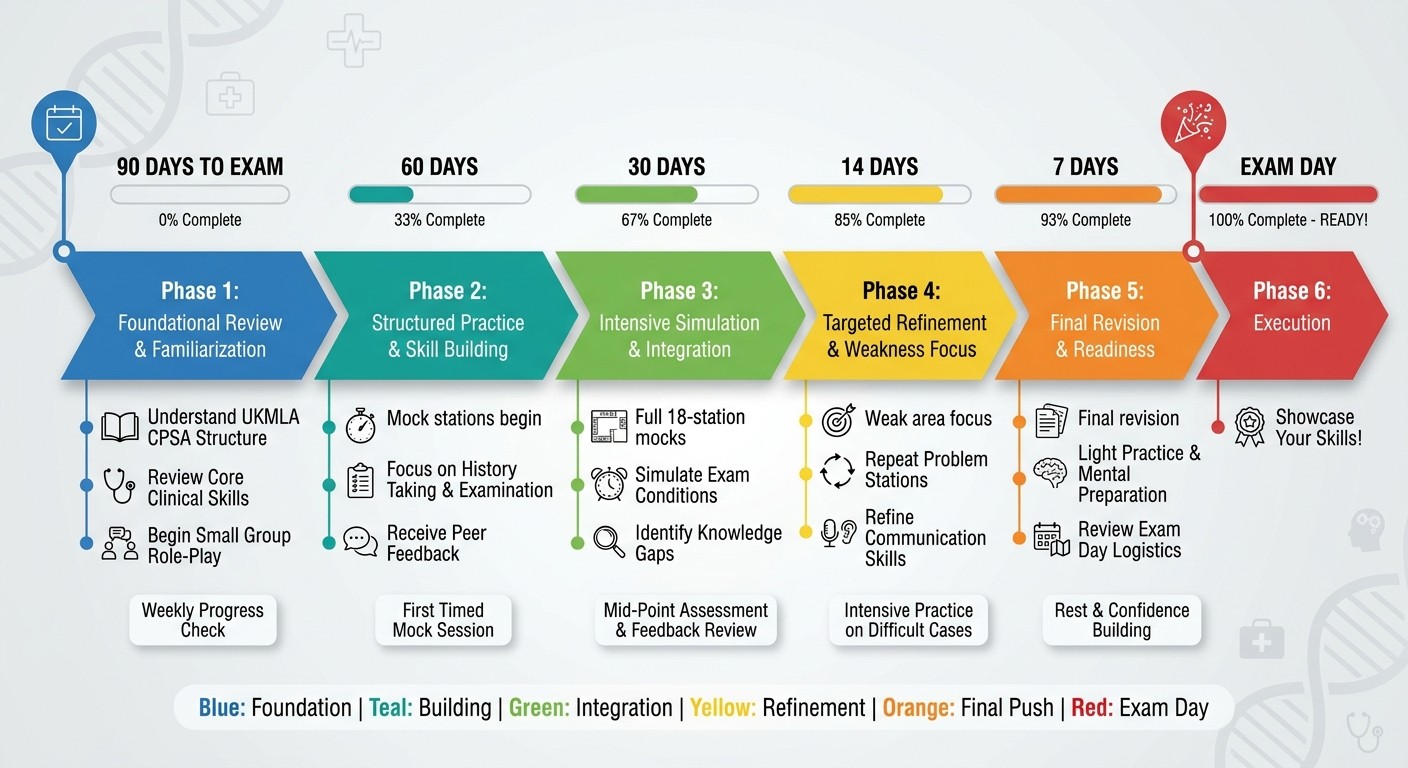
90 Days Out: Baseline Assessment
Complete a diagnostic 18-station mock OSCE to identify your starting point. Map weaknesses across knowledge, reasoning, communication, and time management. This becomes your focused practice plan.
Set up your study partnership now. CPSA preparation requires real people for communication practice. Find study partners who can commit to regular session and structured feedback.
60 Days Out: Intensive Practice Begins
Begin daily station practice with systematic feedback. Rotate through all station types weekly. Record sessions when possible — watching yourself reveals communication blind spots that partners might miss.
Start integrating weak areas identified from your daily plan analytics. If your performance data shows gaps in respiratory medicine, focus extra CPSA practice on breathlessness presentations and respiratory examination techniques.
30 Days Out: Weak Area Intensive
Your practice should now focus 70% on identified weak areas. If breaking bad news consistently scores poorly, dedicate multiple sessions weekly to challenging communication scenarios.
Complete your second full mock OSCE. Compare performance to your 90-day baseline. Improvement should be evident across all four competency domains.
14 Days Out: Final Systems Check
Last full mock OSCE. Focus remaining practice on specific gaps identified. No new content — only refinement of existing skills.
Practice medical emergency scenarios and ethical dilemmas. These high-stress stations often determine pass/fail outcomes.
7 Days Out: Maintenance Mode
Light review only. One 8-station mini-mock to maintain timing and confidence. Focus on sleep, nutrition, and mental preparation.
Review your safety-netting scripts and common explanation frameworks. These should be automatic by now.
Common Mistakes That Kill CPSA Performance
Memorizing Scripts Instead of Learning Principles
Many candidates memorize word-for-word explanations for common conditions. This fails when patients ask unexpected questions or present atypical scenarios. Learn communication principles (empathy, clarity, checking understanding) rather than rigid scripts.
Ignoring Feedback During Practice
Practice without feedback reinforces bad habits. Every session should include specific, actionable feedback on all four competency domains. "That was good" doesnt help — "Your history was thorough, but you spent too long on social history and didnt explore the patient's main concern about chest pain" does.
Not Practicing Out Loud
Reading about communication skills isnt the same as speaking to patients. You must practice verbal explanations, empathetic responses, and safety-netting language until they feel natural under pressure.
Skipping Reflection After Stations
The learning happens in reflection, not just performance. Spend 5 minutes after each practice station analyzing what worked, what didnt, and what you'll change next time.
Treating Weak Stations as Fixed Weaknesses
"I'm just bad at breaking bad news" becomes a self-fulfilling prophecy. Every station type can be improved through deliberate practice. Identify specific skills within challenging station types and practice those components systematically.
Focusing Only on Perfect Scores
CPSA is pass/fail, not ranked performance. You need competent, safe practice across all domains — not perfection in every station. Aim for consistent, reliable performance rather than occasional brilliance.
When you encounter gaps in understanding during practice, Explanation Chat can help clarify the reasoning behind clinical decisions and communication strategies, ensuring you understand the why behind effective station performance.
Building Confidence Through Structured Practice
CPSA anxiety often stems from uncertainty about expectations. Build confidence through structured preparation that simulates exam conditions:
Standardized Timing: Always practice with realistic time constraints. Use timers for reading time, station performance, and transition periods. Realistic Props: Practice with actual medical equipment when possible. Familiarity with stethoscopes, peak flow meters, and blood pressure cuffs builds muscle memory and confidence. Varied Patient Personalities: Practice with partners who can portray different personality types — anxious, angry, confused, or dismissive patients. This prepares you for unexpected interpersonal challenges. Systematic Feedback: Use structured feedback forms that address all four competency domains. Focus feedback on specific behaviors rather than general impressions.
Regular practice with case-based scenarios through Clinical Rounds builds the pattern recognition and clinical reasoning confidence needed for complex CPSA stations.
Frequently Asked Questions
How many mock stations should I complete before the exam?
Aim for 100-150 individual station practices plus 4-5 full 18-station mock OSCEs. This provides sufficient exposure to station variety while building automatic responses to common scenarios.
What if I run out of time during a station?
Prioritize patient safety and clear communication over completing every task. If time is running short, focus on safety-netting and essential management points rather than detailed examination findings.
How do I handle stations where I dont know the diagnosis?
Use the uncertainty management framework: acknowledge the uncertainty, revert to systematic data gathering, involve senior colleagues in your management plan, and focus on patient safety. You can pass stations without knowing the exact diagnosis if you demonstrate safe, professional uncertainty management.
Should I memorize specific phrases for common scenarios?
Learn communication principles rather than scripts. Have flexible frameworks for common tasks (ICE exploration, safety-netting, breaking bad news) but adapt the language to each patient's specific situation and concerns.
How important is it to examine perfectly?
Examination technique matters, but communication during examination often matters more. Explain what you're doing, ensure patient comfort, and demonstrate professional behavior. Perfect technique with poor communication scores lower than adequate technique with excellent patient interaction.
What happens if I make a clinical error during a station?
Acknowledge the error professionally if you recognize it, and demonstrate how you would seek help or escalate appropriately. Showing insight into your limitations often scores better than trying to cover up mistakes.
Prepare smarter with Oncourse AI — practice case-based clinical reasoning with Clinical Rounds, clarify complex explanations with Rezzy, and target your weak areas through personalized study plans. Download free on Android and iOS.