PLAB Medicine: High-Yield Topics, Clinical Cases and Revision Strategy
Master PLAB medicine with our comprehensive guide covering high-yield topics, clinical case practice, and structured revision strategies for 2026 exam success.

PLAB Medicine: High-Yield Topics, Clinical Cases and Revision Strategy
You're staring at 430 conditions in the MLA content map, wondering which ones actually matter for PLAB medicine. The truth? About 80 of them account for most questions, but knowing which 80 makes the difference between passing and failing.
PLAB 1 isn't about memorizing disease lists anymore. Since the 2026 MLA alignment, it's become a clinical reasoning exam that tests your ability to think like an F2 doctor in the NHS. The questions are longer, more complex, and demand you consider patient context – not just recall first-line treatments.
Here's what works: master the high-yield domains first, build systematic clinical reasoning, then practice with targeted case scenarios. This approach has helped thousands of international medical graduates navigate PLAB medicine successfully.
Understanding PLAB Medicine in 2026
The Medical Licensing Assessment (MLA) content map fundamentally changed how PLAB medicine is tested. Instead of isolated disease knowledge, you're assessed on clinical presentations and decision-making under uncertainty.
Key Changes You Need to Know
Content Expansion: The syllabus grew from 311 to 430+ core conditions, with medicine dominating approximately 40% of the exam. New additions include transgender health considerations, updated sepsis criteria, and expanded women's health coverage. Presentation-Based Questions: Rather than asking "What is the first-line treatment for hypertension?", you'll see scenarios like: "A 67-year-old with diabetes, CKD stage 3, and previous stroke presents with BP 165/95. His current medications include ramipril 10mg and amlodipine 10mg. What is the most appropriate next step?" Integrated Clinical Context: Every question considers comorbidities, allergies, renal function, and patient preferences. Generic answers dont work – you need UK-specific, guideline-based reasoning.High-Yield Medicine Domains for PLAB Success
Based on the MLA content map analysis and exam patterns, these domains appear most frequently and carry the highest point values:
Cardiovascular Medicine (35-40 questions)
Safety-Critical Conditions:- Acute coronary syndromes (STEMI/NSTEMI recognition and management)
- Heart failure (acute and chronic management per NICE)
- Atrial fibrillation (anticoagulation decisions and rate control)
- Hypertensive emergencies and resistant hypertension
- ECG interpretation in chest pain scenarios
- Troponin timing and interpretation
- Heart failure medication optimization
- Stroke risk assessment (CHA2DS2-VASc scoring)
Respiratory Medicine (30-35 questions)
High-Yield Presentations:- Acute asthma and COPD exacerbations
- Community-acquired pneumonia management
- Pulmonary embolism (Wells score application)
- Respiratory failure and oxygen therapy
- Spirometry interpretation for diagnosis
- Arterial blood gas analysis in acute settings
- Inhaler technique and stepwise therapy
- CURB-65 scoring for pneumonia severity
Emergency Medicine (25-30 questions)
Cannot-Miss Diagnoses:- Sepsis recognition and management (updated 2026 criteria)
- Anaphylaxis and severe allergic reactions
- Diabetic ketoacidosis and hyperosmolar states
- Meningitis and encephalitis
- ABCDE assessment framework
- Shock recognition and initial treatment
- Poisoning and overdose management
- Trauma assessment basics
Endocrinology (20-25 questions)
Core Conditions:- Type 2 diabetes management (NICE pathway)
- Thyroid disorders (hypo/hyperthyroidism)
- Diabetic emergencies (DKA, HHS)
- Adrenal insufficiency recognition
- HbA1c targets and medication choices
- Insulin prescribing and adjustment
- Thyroid function test interpretation
- Sick day rules for diabetes
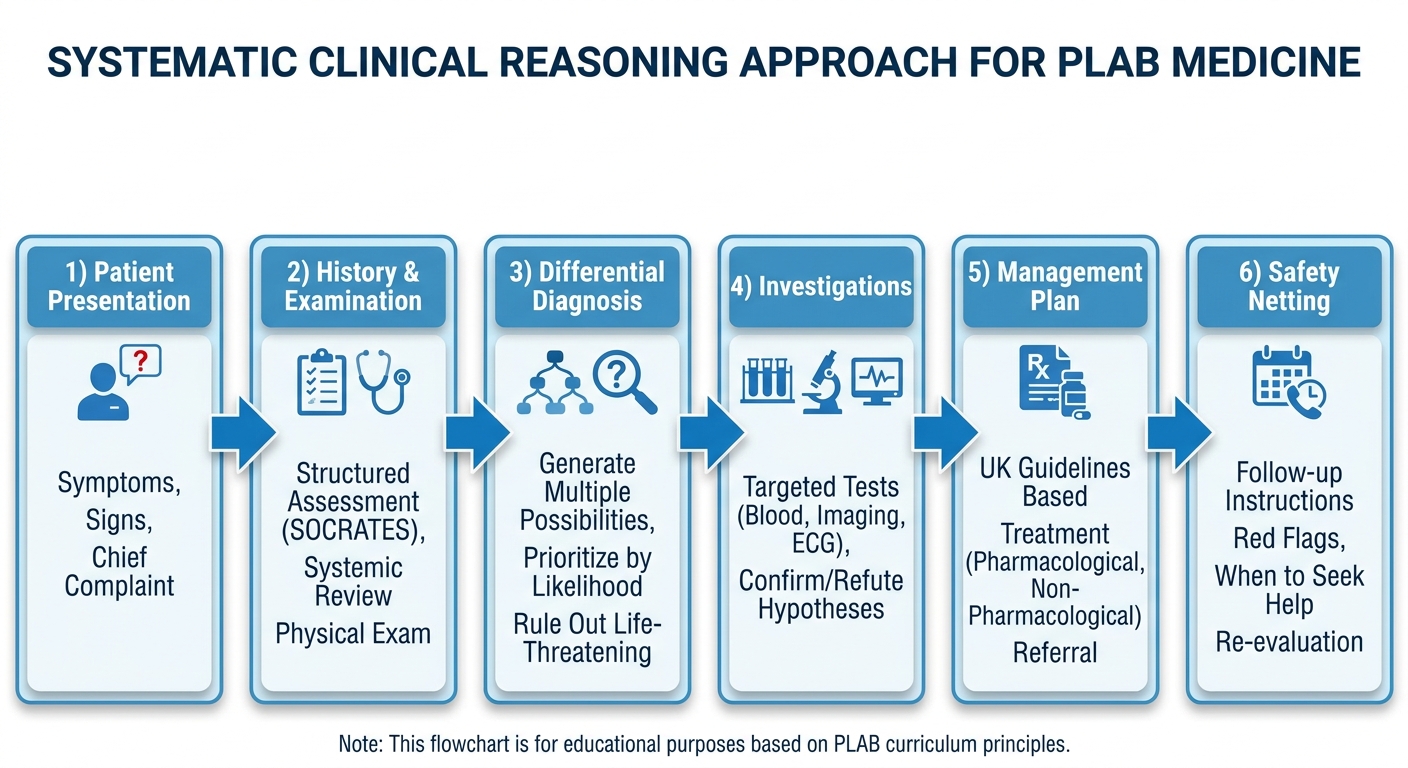
Developing Clinical Reasoning Skills
PLAB medicine success depends on systematic clinical thinking rather than rote memorization. Here's the framework that works:
The PLAB Clinical Approach
1. Presentation Analysis: Read the stem carefully for age, comorbidities, current medications, and specific symptoms. These details determine your differential and management approach. 2. Structured Assessment: Apply the history-examination-investigation-management sequence. Each step builds on the previous one. 3. UK Guideline Integration: Every management decision must align with NICE, CKS, or specialty society guidelines. International approaches often differ from UK practice. 4. Safety First: In emergency scenarios, stabilize before investigating. The exam rewards appropriate prioritization.Common Clinical Reasoning Patterns
"Most Appropriate Next Step" Questions: These test your ability to sequence care appropriately. If the patient is unstable, stabilization comes before detailed investigation. When reviewing these scenarios, Oncourse's Clinical Rounds feature provides structured practice with real patient scenarios that mirror PLAB's clinical reasoning emphasis. Investigation Selection: Choose the most appropriate test for the clinical context, not necessarily the most definitive. A D-dimer in low-probability PE scenarios may be more appropriate than immediate CTPA. Management Decisions: Consider patient factors (age, comorbidities, allergies) when selecting treatments. The "correct" answer is often context-dependent.High-Yield Medicine Topics by Frequency
Tier 1: Highest Frequency (Study First)
| Condition | Key Focus Areas | PLAB Pattern |
|---|---|---|
| Acute Coronary Syndrome | ECG changes, troponin timing, dual antiplatelet therapy | Management decisions based on STEMI vs NSTEMI |
| Heart Failure | ACE inhibitor optimization, fluid management, device therapy | Medication titration scenarios |
| Type 2 Diabetes | HbA1c targets, metformin contraindications, insulin initiation | Medication selection with comorbidities |
| COPD Exacerbation | Oxygen therapy, steroid duration, antibiotic selection | Severity assessment and treatment escalation |
| Pneumonia | CURB-65 scoring, antibiotic choice, discharge criteria | Risk stratification and appropriate setting |
Tier 2: Moderate Frequency (Study Second)
- Stroke and TIA management
- Pulmonary embolism diagnosis
- Sepsis recognition and bundles
- Thyroid disorders
- Atrial fibrillation anticoagulation
- Chronic kidney disease management
- Depression screening and treatment
Tier 3: Lower Frequency (Study After Covering Tiers 1-2)
- Inflammatory bowel disease
- Rheumatoid arthritis
- Parkinson's disease
- Multiple sclerosis
- Complex endocrinology (Cushing's, Addison's)
Effective Case-Based Practice Strategies
Question Analysis Framework
Step 1: Identify the Question Type- Next best step in management
- Most appropriate investigation
- Most likely diagnosis
- Single most important action
- Patient demographics and presentation
- Relevant past medical history
- Current medications and allergies
- Examination and investigation findings
- Generate a focused differential diagnosis
- Consider urgency and safety issues
- Apply UK guidelines and pathways
- Select the most appropriate option
Wrong Answer Analysis
When you get a question wrong, dont just read the explanation and move on. Apply this systematic review:
Diagnostic Errors: Did you miss key clinical features or misinterpret investigation results? Review the presenting symptoms and their significance. Management Gaps: Was your chosen intervention inappropriate for the clinical context? Check UK guidelines for the correct approach. Context Misunderstanding: Did you ignore patient factors like age, comorbidities, or contraindications? Practice considering the whole patient picture. Knowledge Gaps: Are you unfamiliar with specific guidelines or protocols? Identify and fill these gaps immediately.Structured Revision Strategy
Phase 1: Foundation Building (Weeks 1-4)
Week 1-2: High-Yield Domain Review- Focus on Tier 1 conditions from the frequency table
- Read relevant NICE guidelines and CKS summaries
- Complete 30-40 mixed questions daily
- Create error logs for wrong answers
- Practice with clinical vignettes emphasizing decision-making
- Review ECG, ABG, and radiology interpretation
- Target weak areas identified in initial practice
Phase 2: Intensive Practice (Weeks 5-8)
Daily Structure:- Morning: 75 mixed questions (timed blocks)
- Afternoon: Focused practice in 2-3 weakest areas
- Evening: Spaced repetition review of previous errors
- Week 5: Cardiovascular and respiratory focus
- Week 6: Emergency medicine and acute care
- Week 7: Endocrinology and nephrology
- Week 8: Mixed practice with ethics integration
Phase 3: Exam Readiness (Weeks 9-12)
Mock Exam Integration: Complete full 180-question practice tests weekly. Analyze performance by domain and question type. Speed and Accuracy Balance: Practice completing questions in 60 seconds average while maintaining accuracy above 75%. Final Consolidation: Review error logs, reinforce weak areas, and maintain confidence through consistent practice.UK-Specific Medicine Guidelines
PLAB medicine questions often test knowledge of UK-specific approaches that may differ from international practice:
Medication Prescribing Differences
Heart Failure Management: UK protocols emphasize ACE inhibitors + beta-blockers + spironolactone as standard triple therapy, with SGLT2 inhibitors increasingly used. Diabetes Treatment Pathways: NICE diabetes guidelines follow specific escalation sequences that differ from other international protocols. Antibiotic Prescribing: UK antimicrobial guidelines prioritize narrow-spectrum agents and specific duration recommendations.Investigation Protocols
Cancer Referral Pathways: Two-week wait criteria are UK-specific and frequently tested. Imaging Guidelines: NICE imaging recommendations often differ from other countries in terms of first-line choices. Laboratory Reference Ranges: UK laboratories may use different units or reference ranges.Exam Day Clinical Reasoning Tips
Time Management Strategies
First Pass Approach: Answer all questions you're confident about first. Flag uncertain questions for second pass review. Question Stem Efficiency: Read the last sentence first to understand what's being asked, then read the stem with that focus. Option Elimination: Rule out clearly incorrect answers first, then choose the best remaining option.Clinical Decision Framework
Safety First: In acute scenarios, prioritize immediate safety interventions over comprehensive assessment. Guideline Adherence: When multiple options seem reasonable, choose the one that aligns with current UK guidelines. Context Consideration: Factor in patient age, comorbidities, and social circumstances when making management decisions.Common PLAB Medicine Pitfalls
Avoiding Frequent Mistakes
Inappropriate Urgency: Not all chest pain requires immediate catheterization. Consider probability and risk stratification. Guideline Misapplication: Using international rather than UK-specific approaches, especially in prescribing and investigation sequences. Context Ignorance: Selecting "textbook" answers without considering patient-specific factors like renal function or drug interactions. Investigation Over-reliance: Requesting unnecessary tests before considering clinical probability and appropriate first-line approaches.Frequently Asked Questions
How many medicine questions appear on PLAB 1?
Medicine typically comprises 35-40% of PLAB 1 questions (approximately 65-75 out of 180 total questions). This includes internal medicine, cardiology, respiratory, endocrinology, and emergency medicine scenarios.
What's the difference between PLAB medicine questions and other exam formats?
PLAB medicine questions are longer clinical vignettes that test applied reasoning rather than recall. They integrate patient context (comorbidities, medications, social factors) and require UK guideline-based decision making rather than generic medical knowledge.
How should I approach cardiovascular emergency questions on PLAB?
Focus on systematic assessment using ABCDE principles first. Recognize STEMI vs NSTEMI patterns, understand troponin timing, and know UK-specific antiplatelet and anticoagulation protocols. Practice ECG interpretation in clinical context rather than isolated pattern recognition.
What medicine topics are most likely to appear in PLAB 1?
Based on the MLA content map, prioritize acute coronary syndromes, heart failure, diabetes management, COPD/asthma exacerbations, pneumonia, sepsis, stroke/TIA, and pulmonary embolism. These conditions appear frequently and carry high clinical importance.
How do I improve my clinical reasoning speed for PLAB medicine?
Practice systematic question analysis: identify the question type, extract key clinical information, apply UK guidelines, and eliminate inappropriate options. Regular timed practice with immediate review builds both speed and accuracy in clinical decision-making.
Should I memorize medicine guidelines or understand principles?
Understanding principles is more important than memorization. PLAB tests application of guidelines in complex clinical scenarios. Focus on when to apply specific guidelines, how patient factors modify standard approaches, and what safety considerations take priority.
Prepare smarter with Oncourse AI — adaptive MCQs, spaced repetition, and AI explanations built for PLAB success. Download free on Android and iOS.