PLAB 1 Study Plan 2026: Weekly Revision Strategy, Practice Questions and Mock Review
Comprehensive PLAB 1 study plan with 12-week, 8-week, and 4-week timelines. Includes weekly subject rotation, mock test strategy, weak-area repair, and targeted practice schedules for working doctors.

PLAB 1 Study Plan 2026: Weekly Revision Strategy, Practice Questions and Mock Review
You are staring at 180 questions that will determine your UK medical career. Three hours. Sixty-three seconds per question. The margin between pass and fail often comes down to 5-10 questions.
Most international medical graduates approach PLAB 1 with the same mistake — they treat it like a knowledge exam. They read textbooks, make notes, and hope comprehensive coverage will carry them through. But PLAB 1 doesnt test what you know. It tests how quickly you can apply UK guidelines to clinical scenarios under pressure.
The difference between 110/180 (borderline pass) and 140/180 (comfortable pass) isnt more knowledge. Its systematic practice, targeted weak-area repair, and exam-specific pattern recognition. This study plan builds exactly that.
How Much Time Do You Really Need?
The honest answer: most candidates need 8-12 weeks of focused preparation. Not 6 months of casual reading. Not 4 weeks of cramming. A structured 8-12 week plan that prioritizes active practice over passive review.
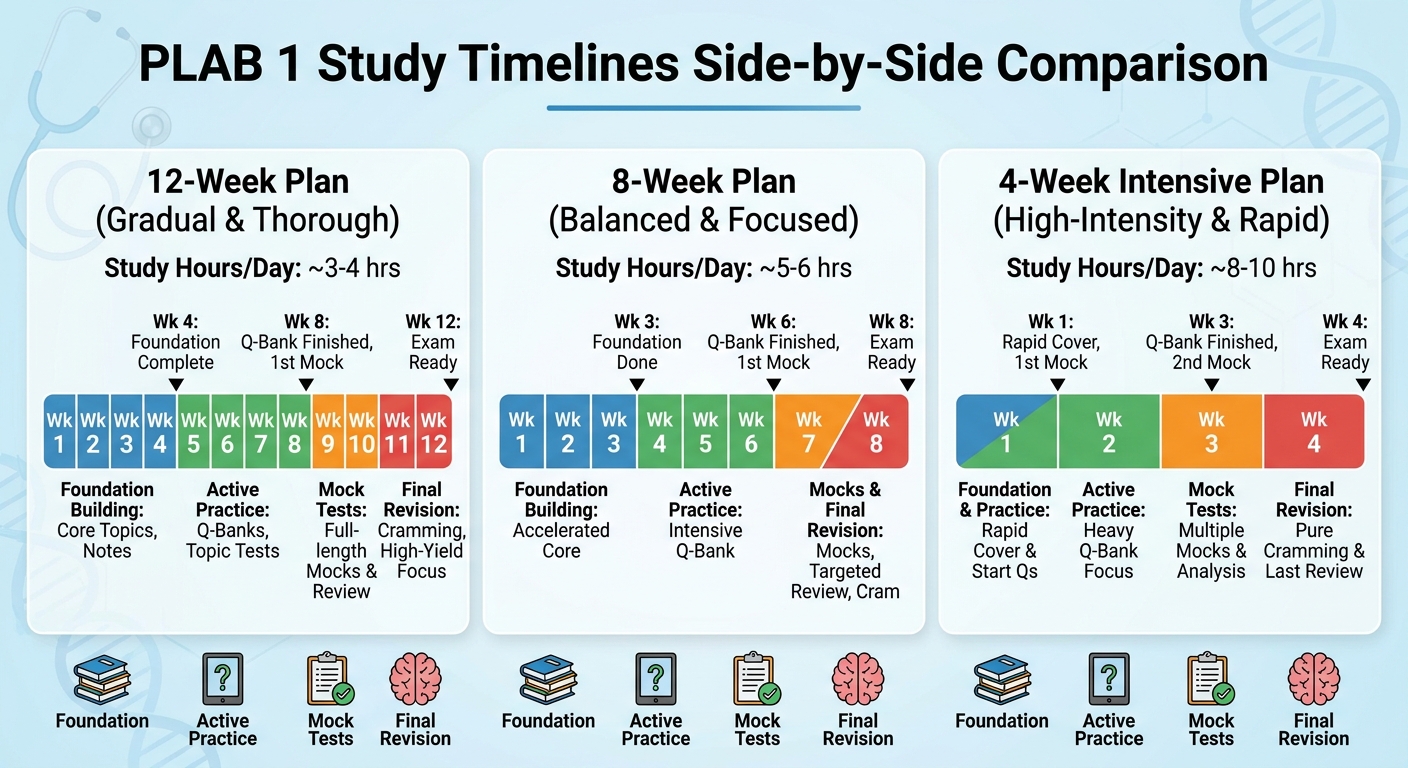
12-Week Plan (Recommended)
Best for: Working doctors, first-time candidates, or those scoring <120 on initial diagnostic- Weeks 1-4: Foundation building and diagnostic assessment
- Weeks 5-8: Intensive question practice and pattern recognition
- Weeks 9-11: Mock tests and targeted weak-area drilling
- Week 12: Final review and consolidation
8-Week Plan (Intensive)
Best for: Full-time study candidates or those with strong baseline knowledge- Weeks 1-2: Rapid system review with immediate question exposure
- Weeks 3-5: High-volume question practice (100+ daily)
- Weeks 6-7: Mock test intensive with focused remediation
- Week 8: Final polish and confidence building
4-Week Plan (Last Resort)
Best for: Emergency situations only - not recommended as first choice- Week 1: Diagnostic assessment and high-yield topic identification
- Weeks 2-3: Question marathon with immediate error review
- Week 4: Mock tests and final weak-area drilling
The 3-Phase PLAB 1 System
Phase 1: Foundation and Diagnostic (Weeks 1-4 of 12-week plan)
Goal: Establish baseline performance and identify major knowledge gaps Daily Structure:- Morning (2 hours): System-based review using UK Medical PG lessons
- Afternoon (2 hours): 50 timed PLAB-style questions
- Evening (1 hour): Review incorrect answers with UK guideline verification
- Monday-Tuesday: Cardiorespiratory medicine and emergencies
- Wednesday-Thursday: Gastroenterology and endocrinology
- Friday: Mental health and psychiatry
- Saturday: Obstetrics, gynaecology, and pediatrics
- Sunday: Ethics, prescribing, and patient safety
Phase 2: Active Practice and Pattern Recognition (Weeks 5-8)
Goal: Build speed, accuracy, and UK-specific clinical reasoning Daily Structure:- Morning (1.5 hours): 75 mixed questions in timed blocks
- Afternoon (2 hours): Targeted practice in weakest 2-3 areas
- Evening (1 hour): Spaced repetition using flashcards and error log review
- Week 5: Focus on medicine and surgery (60% of exam weight)
- Week 6: Emergency care and acute presentations
- Week 7: Primary care, ethics, and prescribing
- Week 8: Pediatrics, obstetrics, and mental health
- Week 5: 400 questions (diagnostic focus)
- Week 6: 500 questions (management focus)
- Week 7: 500 questions (ethical/primary care focus)
- Week 8: 400 questions (mixed specialty review)
Phase 3: Exam Simulation and Final Polish (Weeks 9-12)
Goal: Build exam stamina and eliminate remaining weak spots Schedule:- 3 full mocks per week (Monday, Wednesday, Friday)
- Tuesday/Thursday: Targeted drilling of mock test weak areas
- Weekend: One full mock + comprehensive review
| Week | Mock Focus | Review Time |
|---|---|---|
| Week 9 | Baseline simulation | 4 hours per mock |
| Week 10 | Speed and pacing | 3 hours per mock |
| Week 11 | Weak area validation | 3 hours per mock |
| Week 12 | Confidence building | 2 hours per mock |
The PLAB 1 Mock Test Framework
Most candidates waste mock tests by focusing only on their score. The score tells you where you are — the systematic review tells you how to improve.
Before Each Mock
1. Simulate exact conditions: 180 questions, 180 minutes, no interruptions 2. Use computer-based format — never paper-based practice for PLAB 1 3. Start at 9 AM — many PLAB 1 sessions begin in the morningDuring Each Mock
Two-pass strategy:- First pass: Answer every question you're confident about (aim for 150-160 questions)
- Flag and skip questions requiring lengthy deliberation
- Second pass: Return to flagged questions with remaining time
- 45 seconds per straightforward question
- 90 seconds per complex scenario
- No more than 2 minutes on any single question
After Each Mock (Most Important Part)
Immediate Review (60 minutes): 1. Score by clinical area using GMC domains 2. Identify your 3 worst areas for next-day drilling 3. Flag questions you guessed correctly — these are knowledge gaps disguised as lucky wins Deep Review (2-3 hours): For every incorrect answer, ask these 4 questions: 1. Did I miss the diagnosis? (Pattern recognition issue) 2. Did I know the diagnosis but choose wrong management? (UK guideline gap) 3. Did I misread the question stem? (Reading/pacing issue) 4. Was I trapped by a distractor? (Test-taking technique) Weak Area Analytics: Oncourse's performance tracking shows you exactly which question types and clinical scenarios consistently trip you up. Use the accuracy and topic filters to generate targeted practice sessions — if you're missing 60% of cardiology questions, spend the next morning doing 50 cardiology questions before touching anything else. Converting Mistakes to Memory: Turn every wrong answer into an active recall opportunity. When you miss a question about NICE diabetes guidelines, dont just read the explanation. Create a flashcard: "T2DM patient, HbA1c 8.5% on metformin alone → next step?" Use the Synapses game to practice these high-yield facts through spaced repetition rather than hoping you'll remember them during cramming sessions.Subject-Specific Weekly Rotation
PLAB 1 questions distribute across 10 clinical areas, but they're not equally weighted. Focus your weekly rotation on high-impact domains:
Week-by-Week Subject Focus
Week 1-2: Internal Medicine (25% of exam)- Cardiology: acute coronary syndromes, heart failure, arrhythmias
- Respiratory: asthma, COPD, pneumonia management per BTS guidelines
- Practice focus: Medicine core systems questions
- Resuscitation protocols per UK Resuscitation Council
- Major trauma and burns management
- Poisoning and overdose protocols
- Use Emergency acute care lessons
- Pre/post-operative care
- Common surgical emergencies
- Minor procedures and wound care
- NICE guidelines for diabetes, hypertension, COPD
- Screening programs and health promotion
- Practice with chronic disease management questions
- Antenatal and postnatal care
- Emergency obstetrics
- Gynaecological conditions and contraception
- Child safeguarding protocols (high-yield for UK practice)
- Common childhood illnesses
- Growth and development milestones
- Review Child health lessons
- Mental Capacity Act and consent issues
- Depression and anxiety management per NICE
- Suicide risk assessment
- Use Mental health resources
Daily Study Blocks for Working Doctors
If you're preparing while working clinical shifts, your study plan needs to account for variable energy levels and irregular schedules.
Pre-Shift Days (High Energy)
5-6 hours available:- 06:00-08:00: 100 timed questions + immediate review
- 20:00-22:00: Weak area drilling (50 questions)
- 22:00-23:00: Flashcard review and error log
Post-Shift Days (Moderate Energy)
2-3 hours available:- 30 minutes after shift: Light review of previous day's errors
- Evening: 50 targeted questions in weakest area
- Before bed: 15-minute flashcard session
Off Days (Maximum Productivity)
8+ hours available:- 09:00-12:00: Full 180-question mock test
- 14:00-17:00: Comprehensive mock review + weak area drilling
- 19:00-21:00: System-based learning + practice questions
What to Do When Scores Plateau
Every PLAB 1 candidate hits a plateau around weeks 6-8. You'll feel stuck at the same score range despite increasing practice volume. This is normal and fixable.
Plateau-Breaking Strategies
1. Micro-Analysis of Errors Instead of reviewing by clinical specialty, analyze by error type:- Stem misreading: Practice reading questions twice before looking at options
- Guideline gaps: Spend 2 days exclusively on NICE/BNF quick reference guides
- Time pressure mistakes: Do 20-question speed rounds (10 minutes total)
- Overthinking: Practice elimination technique — cross out obviously wrong answers first
Final Week Strategy
7 Days Before: Stop learning new content. Focus entirely on consolidation. Daily Schedule (Final Week):- Morning: One 90-question mock (90 minutes)
- Afternoon: Review mock + drill worst-performing area (50 questions)
- Evening: Error log review + high-yield flashcards
- One final full mock to calibrate confidence
- Review your error log from the past 4 weeks
- Organize quick-reference sheets for drug dosages and emergency protocols
- No new questions
- Light review of your personal weak-area summary
- Normal sleep schedule and meal times
- Prepare exam day logistics (location, transport, documents)
- Arrive 30 minutes early
- Bring photo ID and confirmation email
- Use provided earplugs to block distractions
- Trust your preparation — second-guessing costs more marks than confident wrong answers
Frequently Asked Questions
How many questions should I do per day during peak preparation?
Target 100-150 questions daily during weeks 5-8. Quality of review matters more than raw volume — 50 thoroughly reviewed questions beats 200 rushed attempts.When should I start taking full-length mocks?
Begin full 180-question mocks around week 6-7. Earlier mocks waste time when your knowledge base is still building. Later mocks dont allow enough time for improvement.What should I do if Im consistently scoring below 100/180?
Extend your preparation timeline. A score below 100 indicates significant knowledge gaps that need systematic filling, not just practice optimization. Consider pushing your exam date by 4-6 weeks.Should I memorize drug dosages and calculations?
Focus on commonly tested dosages (paracetamol, insulin, common antibiotics) and calculation formulas (eGFR, BMI, fluid requirements). Memorize frequently appearing values rather than comprehensive drug lists.How do I handle questions on topics I've never studied?
Use elimination technique aggressively. PLAB 1 questions typically have 1-2 obviously wrong answers, leaving you to choose between 2-3 plausible options. UK guideline knowledge usually points to the safest, most conservative answer.What's the difference between PLAB 1 and UKMLA preparation?
Content overlap is substantial — both test MLA-aligned clinical knowledge. PLAB 1 focuses more on IMG-specific scenarios (recognition of UK healthcare system), while UKMLA emphasizes foundation-level decision making. Your UKMLA AKT preparation translates directly to PLAB 1 success.Beyond PLAB 1: Building Your UK Medical Career
Passing PLAB 1 opens the door to PLAB 2 and GMC registration, but the learning mindset you develop here extends throughout your UK medical career. The systematic approach to weak-area identification, spaced repetition for complex protocols, and UK guideline prioritization becomes essential for specialty training and ongoing professional development.
The question-based learning methodology you perfect during PLAB 1 preparation — immediate error analysis, pattern recognition, and guideline-anchored decision making — mirrors exactly what excellent UK doctors do daily. You're not just memorizing for an exam; you're building the clinical reasoning skills that UK medicine demands.
Prepare smarter with Oncourse AI — adaptive MCQs, spaced repetition, and AI explanations built for PLAB 1 and UK medical licensing. Download free on Android and iOS.