NEET PG Question Bank Strategy: How to Practice PYQs, Mocks, and Weak Areas in 2026
Master NEET PG 2026 with a strategic question bank approach. Learn how to split practice between PYQs, mocks, and weak areas using the 3-bucket review system for maximum score improvement.

NEET PG Question Bank Strategy: How to Practice PYQs, Mocks, and Weak Areas in 2026
You probably have 4-5 question banks bookmarked, 2,000+ questions "completed" in your dashboard, and mock scores that seem stuck around the same percentile. Here's the thing: most NEET PG aspirants treat question banks like Netflix – they binge random questions without a system, hoping volume will magically translate to marks.
It wont.
NEET PG 2026 has 200 questions in 210 minutes. That's 63 seconds per question – including the time you spend reading, eliminating, and marking. The difference between a 50th percentile and 95th percentile candidate isnt how many questions they've solved. Its how systematically they've converted mistakes into fixed knowledge gaps.
This isnt about finding the "best" question bank. Its about turning whatever question bank you have into a precision instrument that identifies exactly what you dont know, when to practice it, and how to never miss it again.
Why Your Question Bank Needs a System (Not Random Solving)
Most students open their question bank, filter by "all subjects," and start solving. Three hours later, they've answered 80 questions, checked the explanations for wrong ones, and moved on. This approach fails because:
Random practice creates random improvement. Your brain learns patterns when you practice with intent. Jumping between Pharmacology, Anatomy, and Surgery within the same session dilutes focus and prevents deep learning. You're not addressing the root cause of mistakes. When you miss a Pharmacology question about ACE inhibitors, the issue might be conceptual (you dont understand the mechanism), recall-based (you forgot the side effects), or technique-based (you misread "contraindication" as "indication"). Each type of gap needs a different fix. Mock test preparation stays disconnected from daily practice. Students treat mocks as separate entities, not as data sources that should directly inform their next study session.
The solution is a four-pillar system that splits your question bank practice into focused blocks: PYQs, mixed timed blocks, subject-specific drills, and weak-area targeted practice.
How to Split Your Practice: The 4-Block System
Block 1: PYQ-Focused Sessions (40% of total practice time)
Previous year questions from NEET PG 2020-2025 should form the backbone of your practice. Research from the National Board of Examinations pattern analysis shows approximately 30% of current exam questions are direct repeats or close variations of previous years.
Daily PYQ structure:
Morning block (30-40 minutes): 25-30 PYQs from a single subject
Evening block (30-40 minutes): Mixed PYQs across 3-4 subjects
Start with subject-wise PYQ blocks to identify knowledge gaps, then move to mixed sessions for pattern recognition. Dont solve PYQs chronologically (2020, then 2021, then 2022). Instead, mix years within each session to prevent memorization of question sequences.
Block 2: Mixed Timed Blocks (30% of practice time)
These simulate actual exam conditions: 50 questions in 52 minutes (slightly faster than exam pace to build speed). Mix all 19 NEET PG subjects randomly.
Purpose: Time management, option elimination, and handling pressure. Use these sessions to practice your two-pass strategy: first pass for confident answers, second pass for educated guesses.
When working through mixed blocks, I recommend using Oncourse AI's analytics to track your per-subject accuracy and time distribution – this data directly feeds into your weak-area practice planning.
Block 3: Subject-Specific Drills (20% of practice time)
Deep-dive sessions on single subjects: 40-50 questions from Pharmacology only, or Anatomy only. These build subject-specific pattern recognition and help you notice recurring themes within each discipline.
High-yield subjects for focused drills: Pharmacology, Pathology, Internal Medicine, Surgery, and Anatomy typically contribute 60-65% of total marks. Dedicate 70% of your drill time to these five.
Block 4: Weak-Area Targeted Practice (10% of practice time)
This is where mock test analysis feeds back into daily practice. After every mock, identify your 3-4 weakest topics and create focused question sets targeting only those areas.
Example: If your last mock showed poor performance in "Cardiovascular Pharmacology" and "Respiratory Medicine," your next weak-area session should include 20-25 questions specifically from these topics.
The 3-Bucket Review System: How to Analyze Every Question
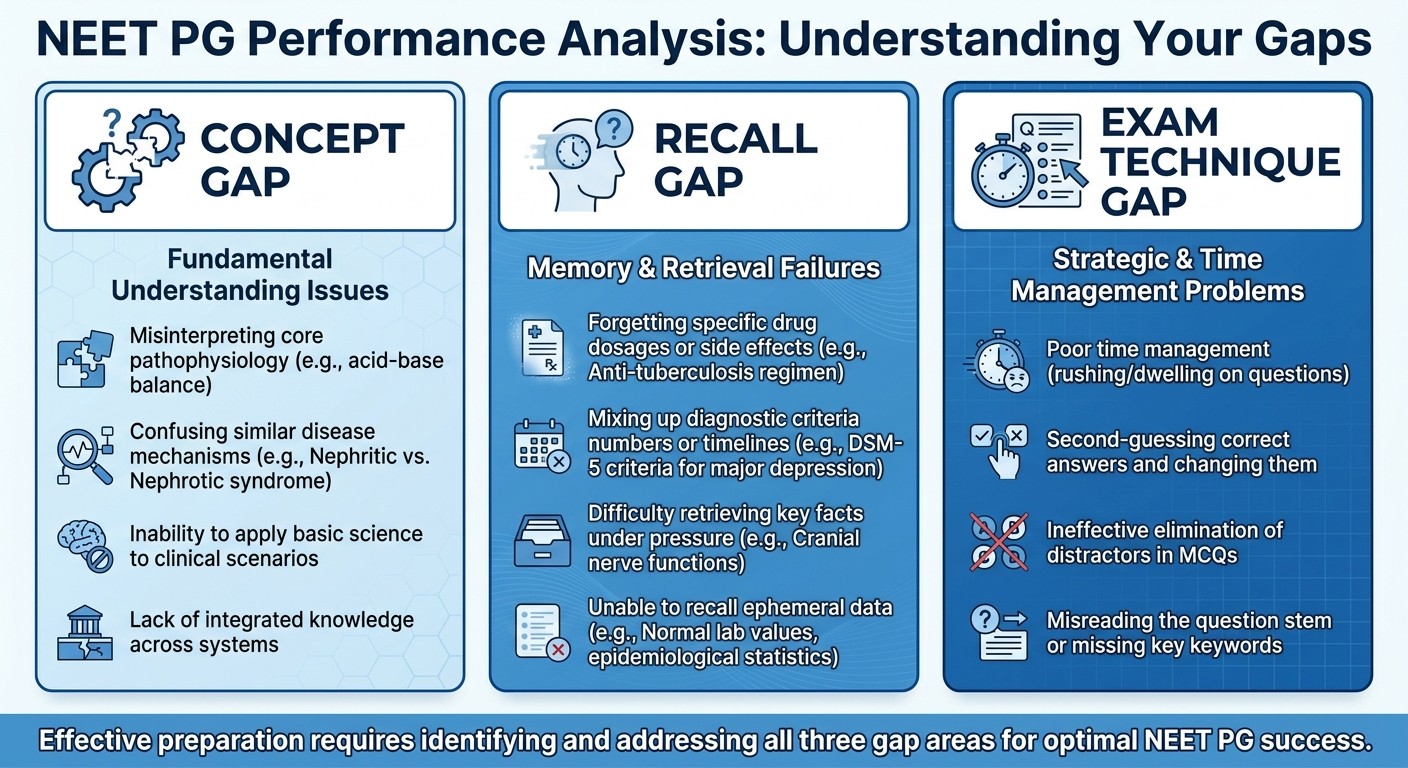
Every question you get wrong (and some you get right by guessing) should be categorized into one of three buckets. Each bucket requires different remediation:
Bucket 1: Concept Gap
You dont understand the underlying mechanism, pathway, or principle.
Example: Missing a question about ACE inhibitor mechanism of action because you never learned how the renin-angiotensin system works. Fix: Go back to your textbook or NEET PG Pharmacology lessons for conceptual clarity. Dont move forward until the mechanism is crystal clear.
Bucket 2: Recall Gap
You know the concept but couldnt retrieve the specific fact under time pressure.
Example: You understand diabetes management but forgot that HbA1c target is <7% for most adults with diabetes. Fix: Active recall practice. Use flashcards for these fact-based gaps. Create mnemonics. The key is spaced repetition – review this fact again in 3 days, then 1 week, then 2 weeks.
Bucket 3: Exam Technique Gap
You knew the answer but made a preventable mistake: misreading the question, falling for a distractor, or running out of time.
Example: Choosing "contraindicated" instead of "indicated" because you read too quickly, or spending 4 minutes on a tough question and rushing through the next five. Fix: Process improvements, not content review. Practice elimination strategies, slow down your reading, or adjust your time allocation per question.
Most students only focus on Bucket 1 (concept gaps) and ignore Buckets 2 and 3. This is why they plateau – they keep learning new concepts but dont fix their recall or technique issues.
For deeper analysis of your mistake patterns, Rezzy (Oncourse AI's tutor) can help you understand exactly why each incorrect option was wrong, not just why the correct option was right. This builds stronger elimination skills for future questions.
Using Mock Tests to Update Your Question Bank Plan
Mocks are diagnostic tools that should directly reshape your question bank strategy. Here's the 48-hour post-mock workflow:
Immediate analysis (Day 0 - within 4 hours of the mock):
1. Weak Topic Hit List: Identify your 5-8 worst-performing topics 2. Time distribution review: Which subjects ate too much time? 3. Mistake classification: Sort errors into the 3 buckets
Next-day action (Day 1):
1. Targeted drill: 30-40 questions on your weakest topic from the mock 2. Concept gaps: Address one conceptual gap identified from the mock 3. Update practice split: If the mock showed poor Pharmacology performance, increase Pharmacology's share in your next week's practice
Integration phase (Day 2):
Review the explanations for all questions from that topic, then test yourself with 10 fresh questions to confirm the gap is closing.
This approach ensures every mock directly improves your question bank preparation instead of just giving you a score to feel good or bad about.
Strategic Timeline: Last 90-60-30-14-7 Day Question Bank Approach
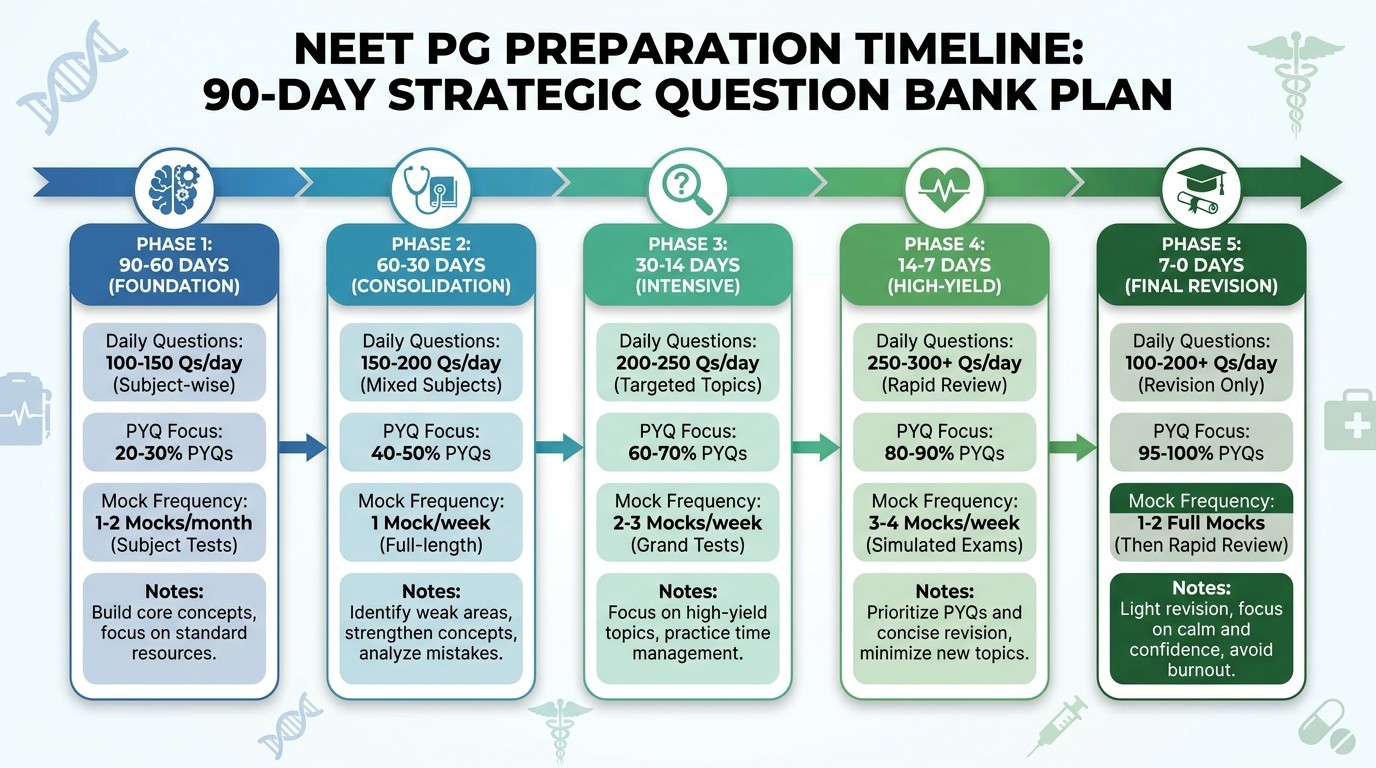
Your question bank strategy should evolve as exam day approaches:
90 days before exam:
Volume: 100-120 questions/day
Split: 50% PYQs, 30% mixed blocks, 20% subject drills
Focus: Building accuracy and identifying major knowledge gaps
60 days before exam:
Volume: 120-150 questions/day
Split: 60% PYQs, 25% mixed blocks, 15% weak areas
Focus: Pattern recognition and mock test integration
30 days before exam:
Volume: 100-120 questions/day
Split: 70% PYQs, 20% weak areas, 10% high-confidence review
Focus: Reinforcing strengths and rapid weak-area improvement
14 days before exam:
Volume: 80-100 questions/day
Split: 80% previously incorrect questions, 20% PYQs
Focus: Converting previous mistakes into strengths
7 days before exam:
Volume: 50-60 questions/day
Split: 90% confidence-building questions, 10% quick weak-area touch-ups
Focus: Mental readiness and preventing new mistakes
During these final phases, Oncourse's Daily Plan becomes crucial – it automatically routes your identified weak areas into focused practice sessions, removing the guesswork about what to study next.
Common Question Bank Mistakes That Kill Your Progress
Mistake 1: Chasing Volume Over Analysis
Solving 200 questions quickly feels productive, but spending 3 hours analyzing 50 questions builds more knowledge. Most toppers solve fewer total questions but analyze each one thoroughly.
Mistake 2: Memorizing Explanations Instead of Understanding Concepts
Reading "ACE inhibitors cause hyperkalemia" 15 times doesnt help unless you understand why potassium levels rise when aldosterone decreases. Seek mechanistic understanding, not rote memorization.
Mistake 3: Ignoring Incorrect Options
NEET PG questions often test your ability to eliminate wrong choices. If Option B is incorrect, understand why its wrong – that knowledge prevents future mistakes.
Mistake 4: Not Revisiting Previously Missed Questions
Your brain forgets 70% of new information within 24 hours unless you review it. Questions you got wrong last week should reappear in this week's practice to ensure the fix has stuck.
Mistake 5: Practicing in Comfort Zone
If your Pharmacology accuracy is 85%, dont spend more time on Pharmacology questions. Focus on subjects where you're scoring 60-70% – those have more room for improvement.
Mistake 6: Separating Question Bank Practice from Mock Analysis
Many students solve questions in the morning and take mocks in the evening without connecting the two. Your question bank should be informed by mock results, and mock performance should reflect question bank improvements.
Daily Execution: Making the System Work
The best question bank strategy fails without consistent daily execution. Here's how to implement this systematically:
Morning routine (45-60 minutes):
25-30 PYQs from your target subject
Immediate review using the 3-bucket system
Log weak topics in your Daily Plan for follow-up
Afternoon block (30 minutes):
Subject-specific drill or weak-area practice
Focus on yesterday's mock-identified gaps
Evening session (45 minutes):
Mixed timed block (50 questions in 52 minutes)
Practice elimination and time management
Use Explanation Chat to understand tricky concepts
This daily structure ensures youre practicing with purpose, not just accumulating question counts. The key insight: question banks are most effective when they identify what you dont know, not when they validate what you already know.
For weak-area identification and targeted practice recommendations, Oncourse AI's analytics automatically track your performance patterns across topics and suggest specific areas that need attention – turning data into actionable study plans.
Frequently Asked Questions
How many questions should I solve daily for NEET PG 2026?
Start with 80-100 questions daily and gradually increase to 120-150 questions as you approach the final 60 days. Quality of analysis matters more than raw volume – 50 thoroughly analyzed questions build more knowledge than 150 questions solved and forgotten.
Should I solve PYQs multiple times?
Yes, but strategically. Questions you got wrong the first time should be revisited after 3 days, 1 week, and 2 weeks to ensure the knowledge sticks. Questions you got right on first attempt need less frequent review.
How do I balance question bank practice with textbook reading?
Use a 70-30 split: 70% active question practice, 30% concept building from books. When you identify concept gaps through questions, immediately refer to standard textbooks for deeper understanding, then return to questions to test retention.
Is it better to solve subject-wise or mixed questions?
Both have roles. Subject-wise practice builds deep pattern recognition within each discipline. Mixed practice simulates exam conditions and improves your ability to context-switch quickly. Use 60% mixed, 40% subject-wise in your final preparation phase.
How many mock tests should I take in the last 2 months?
Take 2-3 mocks per week, but spend 2-3 hours analyzing each mock. The analysis matters more than the frequency. Each mock should directly inform your next week's question bank practice priorities.
What should I do if my mock scores keep fluctuating?
Fluctuating scores usually indicate inconsistent weak areas rather than overall preparation issues. Use our NEET PG mock test analysis strategy to identify and systematically address these inconsistencies through targeted question bank practice.
Transform Your Question Bank Into Your Strongest Tool
The difference between students who clear NEET PG and those who dont rarely comes down to intelligence or even total study hours. It comes down to systematic practice that converts every mistake into permanent knowledge.
Your question bank isnt just a practice tool – its a diagnostic instrument that should guide every hour of your preparation. When used with the 4-block system, 3-bucket analysis, and strategic timeline approach, it becomes your most reliable predictor of exam day performance.
Most importantly, remember that question banks work best when they're part of an integrated study system. Use them to identify gaps, address those gaps through focused study, then validate improvement through repeated practice.
Prepare smarter with Oncourse AI – adaptive MCQs, spaced repetition, and AI explanations built for NEET PG. Download free on Android and iOS.