INICET Subject-Wise Preparation: High-Yield Topics, PYQs and Weak Areas
Master INICET with systematic subject-wise preparation. Get high-yield topics for Medicine, Surgery, OBGYN, Pathology, strategic PYQ analysis, and mock error repair systems that convert mistakes into targeted improvement.

INICET Subject-Wise Preparation: High-Yield Topics, PYQs and Weak Areas
You're staring at 18 subjects. 200 questions. 180 minutes. The INICET pattern isnt just about knowing everything—it's about knowing what matters most, when it appears, and how to fix what breaks under pressure.
After analyzing 5 years of INICET papers and tracking topper strategies, here's what actually works: subject-wise prioritisation that matches question weightage, PYQ review that builds patterns (not memorization), and a systematic weak-area repair loop that converts mock mistakes into targeted topic blocks.
This isn't another generic "study everything equally" guide. This is the practical subject-by-subject system that gets you from scattered preparation to strategic scoring.
INICET Subject Weightage: The Reality Check
INICET isnt democratically distributed across subjects. Some subjects carry 20+ questions. Others barely scrape 5-8. Your time allocation should mirror this reality, not your comfort zones.
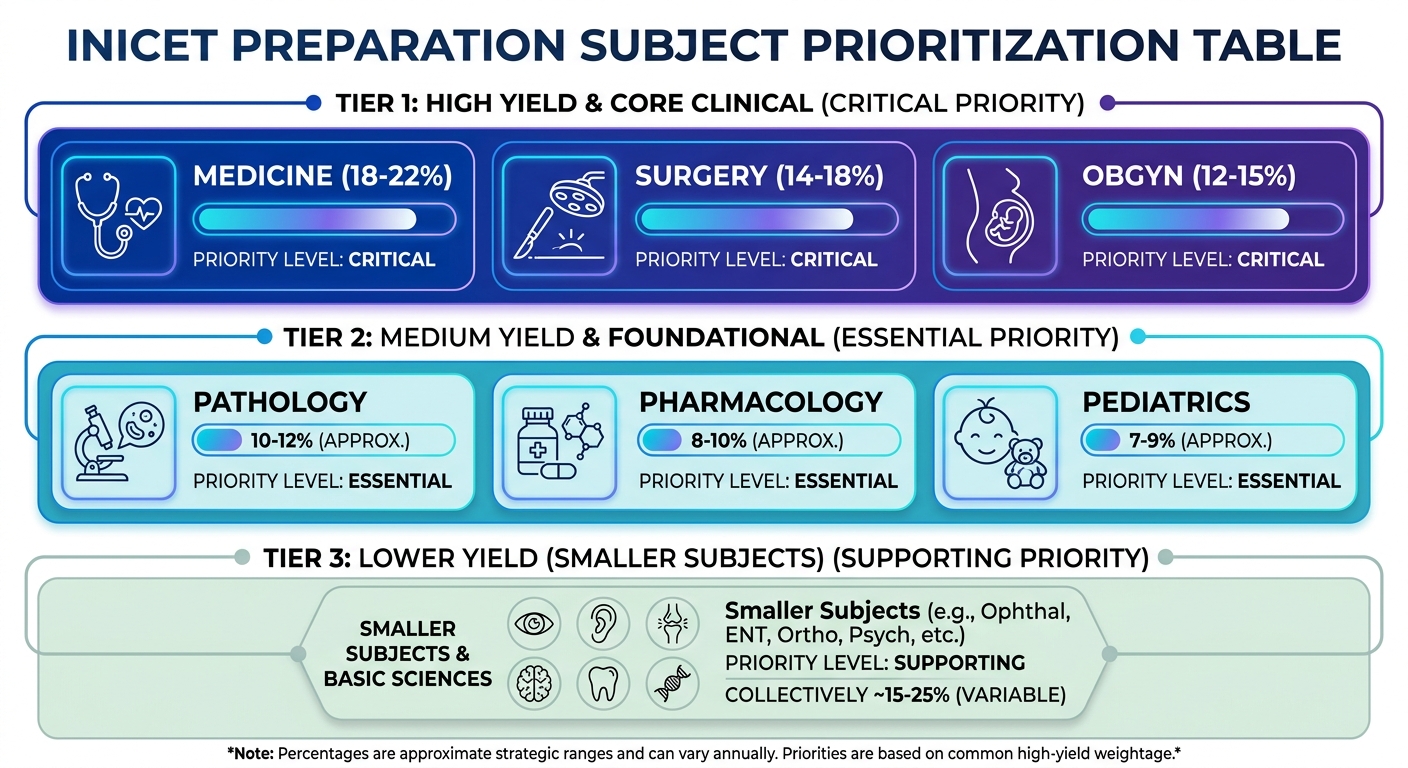
Tier 1: The Heavy Hitters (55-60% of paper)
Medicine (18-25 questions)- Cardiology: ECG interpretation, heart failure protocols, acute coronary syndromes
- Endocrinology: Diabetes complications, thyroid emergencies, adrenal disorders
- Neurology: Stroke management, seizure algorithms, movement disorders
- Nephrology: CKD staging, glomerulonephritis, dialysis indications
- Pulmonology: COPD vs asthma differentials, pleural effusion workup
- GI Surgery: Appendicitis variants, bowel obstruction, GI bleeding
- Trauma: ATLS protocols, damage control surgery, abdominal trauma
- Hepatobiliary: Gallstone complications, jaundice workup, portal hypertension
- Urology: BPH management, renal masses, urological emergencies
- Breast & Thyroid: Cancer staging, surgical complications
- Obstetrics: Preeclampsia/HELLP, antepartum hemorrhage, labor dystocia
- Gynecology: Cancer screening, contraception, infertility workup
- Emergency scenarios: Postpartum hemorrhage, ectopic pregnancy
Tier 2: The Consistent Contributors (25-30% of paper)
Pathology (10-15 questions)- Neoplasia: Tumor markers, staging systems, paraneoplastic syndromes
- Hematopathology: Anemia classification, coagulation disorders, leukemia
- Systemic pathology: Organ-specific disease patterns
- Drug mechanisms: MOA-based questions, drug interactions
- Adverse effects: Particularly in special populations (pregnancy, elderly)
- Antimicrobials: First-line choices, resistance patterns
- Neonatology: Birth asphyxia, neonatal infections, feeding issues
- Growth & Development: Milestones, failure to thrive, developmental delays
- Immunizations: Schedule updates, contraindications, adverse effects
Tier 3: The Tactical Subjects (15-20% of paper)
Short Subjects (5-8 questions each): PSM, Microbiology, Biochemistry, Anatomy, Physiology, Radiology, Dermatology, Ophthalmology, ENT, Orthopedics, Psychiatry, FMTThese need focused, high-yield coverage—not comprehensive deep-dives.
High-Yield Topic Breakdown by Subject
Medicine: Clinical Decision Making
Medicine questions in INICET test your ability to think through cases, not regurgitate textbook facts. Focus on:
Cardiology High-Yield- ECG interpretation: STEMI patterns, arrhythmia recognition, axis deviation
- Heart failure: NYHA staging, diuretic management, device therapy indications
- Valvular disease: Murmur characteristics, surgical timing, anticoagulation
- Diabetic emergencies: DKA vs HHS differentiation, management protocols
- Thyroid storms: Recognition, immediate management, drug dosing
- Adrenal crisis: Triggers, steroid dosing, fluid management
- Acute stroke: tPA eligibility, time windows, contraindications
- Status epilepticus: Drug sequences, refractory management
- Meningitis: CSF analysis patterns, antibiotic choices
Surgery: Pattern Recognition + Management
Surgery in INICET emphasizes recognizing clinical patterns and choosing appropriate management steps.
GI Surgery High-Yield- Acute abdomen: Pain patterns, imaging choices, surgical indications
- Gastrointestinal bleeding: Upper vs lower, endoscopic vs surgical management
- Bowel obstruction: Small vs large bowel, conservative vs operative timing
- Primary survey: ABCDE systematic approach, resuscitation priorities
- Damage control: When to stop, what to pack, ICU vs OR decisions
- Specific injuries: Splenic grading, liver injury management, pelvic fractures
- Acute scrotum: Testicular torsion vs epididymitis, time-sensitive decisions
- Renal trauma: CT grading, surgical vs conservative management
- Stone disease: Location-based management, intervention indications
OBGYN: Emergency + Routine Care
OBGYN questions blend emergency scenarios with routine care protocols.
Obstetrics High-Yield- Hypertensive disorders: Preeclampsia criteria, severe features, delivery timing
- Bleeding disorders: Placenta previa vs abruption, management protocols
- Labor complications: Shoulder dystocia, cord prolapse, uterine rupture
- Abnormal bleeding: PALM-COEIN classification, workup algorithms
- Pelvic masses: Risk stratification, tumor markers, surgical planning
- Contraception: Method selection, contraindications, failure rates
Pathology: Core Concepts + Differentials
Pathology questions test fundamental concepts and your ability to differentiate similar conditions.
Neoplasia High-Yield- Tumor staging: TNM systems, prognostic factors
- Paraneoplastic syndromes: Recognition, associated malignancies
- Metastatic patterns: Common sites, imaging findings
- Anemia workup: MCV-based approach, peripheral smear findings
- Bleeding disorders: Platelet vs coagulation factor defects
- Leukemia classification: Morphology, cytochemistry, immunophenotyping
Pharmacology: Mechanisms + Clinical Applications
Pharmacology in INICET goes beyond memorizing drug names to understanding mechanisms and clinical applications.
High-Yield Drug Classes- Cardiovascular: ACE inhibitors, beta-blockers, diuretics (mechanisms, contraindications)
- Antimicrobials: First-line choices, resistance mechanisms, adverse effects
- CNS drugs: Antiepileptics, antidepressants, antipsychotics (side effect profiles)
PYQ Strategy: Patterns Over Memorization
About 30% of INICET questions are direct repeats or close variants from previous years. But the goal isnt memorizing answers—it's recognizing patterns.
The Right Way to Use PYQs
Pattern Analysis (Not Answer Banking)- Topic frequency: Which cardiology topics appear every year?
- Question formats: How are pharmacology mechanisms tested?
- Difficulty progression: Are recent years emphasizing deeper clinical reasoning?
- Cross-subject questions: Medicine + Pathology combinations
- Clinical vignettes: Multi-step diagnostic reasoning
- Image-based patterns: ECGs, X-rays, histopathology slides
- Week 1-4: Subject-wise PYQ analysis (identify high-frequency topics)
- Week 5-8: Integrated PYQ practice (cross-subject combinations)
- Week 9-12: Recent year focus (last 3 years, full-length format)
Converting PYQ Insights into Study Blocks
When you notice that "rheumatoid arthritis vs osteoarthritis" appears in 4 out of 6 recent papers:
1. Create a comparison table of differentiating features
2. Practice 10-15 related MCQs covering joint patterns, lab findings, imaging
3. Review associated complications and management differences
4. Link to related topics (other inflammatory arthritides)
This systematic approach—converting PYQ patterns into focused study blocks—prevents the common mistake of passive PYQ reading without concept reinforcement.
Mock Test Analysis: Your Weak-Area Radar
Mocks reveal gaps that silent reading never catches. But most students analyze mocks wrong—they focus on scores instead of patterns.
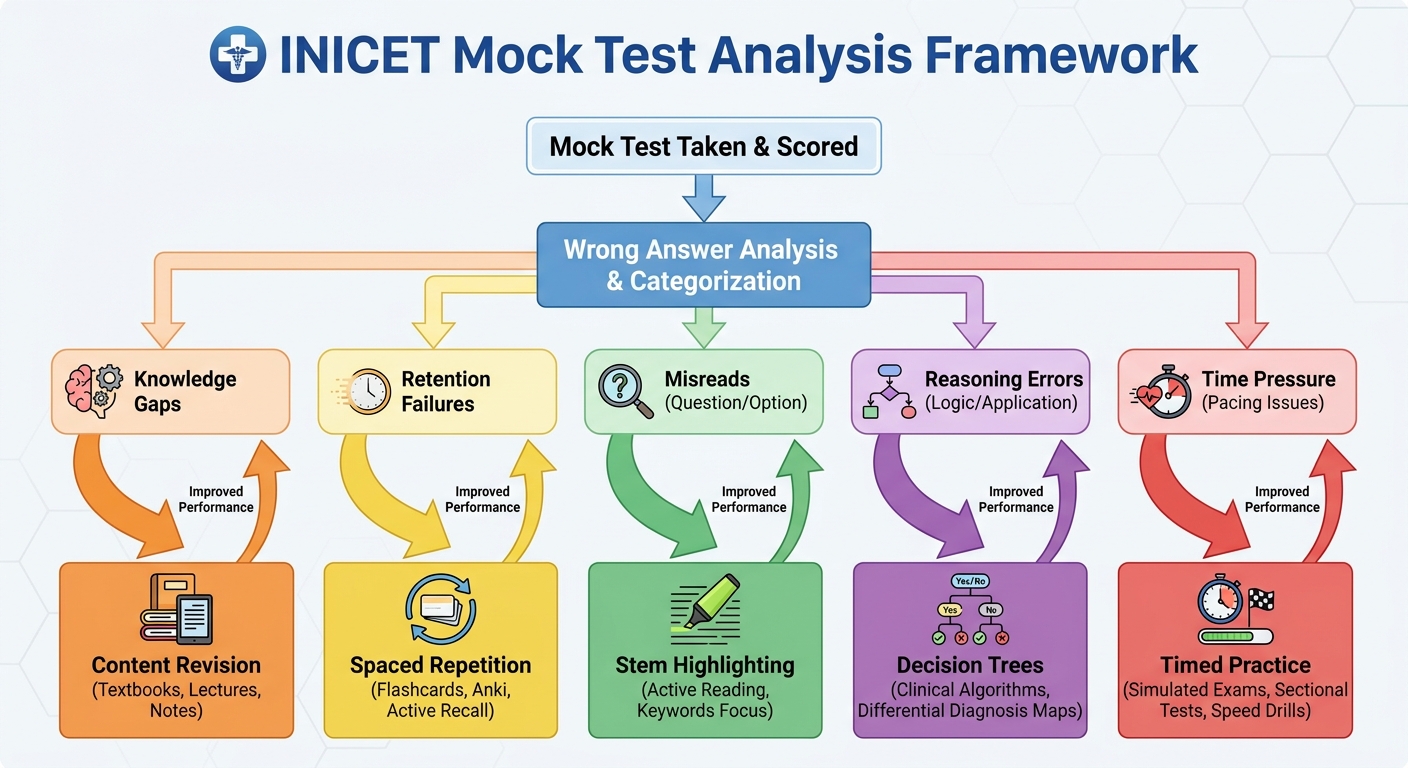
The 5-Category Error System
Every wrong answer fits one of these categories:
1. Knowledge Gaps (Never learned)- Example: Dont know the MOA of rituximab
- Fix: Targeted content revision, concept mapping
- Time allocation: 15-20 minutes per gap
- Example: Know the answer when reviewing, blank during test
- Fix: Spaced repetition, active recall practice
- Tool: Use flashcards for high-forgetting topics
- Example: Miss "NOT" in question stem, select opposite answer
- Fix: Stem highlighting practice, slow down on keywords
- Prevention: Circle qualifiers before reading options
- Example: Know individual facts but cant connect to reach diagnosis
- Fix: Decision tree practice, clinical reasoning frameworks
- Practice: Case-based MCQs with step-by-step explanations
- Example: Rush through complex calculation, make arithmetic mistakes
- Fix: Timed mini-tests, pacing strategies
- Target: 54 seconds per question average
Post-Mock Analysis Protocol
Within 24 hours: 1. Log every error with category classification 2. Identify the top 3 error-generating subjects 3. Note timing issues per section (INICET has 4 blocks of 45 minutes each) Within 48 hours: 1. Create targeted practice blocks for top error categories 2. Review related concepts for knowledge gaps 3. Practice similar question types for reasoning errors Weekly review: 1. Track error pattern changes over multiple mocks 2. Adjust subject time allocation based on persistent weak areas 3. Focus revision blocks on categories that arent improvingThis systematic review process automatically guides your weak-area repair—instead of vague "study more medicine," you get specific actions like "practice ECG rhythm interpretation under time pressure" or "review drug interaction mechanisms through spaced repetition."
Weekly Subject Rotation Strategy
With 18 subjects and limited time, you need a rotation that maintains high-yield focus while covering everything strategically.
Week 1-4: Foundation Phase
Daily Target: 60-80 MCQs (40 new + 20-40 revision) Monday/Tuesday: Medicine (Cardiology, Endocrinology focus) Wednesday: Surgery (GI, Trauma focus) Thursday: OBGYN + Pediatrics Friday: Pathology + Pharmacology Saturday: Short subjects rotation (2-3 subjects) Sunday: PYQ analysis + weak topic repairWeek 5-8: Integration Phase
Daily Target: 80-100 MCQs (50 new + 30-50 revision) Monday: Medicine + Pathology integration Tuesday: Surgery + Anatomy integration Wednesday: OBGYN + Pharmacology integration Thursday: Cross-subject clinical vignettes Friday: Image-based questions (all subjects) Saturday: Full-length mock (200 questions) Sunday: Mock analysis + targeted revisionWeek 9-12: Polishing Phase
Daily Target: 100+ MCQs (mostly revision + new high-yield) Monday-Thursday: Subject-wise weak area repair based on mock analysis Friday: Recent PYQs (2023-2025 focus) Saturday: Full-length mock under strict timing Sunday: Final weak-topic fixes + image practiceThe daily plan feature adapts this schedule based on your performance patterns—if your mocks consistently show cardiology errors, it automatically increases cardiology exposure during your designated medicine days until the pattern improves.
Converting Mock Mistakes into Subject Blocks
The biggest waste in INICET prep is doing 20 mocks but not converting errors into systematic learning. Here's how toppers turn every mistake into targeted improvement:
The Error-to-Study-Block System
Step 1: Immediate Classification (same day)- Log the exact topic and subtopic of each error
- Note whether it was knowledge gap, reasoning error, or misread
- Rate your confidence level when answering (high/medium/low)
- Group errors by subject and subtopic
- Identify recurring themes (e.g., "ECG interpretation errors" vs "cardiac pharmacology errors")
- Prioritize based on frequency + weightage of topic
- Create 25-30 question focused practice sessions around error themes
- Use a mix of similar MCQs + related concept questions
- Include both easy and challenging variants to build confidence + depth
- 8 ECG interpretation (different arrhythmias, MI patterns)
- 6 Heart failure (staging, drug choices, device indications)
- 4 Valve disease (murmur characteristics, surgical timing)
- 12 Related integration (cardiology + pharmacology, cardiology + pathology)
Subject-Specific Weak-Area Patterns
Medicine Weak Areas:- Complex diagnostic reasoning (multiple differential possibilities)
- Drug interactions and contraindications
- Emergency management protocols
- Surgical timing decisions (conservative vs operative)
- Trauma priority sequences (ABCDE application)
- Anatomy-surgery integration (approaches, complications)
- Differentiating similar morphologies
- Integrating gross and microscopic findings
- Clinical correlation with pathological processes
- Mechanism-based prediction of side effects
- Drug selection in special populations
- Interaction prediction and management
Balancing Volatile vs Scoring Subjects
INICET has subjects that swing wildly in difficulty (Medicine, Surgery) and subjects that consistently offer scoring opportunities (Pharmacology, Pathology). Your strategy should balance both.
Volatile Subjects (Medicine, Surgery, OBGYN)
These can give you 15+ correct or 8-10 correct depending on the paper's focus. Strategy:- Build strong fundamentals in high-frequency topics
- Practice clinical reasoning frameworks
- Don't chase every rare condition—focus on common presentations
- Use PYQ analysis to identify recurring clinical scenarios
Scoring Subjects (Pharmacology, Pathology, Microbiology)
These subjects have more predictable question patterns and reward systematic preparation. Strategy:- Create comprehensive drug classification tables
- Practice comparative pathology (normal vs abnormal findings)
- Focus on high-yield microorganisms and their associations
- Use spaced repetition for fact-heavy content
Short Subjects (Anatomy, Physiology, Biochemistry, etc.)
These subjects collectively contribute 30-40 questions but individually carry lower weight. Strategy:- Focus on clinically relevant anatomy (surgical approaches, nerve pathways)
- Emphasize physiological principles that support clinical reasoning
- Cover high-yield biochemical pathways and clinical correlations
- Allocate time proportional to expected questions (not equal time)
Common INICET Preparation Mistakes to Avoid
After analyzing hundreds of mock performance patterns, these mistakes consistently separate average scores from top performers:
Strategy Mistakes
Equal Time Allocation- Wrong: Spending equal hours on all 18 subjects
- Right: Time allocation matching question weightage (Medicine 20%, Anatomy 5%)
- Wrong: Memorizing previous year answers without understanding patterns
- Right: Using PYQs to identify high-frequency topics and question formats
- Wrong: Focusing only on total correct answers
- Right: Analyzing error patterns and converting them to targeted study blocks
Execution Mistakes
Section Timing Mismanagement- Wrong: Practicing 200 questions in 180 minutes without section breaks
- Right: Practicing 4 blocks of 50 questions in 45 minutes each (no crossover)
- Wrong: Reading textbook chapters without active recall practice
- Right: Content review followed immediately by targeted MCQs
- Wrong: Attempting mixed-subject questions without strategic focus
- Right: Subject-wise focused blocks that reinforce specific weak areas
Review Mistakes
Superficial Error Analysis- Wrong: "I got surgery wrong, need to study more surgery"
- Right: "I missed 3 trauma priority questions due to ABCDE sequence confusion—need focused trauma algorithm practice"
- Wrong: Analyzing each mock in isolation
- Right: Tracking error themes across multiple mocks to identify persistent weak areas
- Wrong: Studying a topic once intensively, then moving on
- Right: Cycling back to weak areas with decreasing frequency as improvement occurs
Frequently Asked Questions
How many months should I dedicate to INICET subject-wise preparation?
Most successful candidates need 4-6 months of dedicated preparation. Start with 2 months of subject-wise foundation building, followed by 2 months of integration and mock analysis, and finish with 1-2 months of targeted weak-area repair and final revision.
Should I prioritize PYQs over standard question banks?
Use both strategically. PYQs help identify high-frequency topics and question patterns, while standard question banks provide broader concept coverage. Start with subject-wise question bank practice to build fundamentals, then layer in PYQ analysis to refine focus.
How do I balance clinical reasoning with factual recall for INICET?
INICET emphasizes clinical application over pure recall. For every factual topic, practice at least 2-3 clinical scenarios that apply that knowledge. Use case-based MCQs and clinical vignettes to build reasoning skills alongside content mastery.
What's the ideal number of mocks before INICET?
Quality beats quantity. Take 15-20 full-length mocks with thorough analysis rather than 50 rushed attempts. Focus on one mock every 3 days in the final month, spending 2-3 hours analyzing each mock's error patterns.
How do I handle subjects where I consistently perform poorly?
First, categorize your errors in those subjects (knowledge gaps vs reasoning vs misreads). If it's knowledge gaps, allocate extra daily time for concept revision. If it's reasoning errors, practice more clinical vignettes. If it's misreads, slow down and highlight key terms. Track improvement across multiple mocks rather than expecting immediate fixes.
Should I attempt all 200 questions in INICET?
No. With negative marking (-1/3), aim to attempt 175-185 questions with 75-80% accuracy rather than all 200 with lower accuracy. Use elimination strategies and attempt only when you can narrow down to 2-3 options with confidence.
---
Prepare smarter with Oncourse AI—adaptive MCQs, spaced repetition, and AI explanations built for INICET. Download free on Android and iOS.