Back
INICET Previous Year Questions: How to Turn PYQs Into Weak-Area Practice with Oncourse AI
Transform INICET PYQs from passive practice into targeted weak-area diagnosis. Learn systematic mistake analysis, pattern recognition strategies for 180+ scores.
INICET Previous Year Questions: How to Turn PYQs Into Weak-Area Practice with Oncourse AI
You have probably attempted INICET previous year questions and checked your score. 163/200. Not bad, but not where you need to be for AIIMS or JIPMER. You flip through the answer key, nod at the explanations, and move on to the next paper.
Thats exactly where most INICET aspirants go wrong.
The magic isnt in attempting more PYQs — its in turning each wrong answer into a precise weak-area diagnosis. INICET has 200 questions across 19 subjects in 180 minutes. With -1/3 for wrong answers, even 15 preventable mistakes can cost you 20+ marks and thousands of ranks.
The difference between scoring 160 and 180+ isnt studying harder. Its studying your mistakes smarter.
Why Most INICET PYQ Practice Fails
Most students treat previous year questions like practice tests: attempt, check score, feel good or bad, repeat. This passive approach misses the real value.
INICET PYQs contain every pattern you'll face on exam day. The 2023-2025 papers show a clear shift toward clinical reasoning, image-based questions, and integrated multi-subject scenarios. But these patterns only help if you can identify which ones consistently trip you up.
Consider this: you miss 40 questions across three mock papers. Are they scattered randomly, or do 15 of them cluster around pharmacology mechanisms? Are you missing easy recalls under time pressure, or failing to connect pathophysiology to clinical presentations?
Without systematic analysis, you're practicing blindly.
The Cold Attempt Method: Your Diagnostic Starting Point
Before diving into explanations, attempt each PYQ paper "cold" — exactly as you would on exam day. Set a timer for 180 minutes, no notes, no second-guessing. This creates your baseline weak-area map.
Why cold attempts matter:
Time pressure reveals different weaknesses than untimed practice
Your first instinct shows conceptual gaps vs knowledge gaps
Elimination patterns expose reasoning flaws you dont notice in casual review
After attempting cold, resist the urge to immediately check answers. Instead, mark confidence levels: "Sure," "Eliminate 2 options," "Complete guess." This tags questions where you got lucky vs questions where you actually knew the answer.
When reviewing, you'll discover that many "correct by luck" answers represent hidden weak areas worth addressing.
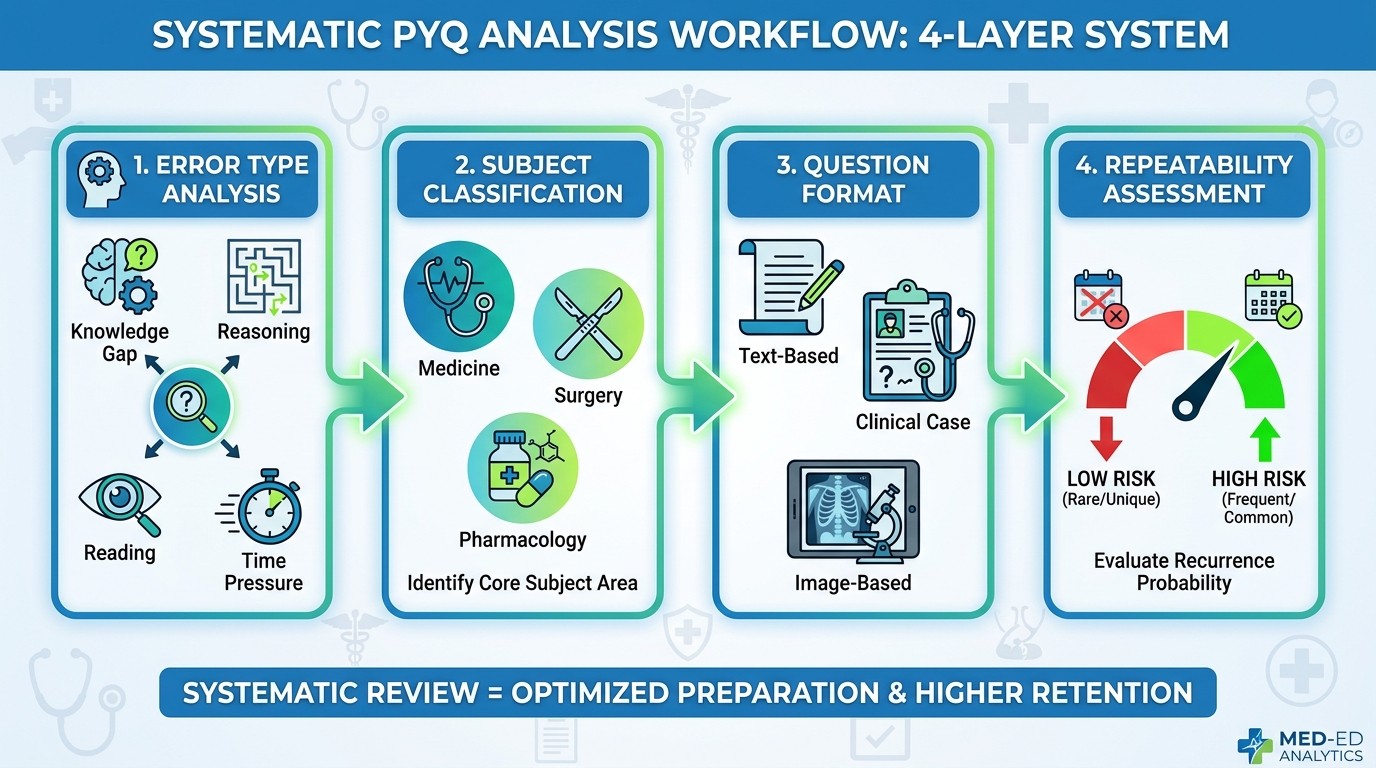
The 4-Layer Mistake Analysis System
Not all mistakes are created equal. A calculation error in enzyme kinetics requires different fixing than misunderstanding drug mechanisms. Use this 4-layer system to categorize every wrong answer:
Layer 1: Error Type
Knowledge gap: You simply didnt know the fact or concept
Reasoning error: You knew the components but connected them wrong
Reading mistake: You misread the question or missed a key qualifier
Time pressure slip: You knew it but rushed and picked wrong
Layer 2: Subject Classification
Tag each miss by major subject (Medicine, Surgery, Pharmacology, Pathology, etc.). After 3-4 papers, you'll see clear patterns. If 60% of your Pharmacology misses are mechanism-related, thats a targetable weak area.
Layer 3: Question Format
Direct recall: "Which drug inhibits ACE?"
Clinical application: "Patient with chest pain, hypertension, what medication?"
Image-based: Histology, radiology, clinical photos
Multi-step reasoning: Case scenarios requiring 2-3 logical connections
Layer 4: Repeatability Assessment
Most important: Could you get this wrong again under pressure? High-repeatability mistakes need immediate attention. Low-repeatability errors (careless slips) need process fixes, not content review.
The analysis reveals your true weak areas. Maybe you think you're weak in Surgery, but actually, you miss Surgery pharmacology questions — a much more specific target.
Subject-Wise vs Mixed Practice: When to Use Each
Subject-wise PYQ blocks work best for:
Initial weak-area identification (attempt all Pharmacology questions from 2021-2025)
Deep-diving specific gaps youve identified through mixed practice
Building confidence in weaker subjects before integrating them back
Start with 50-question subject blocks, untimed, focused purely on pattern recognition. Use Oncourse's INICET Pharmacology lessons to fill gaps as you discover them. Mixed PYQ practice works best for:
Final 4-6 weeks when you need exam-day simulation
Testing integrated reasoning across subjects
Building stamina for full-length attempts
Mixed practice exposes cross-subject reasoning patterns that subject blocks miss. The classic "Anatomy question disguised as Pathology" or "Pharmacology mechanism tested through clinical scenario."
Reading Explanations Like a Clinician, Not a Student
Most students read explanations to understand why the right answer is right. Clinicians read explanations to understand why they chose wrong. Big difference.
For each wrong answer, before reading the explanation, write down:
Why you picked your choice (what logic led you there?)
What information you ignored in the question stem
Which alternatives you eliminated and why
Now read the explanation with these questions:
1. Where did my reasoning break down? Was it a knowledge gap or faulty logic?
2. What pattern should I recognize next time? Clinical presentations, drug categories, pathophysiology connections
3. What similar questions might appear? How would they twist this concept differently?
When using Oncourse for PYQ practice, the explanation chat feature lets you dig deeper. Instead of accepting "ACE inhibitors reduce afterload," you can ask "Why does reducing afterload help this specific patient with this specific presentation?" These follow-up questions turn explanations into clinical reasoning practice.
High-Yield Pattern Recognition Without Overfitting
INICET loves repeating patterns with slight variations. The challenge is recognizing patterns without memorizing specific questions.
Pattern categories worth tracking: Drug Mechanism Patterns: Same mechanism, different drugs or applications
Example: If you miss how β-blockers work in heart failure, you'll likely miss calcium channel blockers in hypertension
Fix approach: Group mechanisms by physiological pathway, not by drug name
Clinical Presentation Patterns: Same disease, different presentations
Example: Hyperthyroidism can present as cardiac issues, anxiety, or metabolic changes
Fix approach: Build symptom-to-disease maps for major conditions
Diagnostic Algorithm Patterns: Same decision tree, different entry points
Example: Chest pain workup varies by patient age, risk factors, and presentation timing
Fix approach: Practice decision trees with multiple starting scenarios
Image Recognition Patterns: Same pathology, different image angles or staining
Fix approach: Active pattern matching rather than image memorization
The key is abstraction. Instead of memorizing "Patient X has Y symptoms, answer is Z," extract "When seeing Y pattern, consider Z mechanism."
Converting Image-Based and Clinical Vignette Mistakes
INICET increasingly tests through clinical scenarios and medical images. These questions expose different weak areas than straight recall questions.
For image-based mistakes:
Dont just memorize the image. Extract the diagnostic features that led to the answer. If you missed a histology slide showing "honeycomb lung pattern," the lesson isnt "memorize this image." Its "learn to recognize honeycombing pattern and associate it with usual interstitial pneumonia."
For clinical vignette mistakes:
Map your reasoning process:
1. What clinical picture did you construct from the stem?
2. What differential diagnoses did you consider?
3. What key information helped narrow it down?
4. Where did your clinical reasoning break?
Most students miss vignette questions because they dont extract the clinical pattern. They focus on specific facts rather than the diagnostic process.
For tough clinical scenarios, Oncourse's AI tutor helps bridge this gap. When you're stuck on "45-year-old with chest pain, elevated troponins, normal ECG," you can ask follow-up questions: "What makes this NSTEMI vs unstable angina?" or "Why rule out aortic dissection here?" This builds the clinical reasoning that vignettes actually test.
Weekly Weak-Area Review Loops: The 15-Minute Rule
Consistency beats intensity for weak-area fixing. Set up weekly 15-minute review sessions for each subject where you track performance.
Week 1-2: Subject-wise PYQ blocks to identify broad weak areas Week 3-4: Mixed practice with targeted review of flagged topics Week 5-6: Full-length simulation with granular mistake analysis Week 7-8: Refinement practice focusing on highest-repeatability errors
During each 15-minute session:
Review 10-15 flagged questions from that subject
Re-attempt without looking at your previous work
Note improvement or persistent confusion
Schedule targeted study for topics that remain problematic
This creates a feedback loop where PYQs directly guide your study priorities rather than following generic syllabus order.
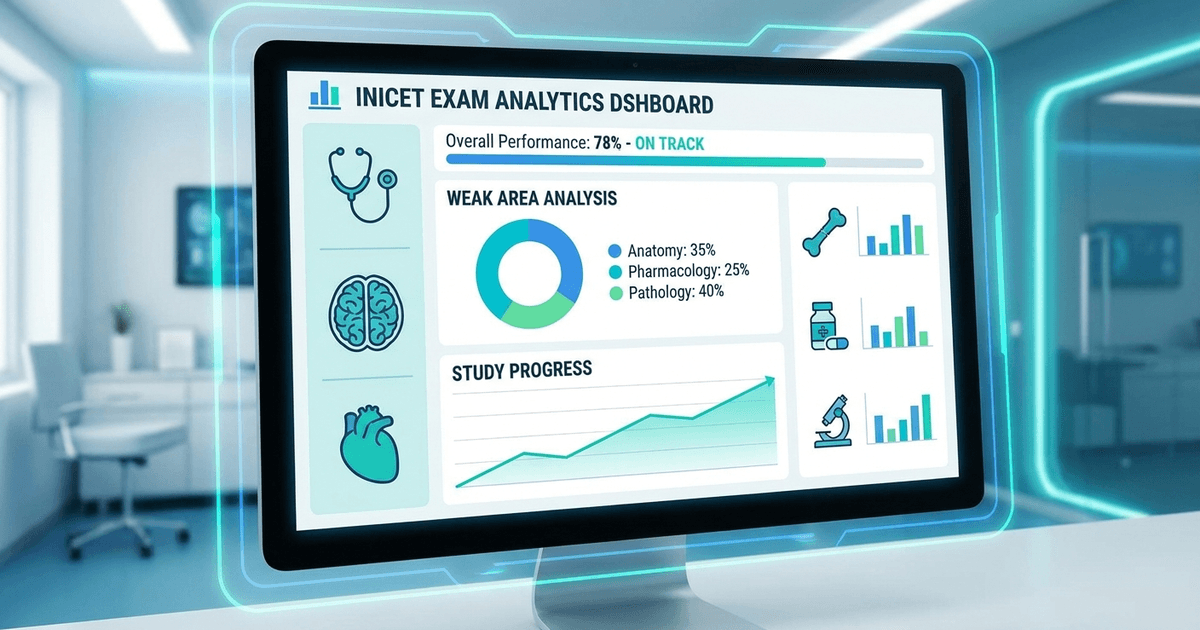
Your performance analytics on Oncourse automatically track these patterns. After attempting PYQs and practice questions, your dashboard shows exactly which topics need attention most — Medicine cardiology vs Pharmacology autonomic drugs vs Pathology neoplasia. No guesswork needed.
Final 30-Day PYQ Cadence: Precision Over Volume
In your last month, shift from learning mode to precision mode. Your PYQ strategy should mirror exam-day conditions exactly.
Days 1-10: Recent Pattern Analysis
Attempt 2023-2025 papers under strict timing
Focus on question types showing increasing frequency
Identify any new patterns or emphasis areas
Days 11-20: Weak-Area Blitz
Target practice on your identified gaps using INICET-specific question banks
Re-attempt previously missed questions without referring to old answers
Measure improvement vs persistent gaps
Days 21-30: Simulation and Refinement
Daily full-length practice maintaining 180+ attempt rate with 75%+ accuracy
Final pattern-spotting for exam-day advantage
Emergency weak-area patches for critical topics
The goal isnt attempting more questions. Its achieving consistent performance on the patterns youll definitely see.
Common Mistakes That Kill PYQ Effectiveness
Mistake 1: Explanation Hopping
Reading explanations immediately after each question breaks pattern recognition. Batch your review: attempt full sections, then analyze systematically.
Mistake 2: Confidence Confusion
Getting questions right for wrong reasons creates false confidence. Always track why you were correct, not just that you were correct.
Mistake 3: Static Practice
Using the same PYQ approach from initial prep through final weeks. Your needs change — your practice method should too.
Mistake 4: Subject Isolation
Studying weak subjects in isolation without integrated practice. INICET tests connections, not compartments.
Mistake 5: Pattern Memorization
Memorizing specific PYQ answers rather than extracting underlying patterns. You'll see pattern variations, not exact repeats.
Building Your Personal Weak-Area Database
Create a simple tracking system for maximum effectiveness:
Question Log: Question text, your answer, correct answer, confidence level, time taken Pattern Tags: Subject, concept, question type, clinical vs basic science Review Status: First attempt, reviewed once, mastered, needs re-review Context Notes: Why you missed it, what pattern to remember, similar questions to watch
After 4-5 PYQ papers, your database reveals clear trends. Maybe 70% of your mistakes cluster around 4-5 specific topics that represent 25% of total questions. Thats a massive efficiency gain.
This data-driven approach transforms PYQ practice from "doing questions" to "building exam-day precision."
Frequently Asked Questions
How many previous year papers should I attempt for INICET?
Attempt 2021-2025 papers completely (5 papers), plus selected subject-wise questions from earlier years for specific weak areas. Quality of analysis matters more than quantity of papers attempted.
Should I time my PYQ practice initially or focus on accuracy first?
Start untimed for subject-wise blocks to identify concepts gaps, then switch to timed practice for mixed papers. Your last 4 weeks should be fully timed to build exam-day stamina and pacing.
What if I consistently score poorly on PYQs despite studying hard?
Poor PYQ performance usually indicates study-exam mismatch, not insufficient effort. Focus on application-based learning rather than passive reading. Use clinical reasoning for every concept, not just memorization.
How do I handle subjects where I have no PYQ pattern because I avoid them?
Start with untimed, single-subject PYQ blocks from your weakest areas. Use lesson content to fill fundamental gaps, then return to questions. Avoidance makes weak areas weaker.
Is it worth attempting very old INICET papers (pre-2020) for pattern analysis?
Use post-2020 papers for primary practice since the exam pattern evolved significantly. Pre-2020 papers work for specific subject-wise gap-filling but dont rely on them for timing or question-type patterns.
When should I stop PYQ practice and focus only on revision?
Continue PYQ-based weak area practice until 3-4 days before your exam. Replace full-length attempts with targeted 20-30 question blocks on your identified weak areas for active recall maintenance.
Prepare smarter with Oncourse AI — adaptive MCQs, spaced repetition, and AI explanations built for INICET. Download free on Android and iOS.