INICET Clinical Questions: How to Practice Decision-Making for Case-Based MCQs
Master INICET clinical decision-making with systematic workflows for case-based MCQs. Learn to read vignettes strategically, build differentials, and practice clinical reasoning under time pressure.
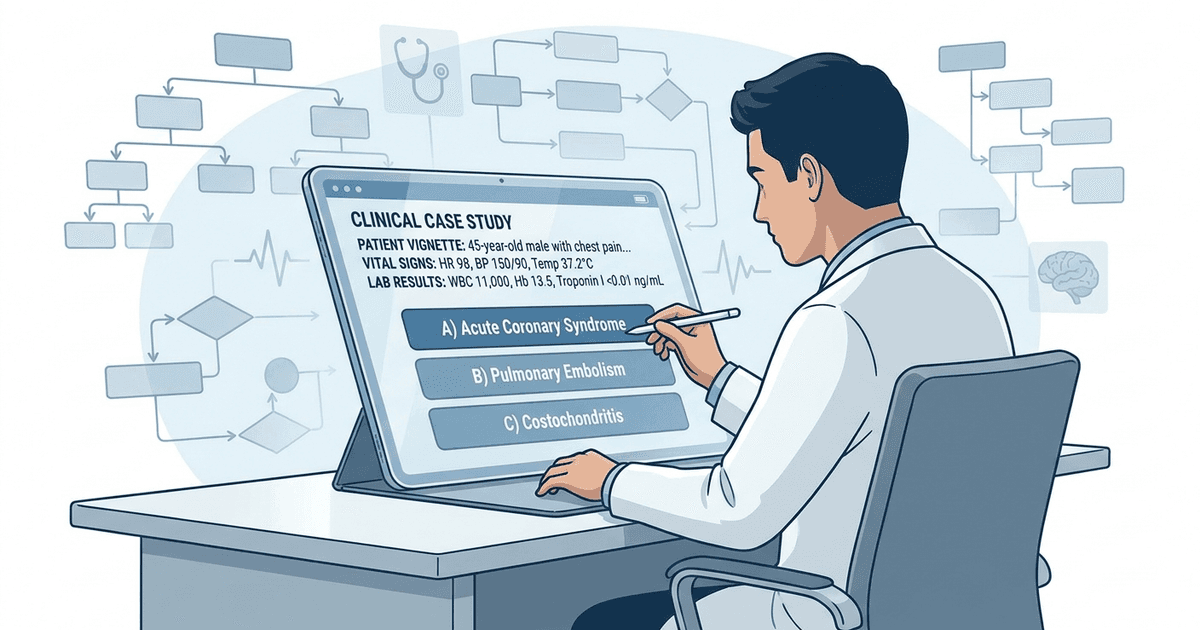
INICET Clinical Questions: How to Practice Decision-Making for Case-Based MCQs
You've cracked open your INICET question bank, and there it is—a 6-line clinical vignette about a 45-year-old diabetic presenting with chest pain and dyspnea. You know the pathophysiology. You memorized the guidelines. But somewhere between reading "3 hours post-meal" and choosing between thrombolysis protocols, your clinical reasoning wobbles.
Sound familiar? INICET 2026 tests clinical decision-making through integrated case-based scenarios, not isolated factual recall. A typical INICET paper contains 70% case-based questions where success depends on systematic clinical reasoning, pattern recognition, and decision-making under time pressure. You have 54 seconds per question to read, analyze, and choose—exactly the skill gap between factual knowledge and clinical application.
If you've been drilling definitions and mechanisms but struggling with "next best step" questions, this workflow bridges that gap. Here's how to practice clinical decision-making systematically, convert reasoning mistakes into targeted revision, and build the pattern recognition INICET actually tests.
Why Factual Recall Fails on INICET Clinical MCQs
INICET has shifted dramatically from traditional definition-based questions to integrated clinical scenarios. Here's what changed:
Traditional Format: "What is the mechanism of action of beta-blockers?" INICET 2026 Format: "A 58-year-old male with diabetes presents with acute chest pain. ECG shows ST-elevation in leads V1-V4. BP is 160/90. Which medication should be avoided in initial management?"
The second question tests the same beta-blocker knowledge but through clinical reasoning, contraindications, and priority-setting. You need to connect diabetes → possible silent MI → cardiogenic shock risk → specific beta-blocker considerations, all within the context of acute management protocols.
Most students memorize drug mechanisms but can't apply them in clinical decision trees. INICET exploits this gap systematically.
How INICET Case-Based Questions Test Decision-Making
INICET clinical questions follow predictable patterns designed to test specific decision-making skills:
Pattern 1: Diagnostic Reasoning
These questions present symptoms and ask you to narrow differentials systematically:
Chief complaint + key symptoms → most likely diagnosis
Atypical presentation + demographics → diagnostic consideration
Multiple systems involvement → integrated diagnosis
Pattern 2: Management Sequencing
These test your ability to prioritize interventions:
"Next best step in management"
"Most appropriate initial treatment"
"Investigation of choice"
When you see "next best step," the question tests clinical priorities. Stabilize first, investigate second, treat third. Missing this hierarchy costs marks.
Pattern 3: Clinical Judgment
These require weighing risks, contraindications, and patient-specific factors:
Drug choice in specific populations (elderly, pregnant, renal disease)
When to operate vs. observe
Appropriate escalation vs. conservative management
INICET integrates multiple subjects within single questions. A cardiology case might test pharmacology (drug interactions), pathology (mechanism), and clinical medicine (management) simultaneously. Traditional subject-wise preparation misses these connections.
Step-by-Step Practice Workflow for Clinical Decision-Making
Here's a systematic approach to practice clinical reasoning for INICET case-based MCQs:
Step 1: Read for Decision Points (15 seconds)
Don't read the entire vignette linearly. Scan for decision points first:
Demographics: Age, sex, comorbidities
Timeline: Acute vs. chronic, duration of symptoms
Red flags: Chest pain, dyspnea, altered sensorium, bleeding
Clinical context: Emergency department, outpatient, post-operative
Practice this: Cover the options, read only the vignette, and ask yourself "What decision is this question testing?" before looking at choices.
Step 2: Identify the Tested Domain (10 seconds)
INICET questions test specific domains:
Diagnosis: "Most likely diagnosis"
Investigation: "Most appropriate next test"
Management: "Best initial treatment"
Prognosis: "Most likely complication"
The domain determines your reasoning approach. Diagnostic questions need differential thinking. Management questions need prioritization. Prognostic questions need risk stratification.
Step 3: Build Your Differential (20 seconds)
For diagnostic questions, generate 3-4 differentials based on:
Common things first: In a 30-year-old with chest pain, think costochondritis, not MI
Age-appropriate diseases: Elderly patients get different differentials
Associated symptoms: Chest pain + dyspnea + leg swelling = CHF consideration
Use Oncourse AI's Clinical Rounds feature to practice this systematic differential building. The tool simulates real patient encounters where you practice taking history, ordering tests, and reaching diagnoses through structured clinical reasoning rather than passive reading.
Step 4: Use Options to Check Reasoning (10 seconds)
Read options strategically:
Eliminate clearly wrong: Options that contradict basic safety or guidelines
Compare reasonable choices: Often 2-3 options seem plausible
Apply clinical priorities: ABC approach, urgent vs. non-urgent
If you're torn between two management options, ask: "Which one addresses the immediate threat to life/organ function?"
Timed vs. Untimed Clinical Practice Blocks
Your practice strategy needs both modes:
Untimed Practice (40% of time)
Use for:
Learning new patterns: First exposure to clinical reasoning frameworks
Deep analysis: Understanding why wrong options are incorrect
Concept building: Connecting pathophysiology to clinical presentation
During untimed blocks, spend 2-3 minutes per question. Ask follow-up questions using Oncourse AI's explanation chat feature. Instead of just reading "Correct answer: B," probe deeper: "Why would option A cause harm in this patient?" or "What if the patient had renal failure—would the answer change?"
Timed Practice (60% of time)
Use for:
Pattern recognition: Building automatic responses to common scenarios
Decision speed: Achieving 54-second average per question
Exam simulation: Managing time pressure and sectional switching
Set strict timers. INICET has 4 sections with no return policy—once you submit Medicine, you can't go back. Practice switching mindsets quickly between subjects.
Image, Lab, and Vignette Interpretation
INICET includes significant visual interpretation components:
ECG Interpretation (5-8 questions)
Practice systematic ECG reading:
Rate, rhythm, axis
P waves, QRS morphology, ST segments
Clinical correlation with symptoms
Don't just memorize patterns—connect ECG findings to management decisions. An inferior STEMI in a diabetic needs different risk stratification than the same ECG in a healthy 25-year-old.
Laboratory Integration (10-15 questions)
Focus on:
Critical values: When to act immediately vs. observe
Pattern recognition: Metabolic panels, cardiac enzymes, inflammatory markers
Clinical correlation: Lab abnormalities that change management
INICET often provides "normal" labs to test whether you can recognize when extensive workup isn't needed.
Imaging Interpretation (8-12 questions)
Key areas:
Chest X-rays: Pneumonia, CHF, pneumothorax patterns
CT/MRI: High-yield emergency findings
Ultrasound: FAST exam, cardiac windows
Practice rapid image interpretation (15 seconds per image). The clinical decision matters more than radiological details—can you identify findings that change immediate management?
How to Review Explanations for Maximum Learning
Most students read explanations passively. Here's how to extract maximum learning:
The "Why Wrong?" Analysis
For each incorrect option, don't just note it's wrong—understand why:
Contraindicated: Would cause harm in this scenario
Irrelevant: Doesn't address the clinical question
Inappropriate timing: Right intervention, wrong time
Wrong population: Correct for different age/condition
The "What If?" Extension
After understanding the correct answer, ask:
"What if the patient were 70 instead of 30?"
"What if there were no chest pain, only dyspnea?"
"What if kidney function were impaired?"
This builds decision trees rather than isolated facts. Oncourse AI's explanation chat is designed for exactly these follow-up questions—you can probe mechanisms, ask about variants, and test edge cases without getting stuck in knowledge gaps.
The "Pattern Mapping" Exercise
After every 10 questions, identify patterns:
Clinical presentations: How does acute MI present in diabetics vs. non-diabetics?
Decision algorithms: When do you choose medication A over B?
Risk factors: What changes management in high-risk patients?
Track these patterns in a clinical reasoning journal.
Common Clinical Reasoning Traps in INICET
Trap 1: The "Textbook Perfect" Error
INICET questions often include atypical presentations. Don't force classic patterns onto atypical cases.
Example: A 65-year-old diabetic with "mild fatigue" and minimal chest discomfort. Students miss MI because it doesn't match the classic crushing chest pain description. Solution: Learn age-specific and comorbidity-specific presentations.
Trap 2: The "Overdiagnosis" Trap
Students often choose complex diagnoses over simple ones.
Example: Young patient with chest pain after exercise gets worked up for rare cardiac conditions instead of musculoskeletal pain. Solution: Apply Occam's razor—common things occur commonly.
Trap 3: The "Investigation Overkill" Error
Ordering every possible test instead of targeted workup.
Example: Patient with clear clinical pneumonia gets extensive cardiac workup because of mild chest pain. Solution: Learn when clinical diagnosis is sufficient vs. when confirmatory testing is needed.
Trap 4: The "Immediate Action" Confusion
Misunderstanding "next best step" vs. "most appropriate long-term management."
Example: Patient in cardiogenic shock—the next best step is stabilization (pressors, oxygen), not long-term management (ACE inhibitors). Solution: Prioritize immediate life-threatening issues first.
Weekly Weak-Area Feedback Loops
Convert your practice results into targeted improvement:
Week 1-2: Baseline Assessment
Take 3-4 subject-specific 50-question blocks
Track accuracy by clinical domain (diagnosis, management, prognosis)
Identify your bottom 3 areas
Week 3-4: Targeted Reinforcement
Focus practice on weak areas:
If you're missing diagnostic questions: increase differential diagnosis practice
If you're missing management questions: drill treatment algorithms and guidelines
If you're missing investigations: practice cost-effective workup strategies
Use Oncourse AI's daily plan feature to convert your practice results into focused daily work. Instead of random questions, you get targeted content that addresses your specific weak areas—more cardiology MCQs if you're missing heart failure questions, more pharmacology if you're confusing drug mechanisms.
Week 5-6: Integration Testing
Mix all subjects in full-length practice tests
Focus on sectional time management
Practice mental switching between clinical domains
Week 7-8: Pattern Consolidation
Identify recurring error patterns
Practice with "difficult" questions only
Build automatic responses to common clinical scenarios
Final 30-Day Clinical Question Cadence
Your final month should emphasize pattern recognition and decision speed:
Days 1-10: High-Yield Clinical Patterns
100 mixed questions daily
Focus on common clinical presentations
Build automatic diagnostic algorithms
Days 11-20: Sectional Mastery
Subject-specific 50-question blocks
Perfect sectional time management
Practice clinical mindset switching
Days 21-30: Full Integration
Daily full-length tests (200 questions)
Emphasis on clinical reasoning under pressure
Final weak-area targeted revision
Maintain a 75% accuracy target in clinical questions during this period. If you're consistently below 70%, extend the pattern recognition phase.
Converting INICET Preparation Into Clinical Skills
The decision-making skills you build for INICET transfer directly to clinical practice:
Pattern Recognition: The systematic approach to reading vignettes mirrors how you'll approach real patient presentations during residency. Priority Setting: Learning to identify "next best step" translates to triage skills and emergency management. Risk Stratification: Understanding when to investigate vs. observe builds clinical judgment that's essential for safe practice. Integrated Thinking: INICET's multi-system questions mirror real patients who don't present with single-system diseases.
This isn't just exam preparation—you're building the clinical reasoning framework that makes you a safer, more effective physician.
Frequently Asked Questions
How many clinical questions should I practice daily for INICET?
Practice 75-100 mixed clinical questions daily, with 60% timed and 40% untimed. Focus on quality analysis over quantity. Each question should teach you a clinical reasoning pattern, not just a fact.
Should I memorize clinical algorithms or focus on understanding?
Both, but prioritize understanding first. Memorized algorithms help with time pressure, but understanding helps when questions twist the scenario. Learn the "why" behind each step so you can adapt when presentations are atypical.
How do I improve my clinical image interpretation speed?
Practice systematic image reading: 15 seconds to identify key findings, 10 seconds to correlate with clinical scenario, 5 seconds to choose management. Use pattern recognition—most INICET images test common findings, not radiological subtleties.
What's the best way to practice clinical decision-making under time pressure?
Start with untimed blocks to build reasoning frameworks, then gradually introduce time pressure. Use 54-second timers per question. Practice sectional switching—can you quickly shift from cardiology thinking to surgical thinking?
How do I know if my clinical reasoning is improving?
Track accuracy trends over time, but also monitor decision confidence. Are you choosing answers because you understand the clinical reasoning, or because you're eliminating obviously wrong options? Aim for confident, reasoning-based choices.
Should I focus more on common diseases or rare conditions for INICET?
Focus 80% on common diseases with common presentations, 15% on common diseases with atypical presentations, and 5% on rare diseases with classic presentations. INICET tests clinical judgment more than medical curiosities.
Prepare smarter with Oncourse AI—adaptive MCQs, spaced repetition, and AI explanations built for INICET. Download free on Android and iOS.