INICET 2026 Exam Date, Pattern, Cutoff and Complete Preparation Strategy
Complete INICET 2026 guide: exam dates (June & November), 200 MCQ pattern, expected cutoff scores by specialty and AIIMS institute, plus proven 6-month preparation strategy for success.
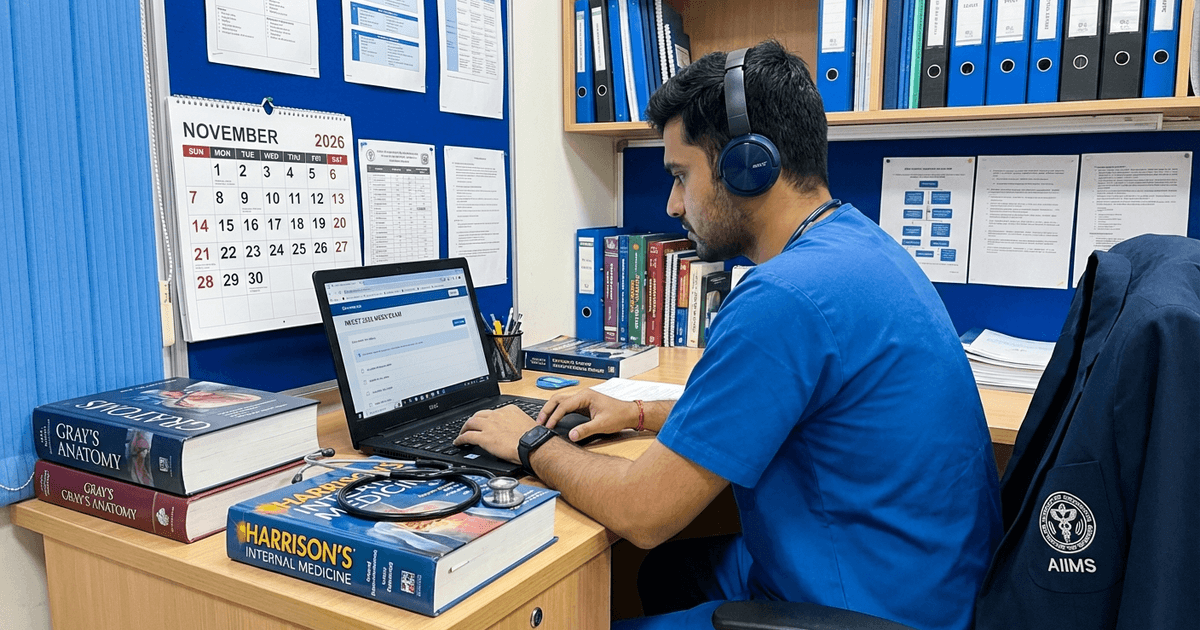
INICET 2026 Exam Date, Pattern, Cutoff and Complete Preparation Strategy
You are probably staring at the INICET 2026 application form, wondering when exactly the exam will be. Or maybe you have already filled it out and now need the complete picture — exam pattern, cutoff scores, and a preparation strategy that actually works.
INICET 2026 exam date will determine your entire study timeline. The exam happens twice yearly, and each session opens different opportunities across AIIMS institutes. With only 200 MCQs standing between you and your dream specialty, every detail matters.
The competition is real. AIIMS Delhi General Medicine had a cutoff of 114 marks in 2024. Surgery crossed 120. Pediatrics hit 116. These numbers didnt happen by accident — they reflect the preparation level of students who made it through.
What is INICET and Who Should Take It
INICET (Institute of National Importance Combined Entrance Test) is your gateway to postgraduate medical programs at AIIMS institutes across India. If you are targeting MD/MS/MDS courses at any AIIMS, this is your only route.
The exam covers candidates who have completed MBBS from any recognized Indian medical college. Unlike NEET-PG which feeds into multiple institutions, INICET serves exclusively AIIMS institutes — making it more focused but equally competitive.
Here's what makes INICET different from other medical entrance exams:
Institute-specific: Only for AIIMS postgraduate programs
Smaller candidate pool: Around 40,000-50,000 aspirants compared to NEET-PG's 2 lakh+
Higher weightage on clinical subjects: 60% of questions come from clinical branches
Case-based approach: More integrated clinical scenarios than pure recall-based questions
INICET 2026 Exam Dates and Schedule
The National Board of Examinations conducts INICET twice yearly. For INICET 2026, the confirmed schedule is:
June 2026 Session
Application starts: February 2026 (expected)
Application deadline: March 2026 (expected)
Admit card release: May 2026
INICET 2026 exam date: First week of June 2026
Result declaration: June-July 2026
Counseling: July-August 2026
November 2026 Session
Application starts: August 2026 (expected)
Application deadline: September 2026 (expected)
Admit card release: October 2026
Exam date: First week of November 2026
Result declaration: November-December 2026
Counseling: December 2026-January 2027
The June session typically offers more seats across specialties, while November serves as an additional opportunity for candidates who missed the first session or want to improve their scores.
INICET 2026 Exam Pattern and Structure
INICET follows a standardized computer-based test format. Here's the exact breakdown:
Component | Details |
|---|---|
Total Questions | 200 MCQs |
Duration | 3 hours 30 minutes |
Marking Scheme | +4 for correct, -1 for incorrect |
Question Type | Single best response |
Language | English only |
Negative Marking | Yes (-1/3 for wrong answers) |
Subject-wise Distribution
The 200 questions are distributed across these subjects with approximate weightage:
Anatomy: 15-18 questions (7.5-9%)
Physiology: 15-18 questions (7.5-9%)
Biochemistry: 12-15 questions (6-7.5%)
Pharmacology: 18-22 questions (9-11%)
Pathology: 20-25 questions (10-12.5%)
Microbiology: 15-18 questions (7.5-9%)
General Medicine: 25-30 questions (12.5-15%)
General Surgery: 20-25 questions (10-12.5%)
Obstetrics & Gynecology: 15-20 questions (7.5-10%)
Pediatrics: 15-20 questions (7.5-10%)
Preventive & Social Medicine: 10-12 questions (5-6%)
Other clinical subjects: 15-18 questions (7.5-9%)
Clinical subjects (Medicine, Surgery, OB-GYN, Pediatrics) together contribute 60-65% of the paper, making clinical preparation crucial for success.
INICET Syllabus Overview: High-Yield Subjects
Your INICET preparation should prioritize subjects based on their question weightage and your comfort level. Here are the high-yield areas:
Top Priority (High weightage + scoring potential)
1. General Medicine: Cardiology, Respiratory Medicine, Gastroenterology, Nephrology 2. Pharmacology: Antimicrobials, Cardiovascular drugs, CNS pharmacology 3. Pathology: Systemic pathology, Hematology, Clinical pathology 4. General Surgery: Trauma, GI surgery, Surgical anatomy
Medium Priority (Moderate weightage but conceptual)
1. Anatomy: Clinically relevant anatomy, Radiology, Embryology 2. Physiology: Cardiovascular, Respiratory, Renal physiology 3. Pediatrics: Neonatology, Growth and development, Pediatric emergencies 4. OB-GYN: High-risk pregnancy, Gynecological oncology
Lower Priority (Important for completion)
1. Microbiology: Clinically important organisms, Antimicrobial resistance 2. Biochemistry: Clinical biochemistry, Molecular biology basics 3. PSM: Epidemiology, Health programs, Biostatistics
The key insight here: INICET questions are application-based rather than pure recall. A question on hypertension wont just ask about normal values — it will present a case and ask about the next best step in management. When reviewing Pharmacology mechanisms through Rezzy, focus on clinical applications rather than just drug names.
INICET 2026 Expected Cutoff Scores
Cutoff scores vary significantly based on specialty choice and institute preference. Here are the expected ranges for INICET 2026 based on historical trends:
AIIMS Delhi (Most competitive)
General Medicine: 115-120 marks
General Surgery: 120-125 marks
Pediatrics: 115-118 marks
Obstetrics & Gynecology: 118-122 marks
Orthopedics: 125-130 marks
Ophthalmology: 130-135 marks
Dermatology: 135-140 marks
Radiology: 125-130 marks
Other AIIMS Institutes (Bhubaneswar, Jodhpur, Patna, Raipur, Rishikesh)
General Medicine: 105-110 marks
General Surgery: 110-115 marks
Pediatrics: 105-108 marks
Obstetrics & Gynecology: 108-112 marks
Orthopedics: 115-120 marks
Ophthalmology: 120-125 marks
Newer AIIMS Institutes
General Medicine: 95-100 marks
General Surgery: 100-105 marks
Pediatrics: 95-98 marks
Obstetrics & Gynecology: 98-102 marks
Remember, these are approximate ranges. The actual cutoff depends on the number of candidates, question difficulty, and seat availability. A safe strategy is to target 20-25 marks above the expected cutoff for your preferred specialty.
INICET 2026 Preparation Strategy: 6-Month Plan
A systematic 6-month preparation plan can help you target 130+ marks in INICET 2026. Here's the month-wise breakdown:
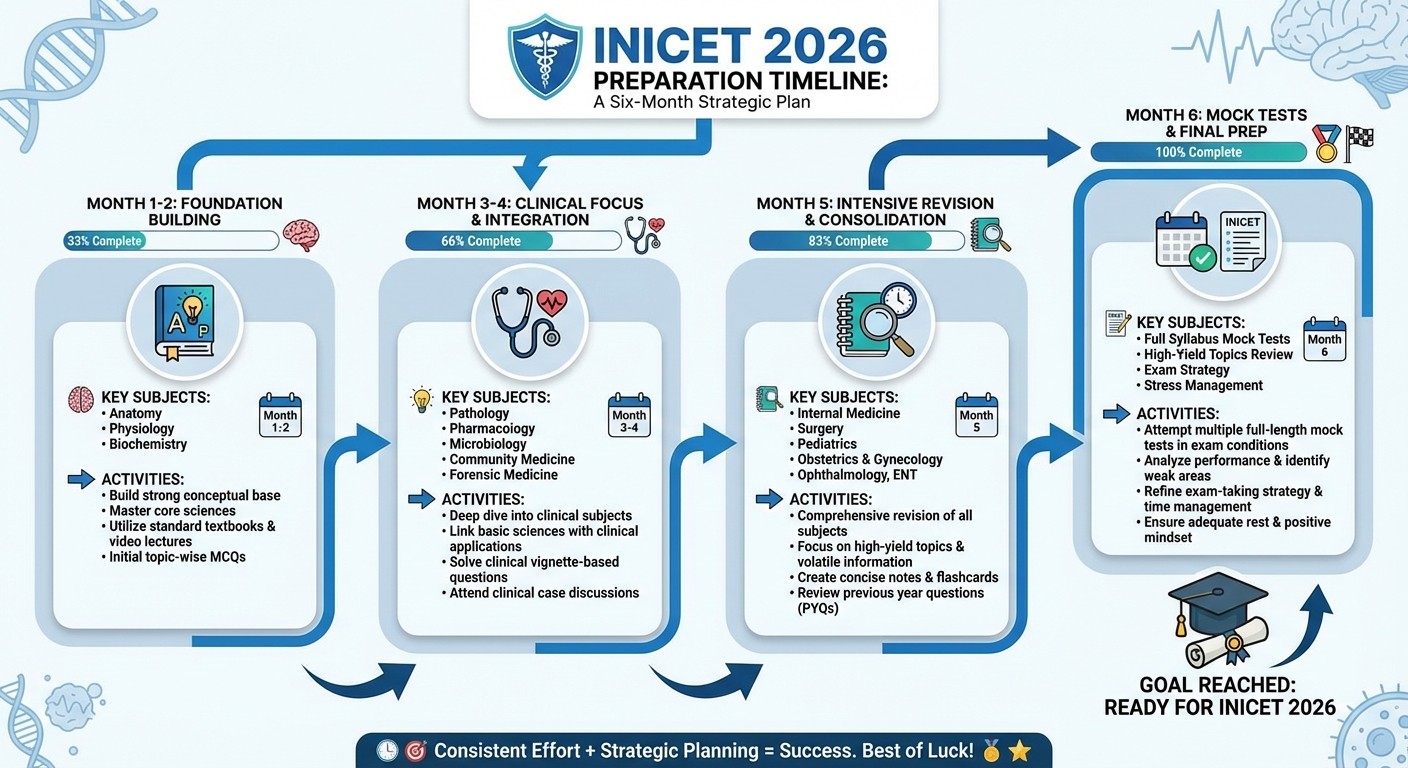
Month 1-2: Foundation Building (January-February 2026)
Focus: Complete basic sciences with clinical correlation Daily schedule: 8-10 hours
Morning: Anatomy + Physiology (3 hours)
Afternoon: Pathology + Microbiology (3 hours)
Evening: Biochemistry + Pharmacology (2 hours)
Night: Question practice (2 hours)
Key activities:
Complete one subject every 10-12 days
Make subject-wise notes for quick revision
Practice 50 MCQs daily from completed topics
Use Synapses to schedule intelligent revision of completed chapters — this ensures you dont forget Anatomy basics when you reach Pharmacology in Month 2
Target: Complete all basic sciences, practice 3,000+ MCQs
Month 3-4: Clinical Subject Mastery (March-April 2026)
Focus: High-yield clinical subjects with case-based learning Daily schedule: 10-12 hours
Morning: General Medicine (4 hours)
Afternoon: General Surgery (3 hours)
Evening: OB-GYN + Pediatrics (3 hours)
Night: Mixed practice tests (2 hours)
Key activities:
Study clinical subjects through case presentations
Focus on diagnostic approaches and management protocols
Practice Clinical Rounds scenarios that mirror INICET's case-integrated MCQs — these help you practice applied clinical reasoning beyond rote recall
Take weekly subject-wise mock tests
Target: Master all clinical subjects, attempt 5,000+ clinical MCQs
Month 5: Intensive Revision (May 2026)
Focus: Consolidate all subjects with emphasis on weak areas Daily schedule: 12-14 hours
Morning: Weak subject revision (4 hours)
Afternoon: High-yield topics across all subjects (4 hours)
Evening: Full-length mock tests (3.5 hours)
Night: Mock analysis + note revision (2-3 hours)
Key activities:
Complete 3 revisions of all subjects
Take daily full-length mock tests
Analyze performance patterns and adjust strategy
Memorize high-yield facts and figures
Target: Attempt 20+ full-length mocks, achieve consistent 120+ scores
Month 6: Final Preparation (May-June 2026)
Focus: Peak performance and exam readiness Daily schedule: 8-10 hours
Morning: Light revision + current topics (2 hours)
Afternoon: Mock test (3.5 hours)
Evening: Mock analysis + weak area practice (3 hours)
Night: Relaxation and light reading (1 hour)
Key activities:
Take mock tests in actual exam conditions
Review only high-yield notes and flashcards
Focus on time management and accuracy
Maintain physical and mental health
Target: Maintain 130+ score consistency, optimize exam strategy
Subject Prioritization Strategy
Not all subjects are created equal for INICET. Here's how to allocate your preparation time:
High-Impact Subjects (40% of your time)
1. General Medicine: Most questions, highest weightage 2. Pharmacology: Directly applicable across all clinical subjects 3. Pathology: Foundation for clinical understanding
Medium-Impact Subjects (35% of your time)
1. General Surgery: Good scoring potential with systematic approach 2. Anatomy: Clinically relevant portions only 3. Physiology: Conceptual clarity helps in clinical subjects
Completion Subjects (25% of your time)
1. OB-GYN: Moderate weightage, specific topics 2. Pediatrics: Age-specific medicine, separate preparation needed 3. Microbiology: Important organisms and clinical correlations 4. PSM: Epidemiology and health programs 5. Biochemistry: Clinical biochemistry focus
The Role of AI-Powered Practice in INICET Preparation
Traditional question banks show you what to memorize. AI-powered platforms teach you how to think. For INICET 2026, this difference is crucial because the exam tests clinical reasoning over factual recall.
Smart Question Practice: Instead of doing random MCQs, focus on adaptive practice that identifies your weak areas and provides targeted questions. The platform should track which topics you consistently get wrong and serve more questions from those areas. Immediate Explanations: When you get a question wrong, you need to understand why immediately. AI explanations break down not just the correct answer, but why the other options were incorrect and what clinical pearls to remember. Spaced Repetition: With 19 subjects to cover, forgetting early topics while learning new ones is a real problem. Intelligent scheduling ensures you review Anatomy concepts from Month 1 while actively studying Pharmacology in Month 4.
The most effective INICET candidates combine traditional textbook study with AI-enhanced practice. They read Harrison's for Medicine concepts, then immediately test their understanding with adaptive MCQs that simulate real exam conditions.
Revision Schedule and Time Management
Your revision strategy should be different in each preparation phase:
Active Learning Phase (Month 1-4)
Read each topic once thoroughly
Make concise notes while reading
Practice questions immediately after completing each topic
Weekly subject tests to assess retention
Revision Phase (Month 5)
Review notes, not textbooks
Focus on high-yield facts and recent guidelines
Attempt mixed-subject mock tests
Analyze performance trends
Maintenance Phase (Month 6)
Quick flashcard reviews
Mock test analysis
Current medical updates
Stress management
Time allocation per subject per day:
Major subjects (Medicine, Surgery): 2-3 hours
Medium subjects (Anatomy, Physiology): 1-2 hours
Minor subjects (PSM, Biochemistry): 45-60 minutes
The key is consistency. Study the same subjects at the same time daily to build a routine that your brain adapts to.
Mock Test Strategy
Mock tests are not just practice — they are your performance optimization tool. Here's how to use them effectively:
Frequency
Month 1-2: 1 subject-wise test per week
Month 3-4: 2 subject-wise tests per week
Month 5: Daily full-length tests
Month 6: Full-length tests every alternate day
Analysis Protocol
After each mock test, spend equal time analyzing your performance:
1. Review all wrong answers: Understand why you chose the incorrect option
2. Review all guesses that were correct: These represent knowledge gaps
3. Time analysis: Identify subjects where you are spending too much time
4. Pattern recognition: Are you making the same types of errors repeatedly?
Target Scores
Month 3: 100+ marks
Month 4: 110+ marks
Month 5: 120+ marks
Month 6: 130+ marks consistently
If you are not hitting these targets, adjust your study plan. More mock tests won't help if you have content gaps — go back to focused subject study.
Frequently Asked Questions
When is INICET 2026 exam date?
INICET 2026 will be conducted in June and November sessions. The June session exam date is expected in the first week of June 2026, while the November session will be in early November 2026. Official dates will be announced by NBE in early 2026.
How many questions are there in INICET 2026?
INICET 2026 will have 200 multiple-choice questions to be completed in 3 hours 30 minutes. Each correct answer carries 4 marks, and each incorrect answer has negative marking of 1 mark.
What is the expected cutoff for INICET 2026?
Expected cutoffs vary by specialty and institute. For AIIMS Delhi, General Medicine may require 115-120 marks, while competitive specialties like Dermatology could need 135+ marks. Other AIIMS institutes typically have cutoffs 10-15 marks lower.
Is 6 months enough to prepare for INICET 2026?
Yes, 6 months is sufficient for INICET preparation if you follow a structured study plan. Focus 40% time on high-yield subjects (Medicine, Pharmacology, Pathology), 35% on medium-impact subjects (Surgery, Anatomy, Physiology), and 25% on remaining subjects.
Which subjects have the highest weightage in INICET?
General Medicine has the highest weightage with 25-30 questions (12.5-15%), followed by Pathology with 20-25 questions (10-12.5%) and Pharmacology with 18-22 questions (9-11%). Clinical subjects together contribute 60-65% of the paper.
How is INICET different from NEET-PG?
INICET is exclusively for AIIMS postgraduate programs while NEET-PG covers multiple institutions. INICET has higher weightage on clinical subjects (60% vs 50% in NEET-PG) and includes more case-based questions requiring clinical reasoning rather than pure recall.
Prepare smarter with Oncourse AI — adaptive MCQs, spaced repetition, and AI explanations built for INICET. Download free on Android and iOS.