FMGE Subject-Wise Preparation 2026: High-Yield Topics, PYQs and Weak Areas
Complete FMGE 2026 subject-wise preparation strategy with high-yield topics, PYQ analysis, and weak area repair methods. Focus on Medicine, Surgery, Community Medicine, and OBG for 125+ marks.
FMGE Subject-Wise Preparation 2026: High-Yield Topics, PYQs and Weak Areas
You are probably staring at the FMGE syllabus thinking "19 subjects, 300 questions, where do I even start?" The answer isn't in the thick textbooks collecting dust on your shelf. It's in the pattern.
FMGE June 2026 is scheduled for June 28th. You need 150 marks to pass. That sounds reasonable until you realize the sheer breadth of topics and the clinical integration trend that's making questions trickier each year. Here's the thing though — NBEMS follows predictable patterns, and the mark distribution isn't equal across subjects.
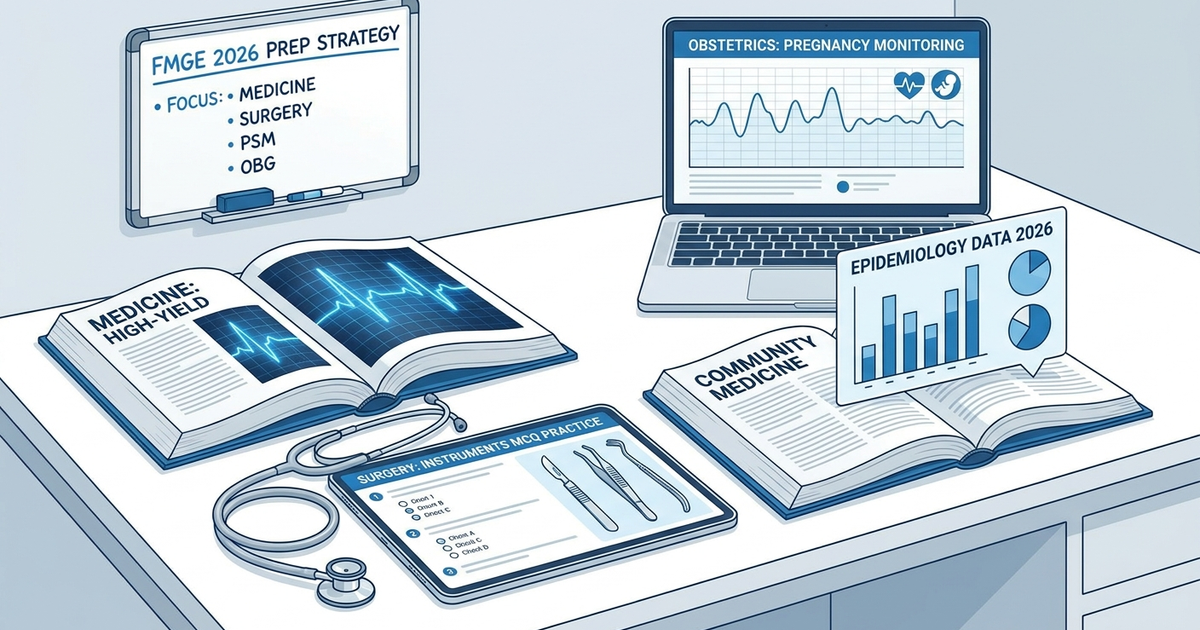
After analyzing PYQs from 2021–2026, one thing is clear: four subjects drive 83% of your passing requirement. Get these right, and you are looking at a first-attempt pass. Miss them, and even perfect scores elsewhere wont save you.
FMGE 2026 Subject Weightage: The Real Distribution
The 300 marks split into Part A (Pre-clinical & Para-clinical) with 100 marks and Part B (Clinical) with 200 marks. But the distribution within these parts isn't uniform.
Part A: Pre-Clinical & Para-Clinical (100 marks)
| Subject | Marks | Priority Level | High-Yield Focus Areas |
|---|---|---|---|
| Anatomy | 17 | High | Embryology, Neuroanatomy, Applied Anatomy |
| Physiology | 17 | High | CVS, Renal, Neurophysiology |
| Biochemistry | 17 | High | Metabolic pathways, Enzymes, Clinical biochemistry |
| Pathology | 13 | Medium | Neoplasia, Inflammation, Hematology |
| Microbiology | 13 | Medium | Bacteriology, Virology, Lab diagnosis |
| Pharmacology | 13 | Medium | Mechanisms of action, Antimicrobials |
| Forensic Medicine | 10 | Low | Toxicology, Medicolegal procedures |
Part B: Clinical Subjects (200 marks)
| Subject | Marks | Priority Level | High-Yield Focus Areas |
|---|---|---|---|
| Medicine | 33 | Critical | Cardiology, Endocrinology, Clinical cases |
| Surgery | 32 | Critical | GI Surgery, Trauma, Burns management |
| Community Medicine | 30 | Critical | Epidemiology, National programs, Biostatistics |
| Obstetrics & Gynaecology | 30 | Critical | Antenatal care, Labour, Contraception |
| Pediatrics | 15 | Medium | Neonatology, Immunization, Growth milestones |
| Ophthalmology | 15 | Medium | Cataract, Glaucoma, Refractive errors |
| ENT | 15 | Medium | Otitis media, CSOM, Laryngeal disorders |
| Short Subjects | 30 | Medium | Dermatology, Psychiatry, Radiology, Anaesthesia |
High-Yield Topic Analysis from PYQs (2021-2026)
Medicine: Clinical Integration is King
The 2026 trend shows NBEMS moving away from direct textbook questions to clinical scenarios. Instead of asking "What is the treatment for MI?", they now present a 55-year-old male with chest pain, elevated troponins, and specific ECG changes, then ask for the next best step in management.
Must-Master Topics:- ECG Interpretation: 4-6 questions guaranteed. Practice STEMI patterns, arrhythmias, and bundle branch blocks
- Diabetes Complications: Retinopathy, nephropathy, and DKA management appear in every session
- Tuberculosis Protocols: DOTS, drug resistance patterns, and extrapulmonary TB
- Poisoning Management: Organophosphorus, methanol, and snake bite protocols
- Emergency Medicine: Shock management, CPR guidelines, and acute coronary syndromes
When practicing medicine MCQs, Oncourse's weak-area analytics identifies which clinical systems you are consistently missing, so revision time goes where mistakes repeat rather than random topic selection.
Surgery: Visual Learning is Non-Negotiable
Surgery questions are increasingly image-heavy. The January 2026 session had 18 image-based questions out of 32 surgical topics.
High-Yield Visual Topics:- Burns: Rule of Nines, Parkland formula, and fluid resuscitation
- Hernias: Clinical presentation images and surgical approaches
- Thyroid Disorders: USG findings, FNAC interpretations
- Trauma Management: ATLS protocols, imaging interpretation
- Breast Pathology: Clinical examination findings and staging
The explanation chat feature becomes crucial here — when you get a surgical image wrong, you can ask follow-up questions about why specific imaging findings point to particular diagnoses.
Community Medicine: India-Specific Content Rules
This is where international medical graduates often stumble. FMGE heavily emphasizes Indian health programs and epidemiological contexts.
Non-Negotiable Topics:- National Immunization Schedule: Updated UIP schedules, new vaccines
- National Health Programs: RNTCP, NVBDCP, NPCDCS updates
- Biostatistics: Sensitivity, specificity, predictive values (calculation-based)
- Epidemiological Study Designs: Case-control vs cohort studies
- Disaster Management: Cycle, triage principles
Obstetrics & Gynaecology: Highest Scoring Potential
OBG consistently shows the highest accuracy rates among FMGE toppers. The subject has well-defined protocols and guidelines.
Core Areas:- Antenatal Care: ANC visits, screening protocols, high-risk pregnancies
- Labour Management: Partogram interpretation, normal and abnormal labour
- Contraception: Mechanisms, indications, contraindications
- Gynaecological Oncology: Screening programs, staging
- Menstrual Disorders: PCOS, endometriosis management
Converting Weak Areas into Daily Drill Routine
Your mock test results aren't just scores — they are diagnostic tools. Here's how to systematically convert weaknesses into strengths:
Step 1: Diagnostic Phase (Week 1-2)
Take one subject-wise mock for each of the Big Four subjects. Don't worry about the score; focus on error analysis.
Diagnostic Criteria:- Strong Subject: >70% accuracy
- Average Subject: 50-70% accuracy
- Weak Subject: <50% accuracy
- Strong subjects: Maintain with 20-30 minutes daily review
- Average subjects: Target improvement with focused 45-60 minutes daily
- Weak subjects: Intensive repair mode — 90+ minutes daily until improved
Step 2: Weak Area Repair Protocol
For each weak subject, extract the 5-8 highest yield topics that typically account for 60-70% of questions.
Example - Community Medicine Weak Area Repair:- Week 1: National Health Programs (RNTCP, NVBDCP, NPCDCS)
- Week 2: Biostatistics and epidemiological calculations
- Week 3: Immunization schedules and vaccine-preventable diseases
- Week 4: Environmental health and occupational health
- Morning (30 min): High-yield facts and mnemonics
- Afternoon (45 min): Topic-specific MCQs (minimum 20 questions)
- Evening (15 min): Error review and note-making
Step 3: PYQ Integration Strategy
Previous year questions aren't just practice — they are the roadmap to NBEMS' thinking pattern.
5-Year PYQ Analysis Protocol: 1. Month 1-2: Solve PYQs topic-wise while studying 2. Month 3-4: Full-length PYQ sessions (300 questions in 5 hours) 3. Final month: Rapid PYQ revision focusing on repeated concepts Pattern Recognition Tips:- Medicine: Same clinical scenarios with slight variations
- Surgery: Similar image types and management algorithms
- Community Medicine: Repeated program names, statistics, and calculations
- OBG: Protocol-based questions with standard guidelines
Subject-Wise Revision Loops: 60/30/15 Day Strategy
60 Days Before FMGE: Foundation Reinforcement
Big Four Focus (70% time allocation):- Medicine: System-wise revision, ECG practice, emergency protocols
- Surgery: Image-based question banks, operative procedures
- Community Medicine: Program updates, biostatistics problem-solving
- OBG: Guidelines revision, case-based scenarios
- High-yield Pre-clinical: Anatomy (neuroanatomy), Physiology (CVS, renal), Biochemistry (metabolism)
- Para-clinical: Pathology (neoplasia), Pharmacology (mechanisms), Microbiology (lab diagnosis)
30 Days Before FMGE: Intensive Mock Phase
Week 1-2: Subject-wise intensive mocks- One mock per day for Big Four subjects
- Immediate error analysis and topic revision
- Create subject-wise weak point lists
- Minimum 15 full-length tests
- Simulate exam day conditions (5-hour sessions)
- Track accuracy improvement trends
- Morning: Mock test (150 questions in 2.5 hours)
- Afternoon: Error analysis and topic revision
- Evening: High-yield fact revision and mnemonics
15 Days Before FMGE: Rapid Recall Mode
Week 1 (Days 15-8): High-velocity revision- Medicine: ECG patterns, drug protocols, emergency management
- Surgery: Instrument identification, procedural steps, complications
- Community Medicine: Program statistics, calculation shortcuts
- OBG: ANC protocols, contraception mechanisms
- Daily 2-hour mock sessions
- No new topics — only revision of prepared material
- Stress management and sleep cycle optimization
Common Preparation Mistakes to Avoid
Mistake 1: Equal Time Distribution
Wrong Approach: Spending 1 hour each on all 19 subjects daily Right Approach: Allocate time proportional to marks weightageMedicine (33 marks) deserves 2.5x more time than Forensic Medicine (10 marks). This seems obvious, but most students default to "fairness" across subjects.
Mistake 2: Ignoring Incorrect Options
Many students analyze only why the correct option is right, not why the wrong options are wrong. FMGE questions often have subtle distinctions between options.
Better Approach: For each MCQ, understand all four options. Create mental categories: "definitely wrong", "possibly correct", and "correct".Mistake 3: Postponing Mock Tests
Wrong Timeline: "I'll take mocks once I finish studying all subjects" Right Timeline: Start subject-wise mocks from Week 4, full-length mocks from Week 8Mocks aren't assessments; they are learning tools. Early mocking helps identify knowledge gaps while you still have time to fix them.
Mistake 4: Collecting Too Many Lists
High-yield lists, mnemonics, and fact compilations are useful, but too many creates confusion. Stick to maximum 2-3 sources for each subject.
Quality over Quantity: One well-practiced mnemonic is better than ten half-remembered lists.Final 48 Hours: Strategic Calm
Day -2: Complete one final 300-question mock. Score doesn't matter — use it to identify any forgotten high-yield facts. Day -1: No new studying. Review your personal high-yield notes, practice 2-3 ECGs, and ensure you remember the route to your exam center. Exam Day Morning: Light breakfast, reach center 30 minutes early, carry required documents, and trust your preparation.Important Official Updates
Verification Note: Always verify the latest eligibility criteria, exam dates, and syllabus updates from the official NBE FMGE 2026 Information Bulletin available at nbe.edu.in and natboard.edu.in. The bulletin contains authoritative information about application deadlines, document requirements, and examination procedures that supersede any preparation guidance. Key Dates for FMGE 2026:- Application deadline: May 11, 2026
- Exam date: June 28, 2026
- Result declaration: By July 28, 2026
Frequently Asked Questions
How much time should I spend on each subject daily for FMGE preparation?
Allocate time based on marks weightage, not equal distribution. Medicine (33 marks) should get 1.5-2 hours daily, while Forensic Medicine (10 marks) needs only 20-30 minutes. Focus 60% of your time on the Big Four: Medicine, Surgery, Community Medicine, and OBG.
What's the minimum number of PYQs I should solve for FMGE 2026?
Solve at least 5 years of FMGE PYQs (2021-2025) completely — that's roughly 1,500 questions. Additionally, practice 3,000+ topic-wise MCQs. Start PYQ analysis from Week 2, not after completing the syllabus.
How can I identify my weak areas accurately in FMGE preparation?
Take diagnostic mocks early — one subject-wise test for each major subject by Week 2. Subjects with <50% accuracy are weak areas requiring intensive daily focus. Track error patterns: are you missing because of knowledge gaps or silly mistakes?
Should I study all 19 FMGE subjects with equal importance?
No. The Big Four subjects (Medicine, Surgery, Community Medicine, OBG) contribute 125 out of 150 passing marks. Prioritize these heavily. Pre-clinical subjects like Anatomy, Physiology, and Biochemistry are next priority. Forensic Medicine and short subjects get minimal daily time.
What's the best revision strategy for the final 30 days before FMGE?
Switch to mock-intensive mode: take 15+ full-length tests, analyze every error immediately, and revise only your mistake topics. No new learning — focus on converting your existing knowledge into consistent accuracy. Practice 5-hour stamina daily.
How important are image-based questions in FMGE 2026?
Extremely important, especially in Surgery (60% image-based), Pathology, and Radiology. Practice identifying X-rays, CT scans, clinical photographs, and histopathology slides daily. Surgery questions increasingly test visual pattern recognition over theoretical knowledge.
Prepare smarter with Oncourse AI — adaptive MCQs, spaced repetition, and AI explanations built for FMGE. Download free on Android and iOS.