Back
FMGE Study Plan: Build an Adaptive Daily Plan Around Your Weak Areas
Learn how to create an adaptive FMGE study plan that automatically adjusts based on your weak areas. Includes daily planning strategies, mock test analysis, and revision techniques for 2026.
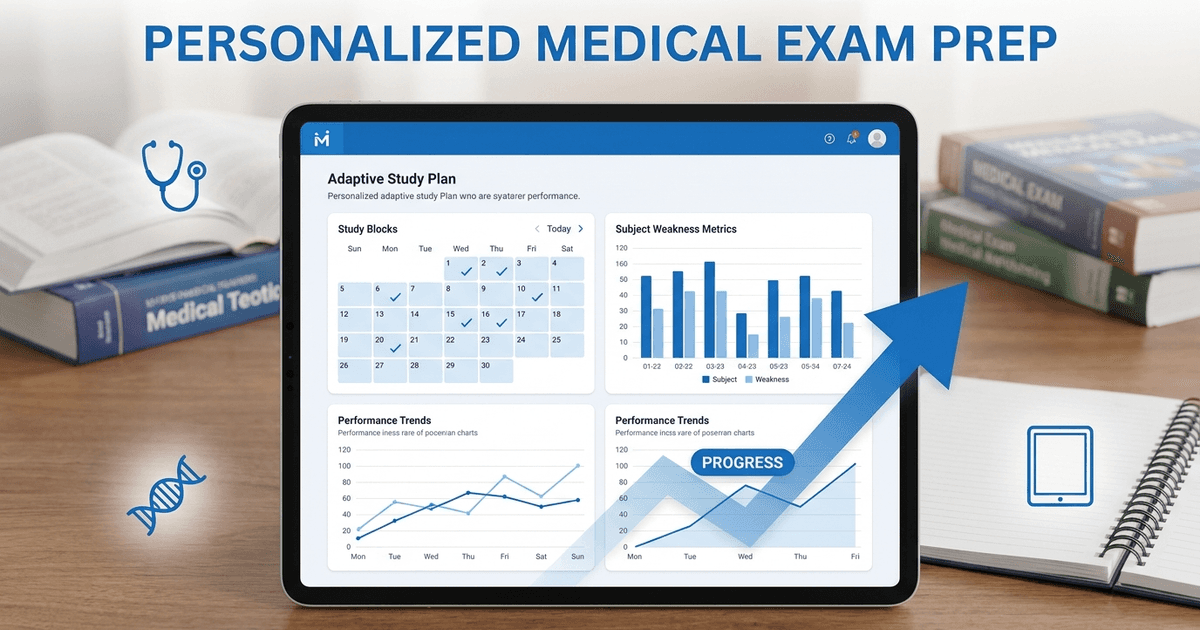
FMGE Study Plan: Build an Adaptive Daily Plan Around Your Weak Areas
You are staring at another generic FMGE timetable. Medicine from 9-11 AM, Surgery from 11-1 PM, and so on. But what if you are already solid in Pediatrics and terrible at Pharmacology? What if your OB-GYN accuracy is stuck at 58% while your Surgery sits at 78%?
Static timetables dont work because they treat every student the same. An adaptive FMGE study plan adjusts to where you actually struggle, not where someone else thinks you should spend time.
The FMGE has 300 questions across 19 subjects in 4.5 hours. With a 15-20% pass rate, most failures happen because students spend equal time on strong and weak subjects. The winners? They diagnose their gaps early and build daily plans that fix them systematically.
Here's how to create an FMGE study plan that evolves with your performance and gets you to 150+ correct answers by exam day.
Why Static FMGE Timetables Fail
Traditional study plans assume every student struggles with the same topics in the same way. They allocate fixed hours to each subject regardless of your baseline knowledge or error patterns.
The problem? If you spent 4 years in a Caribbean medical school, your Pharmacology might be stronger than your Community Medicine. If you studied in China, your basic sciences could be solid while clinical applications need work. A static plan ignores these differences.
The data confirms this. Students who adapt their study plans based on practice performance score 15-20% higher on the FMGE than those following rigid schedules. The reason is simple: they spend more time where they need it most.
Your brain also works differently at different times. Some students absorb complex Pathology better in the morning when their minds are fresh, while others prefer to tackle high-yield Medicine topics during afternoon study blocks when they can focus on clinical correlations.
The 4-Phase Adaptive FMGE Strategy
An adaptive FMGE study plan works in phases, each building on data from the previous one. Here's the framework that works:
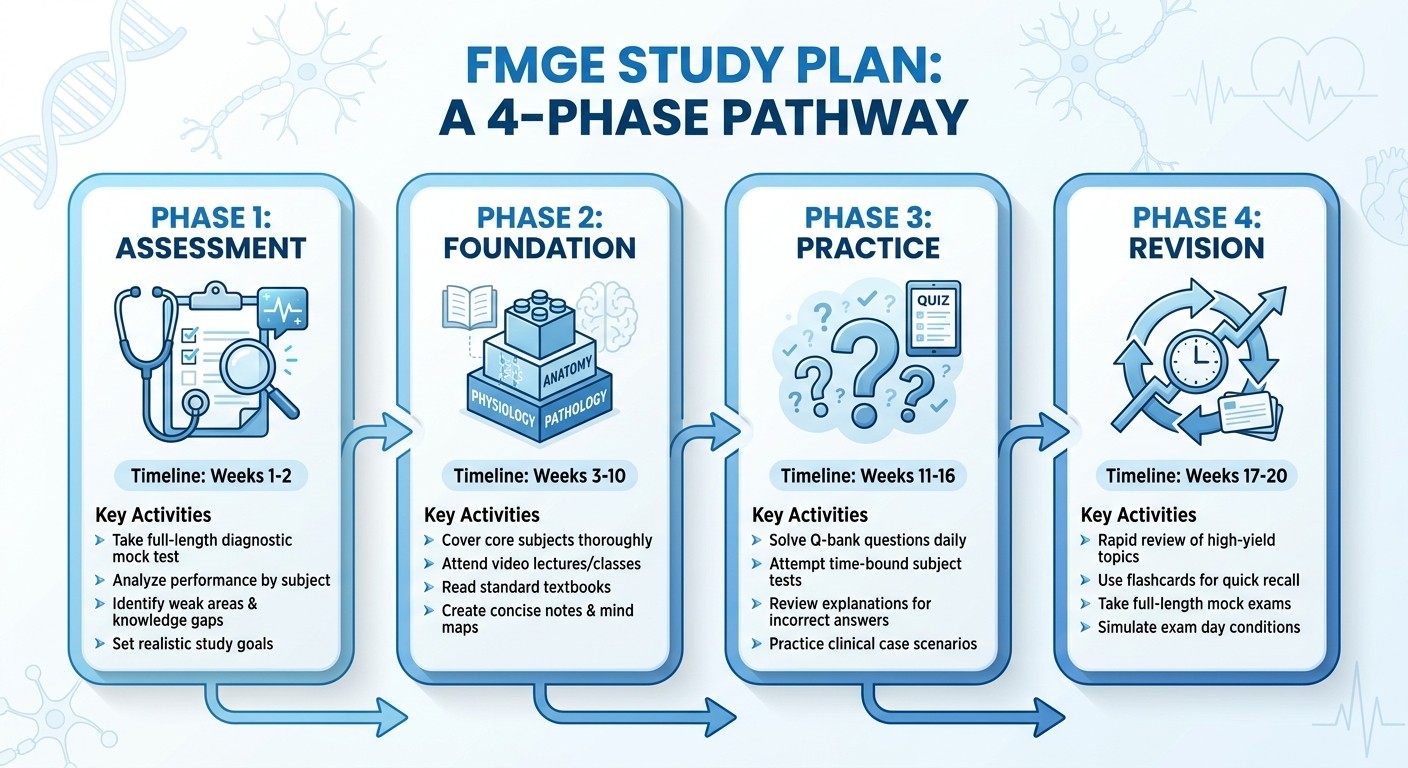
Phase 1: Baseline Assessment (Weeks 1-2)
Start with diagnostic testing, not subject review. Take 3-4 mixed practice tests of 75 questions each, covering all major subjects. Dont study beforehand — you need honest data.
Track accuracy by subject:
Medicine: Aim for 65%+ baseline
Surgery: Target 60%+ baseline
OB-GYN: Expect 55%+ baseline
Pediatrics: Look for 60%+ baseline
Community Medicine: Target 50%+ baseline
Pathology: Aim for 65%+ baseline
Pharmacology: Expect 55%+ baseline
Anything below these baselines becomes a priority subject. Create a weakness map showing your bottom 3 subjects and the specific topics within them where you consistently miss questions.
During this phase, Oncourse's Performance Analytics dashboard converts your practice history into a clear map of weak subjects, systems, and recurring mistakes — making it easy to spot patterns you might miss reviewing individual tests.
Phase 2: Foundation Repair (Weeks 3-8)
Dedicate 60% of your study time to your weakest 3 subjects. If Community Medicine, Pharmacology, and OB-GYN are your problem areas, structure your day around these.
Sample daily split for foundation repair:
2 hours: Weakest subject (detailed concept review)
1.5 hours: Second weakest subject (focused practice)
1 hour: Third weakest subject (quick review + MCQs)
1 hour: Maintenance review of strong subjects
30 minutes: Mixed practice questions
The key is depth over breadth. Better to master Community Medicine's biostatistics and epidemiology than to skim all 19 subjects superficially.
Create topic-specific error logs. When you miss a Pharmacology question about beta-blockers, dont just mark it wrong. Note the mechanism you confused, the clinical correlation you missed, or the drug name you mixed up. These patterns repeat on the FMGE.
Phase 3: Intensive Practice (Weeks 9-16)
Shift to 50% weak areas, 50% mixed practice. Take full-length 300-question tests weekly. Your accuracy targets should be improving:
Week 9-12: Aim for 55%+ overall accuracy
Week 13-16: Target 60%+ overall accuracy
After each mock test, spend 2-3 hours on detailed analysis. Which subjects dragged your score down? Which topics within those subjects? Which types of mistakes — knowledge gaps, silly errors, or time pressure?
This is where Oncourse's AI Question Bank with Rezzy tutor shines. Instead of just seeing "wrong answer," you can ask follow-up questions about why other options were incorrect, clarify mechanisms you missed, or explore related concepts that might appear on the actual exam.
Adjust your daily plan every 2 weeks based on mock results. If your Medicine accuracy jumps from 60% to 72%, reduce daily Medicine time and add more to your persistent weak areas.
Phase 4: Final Revision (Weeks 17-20)
The last month should be 70% revision, 30% new weak-area work. Take 2 full-length mocks per week. Your target accuracy: 65%+ overall, with no subject below 50%.
Focus on rapid review cycles. Use spaced repetition for your error log. Review missed questions from 1 week ago, 2 weeks ago, and 1 month ago on alternating days.
Build high-yield topic lists for each subject. For Community Medicine: vaccination schedules, biostatistics formulas, NHM programs. For OB-GYN: labor stages, contraception mechanisms, antenatal care protocols. These lists become your final week review material.
How to Identify Your FMGE Weak Areas
Weak area identification needs to be systematic, not based on how difficult a subject feels. Your brain lies to you about what you know.
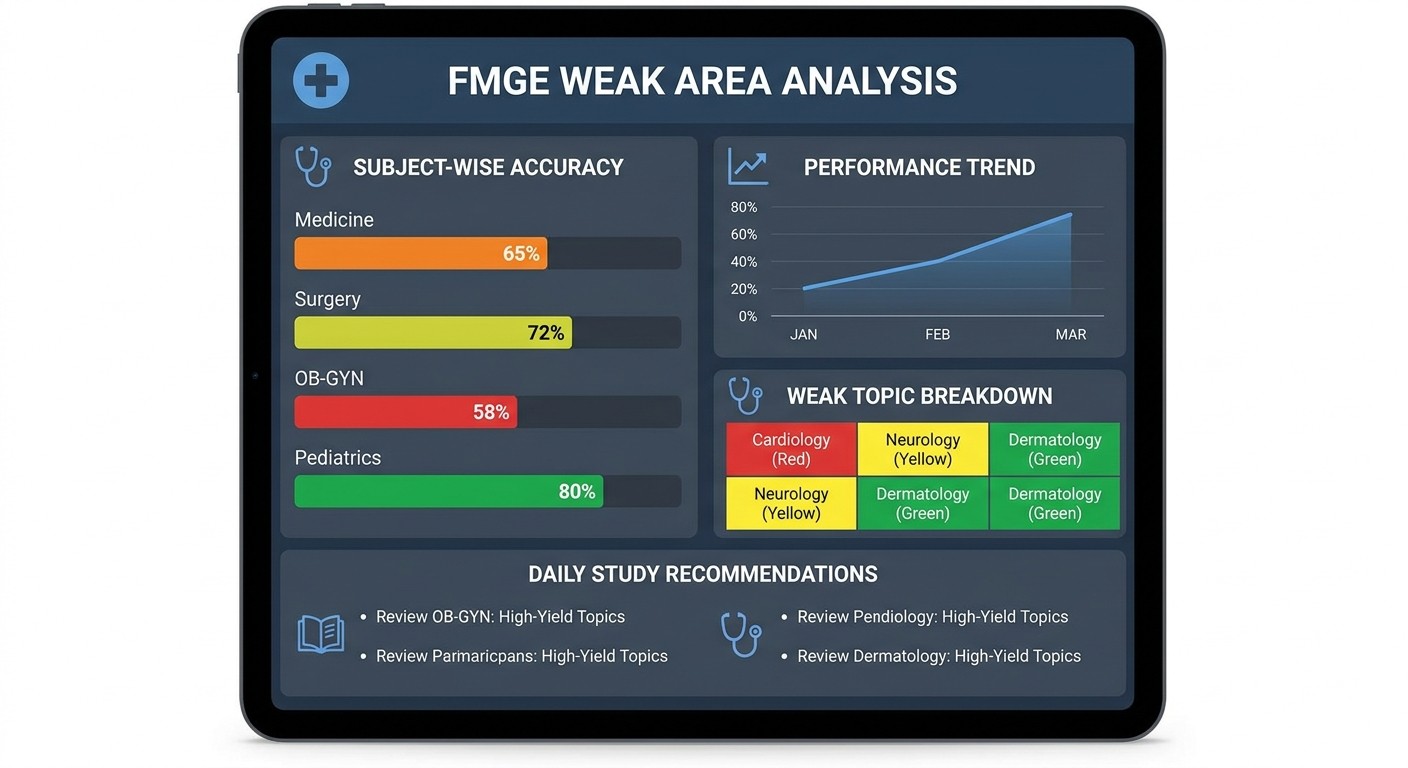
Track These Metrics Daily
Subject-wise accuracy: Calculate your correct percentage for each of the 19 FMGE subjects over the last 100 questions you attempted. Anything below 60% needs attention. Topic-specific patterns: Within weak subjects, which subtopics consistently trip you up? In Medicine, is it cardiology, endocrinology, or infectious diseases? In Surgery, is it trauma, orthopedics, or GI surgery? Error types: Categorize your mistakes:
Knowledge gaps (you didnt know the concept)
Application errors (you knew the concept but couldnt apply it)
Silly mistakes (you knew the answer but marked wrong)
Time pressure errors (you ran out of time)
Question stem patterns: Do you struggle more with case-based questions, direct factual questions, or image-based questions? FMGE heavily favors clinical application, so case-based weakness is particularly problematic.
The 2-Week Testing Cycle
Every 2 weeks, take a comprehensive assessment:
Week 1-2: Track daily practice performance Week 3: Take full-length mock test Week 4: Analyze results and adjust study plan
If your Community Medicine accuracy hasn't improved after 2 weeks of focused study, change your approach. Switch from passive reading to active recall. Use flashcards instead of notes. Practice more case-based questions instead of fact-based ones.
When you consistently score above 70% in a subject for 2 weeks running, that subject graduates to maintenance mode. You still review it but spend the freed-up time on your next-weakest area.
Building Your Daily Adaptive Plan
Your daily schedule should change based on your most recent performance data. Here's the framework:
The 6-Hour Daily Structure
Hour 1: Weakest Subject Deep Dive
Your worst-performing subject gets the first hour when your brain is freshest. If Pharmacology is your problem, spend this hour on mechanisms, not memorization. Understand why beta-blockers work differently in heart failure versus hypertension.
Hour 2: Weak Area MCQ Practice
Do 30-40 questions from your weak subject. Dont just mark right or wrong. For every question, identify why the correct answer is right and why each incorrect option is wrong. This builds the clinical reasoning the FMGE tests.
Hour 3: Second Weakest Subject
Apply the same deep-dive approach to your second-worst subject. Focus on your specific error patterns. If you keep missing Community Medicine statistics questions, work through biostatistics step-by-step until the formulas become automatic.
Hour 4: Mixed Practice
Take 40-50 questions across all subjects, mimicking FMGE distribution. Use this to maintain your strong subjects and check whether your weak-area work is paying off in mixed contexts.
Hour 5: High-Yield Review
Review your error log from the previous week. Focus on questions you got wrong initially but should now be able to answer correctly. If you still cant answer them, these topics need more foundation work.
Hour 6: Next-Day Planning
Review today's performance. Which subject needs more time tomorrow? Which topics are clicking and which still confuse you? Adjust tomorrow's plan accordingly.
Weekly Adjustments
Every Sunday, calculate your weekly performance:
Subject-wise accuracy for the week
Total questions attempted
Error log additions
Mock test performance (if applicable)
If your weakest subject improved by more than 10%, reduce its daily time allocation. If it stagnated or worsened, increase its allocation and change your approach.
The goal isnt to follow the same plan every day. The goal is to let your performance data guide where you spend time.
Mock Test Analysis That Actually Works
Taking mocks isnt enough. Most students look at their score, feel good or bad, then move on. Effective mock analysis takes 2-3 hours per test and drives your next 2 weeks of study.
The 4-Layer Analysis Method
Layer 1: Overall Performance
Overall accuracy: Is it trending upward?
Time management: Did you finish all 300 questions?
Subject distribution: Which subjects helped or hurt your score?
Layer 2: Subject Deep-Dive
For each subject, calculate:
Questions attempted vs. questions available
Accuracy within that subject
Average time per question in that subject
Types of questions missed (factual, case-based, image-based)
Layer 3: Error Classification
For every wrong answer, categorize it:
Type A: Knowledge gap (you didnt know the concept)
Type B: Application error (you knew the concept but misapplied it)
Type C: Silly mistake (you knew the answer but marked wrong)
Type D: Time pressure (you guessed due to time constraints)
Layer 4: Pattern Recognition
Look for patterns across multiple mocks:
Which subjects consistently underperform?
Which error types are most common for you?
Which question formats give you the most trouble?
Which time periods during the test show accuracy drops?
Translating Analysis into Action
After analysis, create specific action items:
For Type A errors (knowledge gaps): Add these topics to your weak-area review. Spend extra time on concept understanding, not just memorization. For Type B errors (application mistakes): Practice more case-based questions in these areas. You know the facts but struggle to apply them clinically. For Type C errors (silly mistakes): Slow down during practice. Read question stems twice. Double-check your marked answers before moving on. For Type D errors (time pressure): Practice timed sets more frequently. Work on question elimination strategies. Some questions can be answered in 30 seconds, others need the full 54 seconds.
Using Oncourse's Adaptive Daily Plan feature, these insights get automatically converted into adjusted study recommendations, rebalancing your weak subjects and time allocation without you having to manually recalculate everything.
Revision Strategy for Maximum Retention
FMGE preparation isnt just about learning new material. Its about retaining what you have learned while continuously adding to it. This requires systematic revision that adapts to your forgetting patterns.
The 3-Cycle Revision System
Daily Review Cycle: Every day, review missed questions from:
Yesterday (immediate reinforcement)
3 days ago (short-term retention check)
1 week ago (medium-term retention check)
Weekly Review Cycle: Every Sunday, comprehensive review of:
All questions missed this week
High-yield topics from your weak subjects
Flashcards for facts that you keep forgetting
Monthly Review Cycle: First Sunday of each month:
Full subject reviews for your previously weak areas
Complete mock test with comprehensive analysis
Adjustment of your weak-area focus based on monthly trends
Spaced Repetition for Medical Facts
FMGE tests thousands of discrete facts alongside clinical reasoning. Use spaced repetition intervals:
New fact: Review after 1 day, 3 days, 1 week, 2 weeks, 1 month Missed fact: Reset to 1-day interval regardless of previous progress Mastered fact: Extend intervals to monthly or longer
For example, if you keep forgetting the mechanism of ACE inhibitors, dont just re-read the chapter. Create a flashcard, practice it daily until you get it right 3 days in a row, then space it out to weekly review.
Final 30-Day Strategy
The last month before FMGE requires a different approach. You are no longer learning new concepts — you are optimizing what you already know.
Weeks 29-30: Intensive Mock Phase
Take one full-length mock every other day. Spend the off-days doing detailed analysis and targeted review of missed topics. Your accuracy should be trending toward 65%+ overall.
Focus on time management. You have 54 seconds per question on average, but you should aim to bank time on easier questions (30-40 seconds) to spend more time on complex cases (60-90 seconds).
Practice educated guessing. With no negative marking, you should attempt all 300 questions. Learn to eliminate 1-2 obviously wrong options quickly, then make your best guess from the remaining choices.
Weeks 31-32: Rapid Revision
Stop taking full mocks. Instead, do 2-3 timed 75-question sets daily. This maintains your test-taking stamina while allowing more time for targeted review.
Create ultra-high-yield lists for each subject:
Community Medicine: Top 20 biostatistics formulas, vaccination schedules, NHM program details
OB-GYN: Labor stages, contraception mechanisms, high-risk pregnancy criteria
Medicine: ECG patterns, diabetes management protocols, common drug mechanisms
Surgery: Trauma scoring systems, common surgical procedures, anatomy landmarks
Review these lists daily. They should be facts you can recall instantly.
Final Week: Confidence Building
Take 2-3 moderate-difficulty mock tests. Avoid anything too challenging that might shake your confidence. Review your error logs one final time, focusing on patterns you have already addressed.
The day before FMGE, do light review only. Read through your high-yield lists once. Take a short 50-question practice set to keep your brain engaged but not exhausted.
Common Mistakes to Avoid
Mistake 1: Ignoring Your Strong Subjects
Just because you score 75% in Pediatrics doesnt mean you should ignore it completely. Strong subjects need maintenance review — about 15-20% of your daily study time. Let them slide too far and they will drag down your overall score.
Mistake 2: Changing Plans Too Frequently
Adjust your study plan every 2 weeks, not every day. It takes time to see improvement from focused work. If you change your approach every few days based on single bad performances, you never give any method enough time to work.
Mistake 3: Focusing Only on Accuracy
Time management matters as much as knowledge. If you get 80% accuracy but only attempt 250 questions, you will fail. Practice speed alongside accuracy. Use elimination strategies. Guess intelligently on questions you dont know.
Mistake 4: Neglecting Error Analysis
Taking mocks without detailed analysis is like going to the gym without a plan. You are doing work, but its not targeted work. Spend 2-3 hours analyzing every mock test. Your analysis should take longer than the test itself.
Mistake 5: Memorizing Instead of Understanding
FMGE tests clinical application, not rote memorization. Understand the why behind medical facts. Know not just that ACE inhibitors lower blood pressure, but how they work, when you use them, what their side effects are, and how they differ from other antihypertensives.
Frequently Asked Questions
How long should I spend on FMGE preparation?
Most successful candidates spend 4-6 months in focused preparation. If you have strong MBBS fundamentals, 4 months is often sufficient. If your basics need work or you have been away from studies for several years, plan for 6 months.
Can I prepare for FMGE while working?
Yes, but it requires strict time management. Dedicate 2-3 hours daily on weekdays and 4-5 hours on weekends. Focus on high-yield subjects (Medicine, Surgery, OB-GYN, Community Medicine) first. Use your clinical work as reinforcement for FMGE concepts when possible.
How often should I take mock tests?
During foundation phase (weeks 1-8): One mock test every 2 weeks
During practice phase (weeks 9-16): One mock test per week
During revision phase (weeks 17-20): Two mock tests per week
Each mock should be followed by 2-3 hours of detailed analysis. Quality of analysis matters more than quantity of tests.
What accuracy should I target in mock tests?
8 weeks before FMGE: 50%+ overall accuracy 4 weeks before FMGE: 60%+ overall accuracy 1 week before FMGE: 65%+ overall accuracy
Remember that FMGE pass mark is 50% (150/300), but aiming higher gives you a safety buffer and accounts for exam-day stress.
How do I handle subjects I consistently struggle with?
For persistently weak subjects, change your learning method, not just your time allocation. If reading textbooks isnt working for Pharmacology, try video lectures, flashcards, or teaching the concepts to someone else. Sometimes a different approach clicks better than just more time.
Should I study all 19 FMGE subjects equally?
No. Focus time allocation on subject weightage and your personal weaknesses. Medicine, Surgery, OB-GYN, and Community Medicine carry the most questions. Within your weak subjects, prioritize the highest-yield topics that appear most frequently on past FMGEs.
An adaptive FMGE study plan works because it treats you as an individual, not as a generic medical graduate. It diagnoses your specific weaknesses, targets your limited study time where you need it most, and evolves as your knowledge grows.
The students who pass FMGE dont necessarily study the longest — they study the smartest. They know exactly where their knowledge gaps are, they have systems to fix those gaps systematically, and they track their progress objectively through regular testing and analysis.
Prepare smarter with Oncourse AI — adaptive MCQs, spaced repetition, and AI explanations built for FMGE. Download free on Android and iOS.