FMGE 2026: Complete Exam Guide, Eligibility, and Preparation Tips
Comprehensive guide to FMGE 2026 with exam pattern, eligibility criteria, preparation strategies, and expert tips for foreign medical graduates.
FMGE 2026: Complete Exam Guide, Eligibility, and Preparation Tips
The Foreign Medical Graduate Examination (FMGE) 2026 is your gateway to practicing medicine in India as a foreign medical graduate. With over 15,000 students appearing annually and a pass rate of approximately 15-20%, FMGE demands strategic preparation and thorough understanding of the exam pattern.
This comprehensive guide covers everything you need to know about FMGE 2026, including eligibility criteria, exam structure, preparation strategies, and expert tips to maximize your chances of success.
What is FMGE 2026?
The Foreign Medical Graduate Examination (FMGE) is conducted by the National Board of Examinations (NBE) for foreign medical graduates who wish to practice medicine in India. FMGE 2026 serves as a screening test to ensure that foreign medical graduates meet the required standards of medical education equivalent to Indian medical colleges.
Passing FMGE is mandatory for foreign medical graduates to obtain registration with the Medical Council of India (MCI) or State Medical Councils, making it the most crucial step toward medical practice in India.
Key FMGE 2026 Statistics
Parameter | Details |
|---|---|
Conducting Body | National Board of Examinations (NBE) |
Exam Mode | Computer-based Test (CBT) |
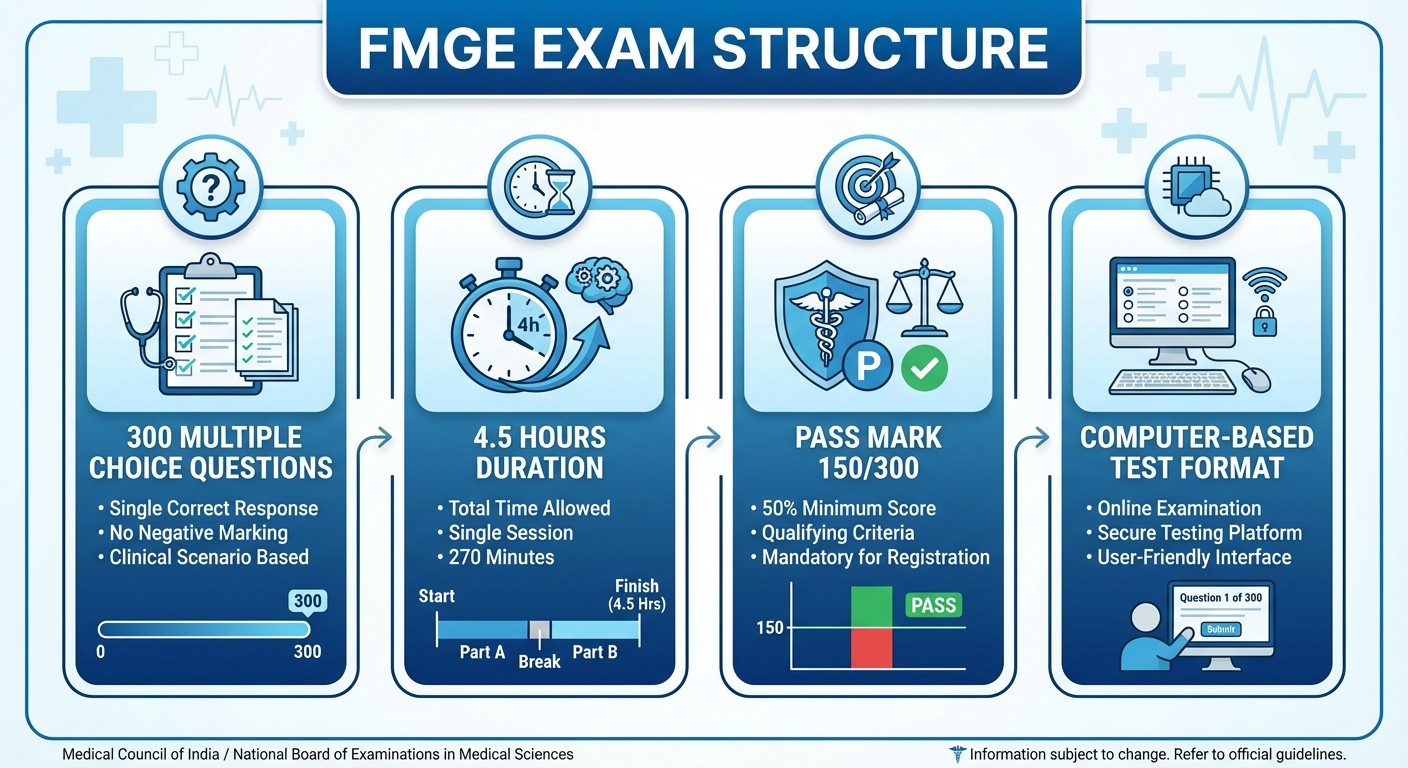
Total Questions | 300 Multiple Choice Questions |
Exam Duration | 4 hours 30 minutes |
Pass Mark | 150/300 (50%) |
Annual Candidates | 15,000+ |
Average Pass Rate | 15-20% |
FMGE 2026 Eligibility Criteria
Understanding FMGE eligibility is crucial before starting your preparation journey. The NBE has specific requirements that all candidates must fulfill.
Educational Qualification Requirements
1. Medical Degree: Candidates must possess a primary medical qualification (MBBS or equivalent) from a medical institution outside India
2. Course Duration: The medical course duration must be equivalent to MBBS as per MCI regulations
3. Recognition: The medical institution must be recognized by the respective country's medical council
4. Medium of Instruction: The course should have been conducted in English
Additional Eligibility Conditions
Internship: Completion of mandatory internship (if required by the country where the degree was obtained)
Age Limit: No specific age limit for FMGE 2026
Attempt Limit: No restriction on the number of attempts
Document Verification: All educational documents must be verified and authenticated
Documents Required for FMGE 2026
Medical degree certificate (original and attested copies)
Mark sheets of all professional examinations
Internship completion certificate
Certificate of recognition from the medical council of the respective country
Passport and visa documents
Photographs and identity proof
FMGE 2026 Exam Pattern and Structure
The FMGE exam pattern has evolved over the years, and understanding the current structure is essential for effective preparation.
Exam Format Details
Question Type: All questions are Multiple Choice Questions (MCQs) with four options each. Only one option is correct for each question. Negative Marking: There is no negative marking in FMGE, so candidates should attempt all questions. Time Management: With 300 questions in 270 minutes, candidates get approximately 54 seconds per question.
Subject-wise Distribution
FMGE covers the following major subjects based on undergraduate medical curriculum:
Subject | Approximate Questions |
|---|---|
Medicine | 70-80 questions |
Surgery | 60-70 questions |
Obstetrics & Gynecology | 40-50 questions |
Pediatrics | 40-50 questions |
Preventive & Social Medicine | 25-30 questions |
Pharmacology | 20-25 questions |
Pathology | 20-25 questions |
Microbiology | 15-20 questions |
Forensic Medicine | 10-15 questions |
Others | 10-15 questions |
High-Yield Topics for FMGE 2026
Based on previous year analysis, certain topics consistently appear in FMGE:
Medicine: Cardiology (MI, Heart Failure), Endocrinology (Diabetes, Thyroid), Respiratory Medicine (Pneumonia, TB), Nephrology (CKD, AKI) Surgery: GI Surgery, Trauma, Orthopedics (Fractures), Urology Obstetrics & Gynecology: High-risk pregnancy, labor complications, menstrual disorders Pediatrics: Growth and development, immunization, neonatal medicine Community Medicine: Epidemiology, biostatistics, national health programs
How to Check FMGE 2026 Exam Dates
The NBE typically releases FMGE exam dates 2-3 months before the examination. Here's how to stay updated:
Official Announcement Channels
1. NBE Website: Visit natboard.edu.in for official notifications
2. Information Bulletin: Download the detailed information bulletin from the NBE portal
3. Email Alerts: Register for email notifications on the NBE website
4. Mobile App: Download the NBE mobile application for instant updates
Expected FMGE 2026 Timeline
Event | Expected Timeframe |
|---|---|
Notification Release | March 2026 |
Application Start | April 2026 |
Application End | May 2026 |
Admit Card Release | June 2026 |
Exam Date | July 2026 |
Result Declaration | August 2026 |
FMGE 2026 Preparation Strategy
Success in FMGE requires a structured approach combining conceptual understanding with extensive practice. Here's a proven preparation strategy:
Phase 1: Foundation Building (6-8 months)
Subject-wise Approach: Start with high-weightage subjects like Medicine and Surgery. Use standard textbooks recommended for Indian medical curriculum. Conceptual Clarity: Focus on understanding basic concepts rather than rote memorization. FMGE tests application of knowledge in clinical scenarios. Resource Utilization: Leverage comprehensive study materials from platforms like Oncourse, which offers specialized FMGE preparation resources with 40,000+ high-yield questions and flashcards.
Phase 2: Question Practice (3-4 months)
Previous Year Analysis: Solve at least 5 years of previous FMGE papers to understand question patterns and difficulty levels. Mock Tests: Take regular full-length mock tests to improve speed and accuracy. Aim for 2-3 mock tests per week. Weak Area Identification: Analyze mock test results to identify weak areas and focus additional study time on these topics.
Phase 3: Revision and Fine-tuning (1-2 months)
Quick Revision: Create concise notes for rapid revision. Focus on high-yield facts, drug doses, and normal values. Recent Advances: Stay updated with recent developments in medicine, especially new guidelines and treatment protocols. Stress Management: Maintain physical fitness and manage exam stress through regular exercise and relaxation techniques.
Best Study Resources for FMGE 2026
Recommended Textbooks
Medicine: Harrison's Internal Medicine (selected chapters), API Textbook of Medicine Surgery: Bailey & Love's Short Practice of Surgery, SRB's Manual of Surgery Obstetrics & Gynecology: DC Dutta's Textbook, Shaw's Textbook Pediatrics: Nelson Textbook of Pediatrics (essential chapters), Ghai Essential Pediatrics Community Medicine: Park's Textbook of Preventive and Social Medicine
Digital Learning Platforms
Oncourse AI: With its extensive question bank covering all FMGE subjects, Oncourse offers specialized FMGE preparation modules with detailed explanations and performance analytics. The platform's AI-powered learning system adapts to your progress and focuses on weak areas. Question Banks: Access to thousands of high-quality MCQs similar to FMGE pattern from Oncourse's question collection. Flashcards for Quick Revision: Utilize spaced repetition flashcards for efficient memorization of key facts and concepts.
Subject-wise Preparation Tips
Medicine Preparation Strategy
Medicine contributes the highest number of questions in FMGE. Focus on:
Cardiology: ECG interpretation, acute coronary syndromes, heart failure management
Endocrinology: Diabetes mellitus, thyroid disorders, adrenal diseases
Respiratory: Pneumonia protocols, TB management, COPD, asthma
Gastroenterology: Liver diseases, inflammatory bowel disease, GI bleeding
Study Tip: Create flowcharts for diagnostic and treatment algorithms. Practice case-based questions extensively.
Surgery Preparation Approach
Surgery questions often include clinical scenarios and image-based questions:
General Surgery: Acute abdomen, trauma management, surgical infections
Orthopedics: Fracture management, joint diseases, sports injuries
Urology: Kidney stones, prostate diseases, urinary tract infections
Study Tip: Understand surgical anatomy thoroughly. Practice identifying surgical instruments and procedures.
Obstetrics & Gynecology Focus Areas
Obstetrics: Antenatal care, labor management, pregnancy complications
Gynecology: Menstrual disorders, fertility issues, gynecologic oncology
Study Tip: Memorize normal values for pregnancy parameters. Understand contraception methods and their mechanisms.
Pediatrics Key Topics
Growth and Development: Milestones, growth charts, developmental assessment
Immunization: Schedule updates, contraindications, adverse effects
Neonatology: Birth asphyxia, neonatal sepsis, feeding issues
Study Tip: Create age-wise classification charts for various pediatric conditions.
Time Management and Exam Strategy
Pre-exam Preparation
Sleep Schedule: Maintain a regular sleep schedule for at least one week before the exam. Aim for 7-8 hours of quality sleep. Nutrition: Eat balanced meals and stay hydrated. Avoid trying new foods that might cause digestive issues. Document Check: Verify all required documents and keep multiple copies ready.
During the Examination
Time Allocation: Spend approximately 1 minute per question. Reserve 30 minutes at the end for review. Question Approach: Read questions carefully, eliminate obvious wrong options, and make educated guesses for uncertain answers. Stress Management: Stay calm and focused. If stuck on a question, mark it for review and move forward.
Common Mistakes to Avoid
Spending too much time on difficult questions
Leaving questions unanswered (no negative marking)
Changing answers without strong justification
Getting anxious about unfamiliar questions
FMGE Results and Next Steps
Result Declaration Process
FMGE results are typically declared 4-6 weeks after the examination. Results include:
Score: Your total score out of 300
Percentile: Your performance relative to other candidates
Qualification Status: Pass/Fail status based on minimum qualifying criteria
Post-FMGE Procedures
Medical Council Registration: Successful candidates must register with the Medical Council of India or respective State Medical Councils. Internship Requirements: Some candidates may need to complete additional internship requirements in India. Career Options: Explore opportunities in clinical practice, residency programs, or healthcare management.
Frequently Asked Questions
Is 6 months enough for FMGE preparation?
While 6 months can be sufficient for dedicated students with strong foundation, 8-12 months of structured preparation is recommended for optimal results. The key is consistency and quality of study rather than just duration.
Can I use NEET PG study materials for FMGE?
Yes, many NEET PG study materials are relevant for FMGE as both exams cover similar undergraduate medical topics. However, FMGE has its specific pattern and emphasis areas that require targeted preparation.
What is the best time to start FMGE preparation?
Ideally, start FMGE preparation 10-12 months before your target exam date. This allows sufficient time for comprehensive coverage of all subjects and extensive practice.
How important are mock tests for FMGE success?
Mock tests are crucial for FMGE success. They help in time management, identify weak areas, and build exam confidence. Aim to take at least 50-100 full-length mock tests during your preparation.
Should I focus more on clinical subjects or basic sciences?
FMGE predominantly focuses on clinical subjects (Medicine, Surgery, ObGyn, Pediatrics) which constitute about 80% of the exam. However, don't completely ignore basic sciences as they provide the foundation for clinical understanding.
Conclusion
FMGE 2026 represents a significant milestone for foreign medical graduates aspiring to practice in India. Success requires systematic preparation, consistent practice, and strategic approach to the examination.
Key takeaways for FMGE 2026 preparation:
Start early with a structured study plan
Focus on high-yield topics and question practice
Utilize comprehensive resources like Oncourse's FMGE preparation modules
Take regular mock tests and analyze performance
Maintain physical and mental health throughout preparation
Remember, FMGE is challenging but definitely achievable with the right strategy and dedication. With proper preparation and resources, you can join the successful candidates who clear FMGE and build rewarding medical careers in India.
Start your FMGE 2026 preparation today with confidence, and take the first step toward your medical career goals in India. The journey may be demanding, but the reward of practicing medicine in one of the world's largest healthcare systems makes every effort worthwhile.