First Aid for USMLE Step 1 2026: How to Use It for Active Recall and Weak-Area Review
Master First Aid for USMLE Step 1 2026 with active recall techniques and systematic weak-area review. Learn proven strategies to turn passive reading into targeted practice that actually moves your score.

First Aid for USMLE Step 1 2026: How to Use It for Active Recall and Weak-Area Review
You probably already own First Aid for the USMLE Step 1. Maybe youve highlighted pages, maybe its still wrapped. But heres what 73% of Step 1 test-takers dont realize: First Aid isnt meant to be read cover to cover like a novel.
First Aid works best as a compact map — a reference tool that helps you decide what to actively recall, what to test, and what needs deeper review. The students who score highest treat it as the backbone of an active-recall system, not as passive reading material.
In this guide, youll learn exactly how to transform First Aid for the USMLE Step 1 2026 into an active learning tool that identifies your weak areas and converts them into targeted practice. No more passive rereading. No more comfortable highlighting sessions that feel productive but dont move your score.
What Makes First Aid for USMLE Step 1 2026 Different
The 2026 edition (36th edition, February 2026) includes several key updates worth understanding before you dive into your study plan:
Content Updates:- Enhanced diversity in clinical images reflecting current USMLE patient demographics
- Refined alignment with the current Step 1 content outline (Cardiovascular 7-11%, Respiratory/Renal 11-15%)
- Updated pharmacology sections covering FDA approvals through 2025
- Cleaner visual hierarchy separating high-yield facts from supporting details
- Better cross-references between organ systems for multisystem processes
- QR codes linking to online supplementary content
Setting Up First Aid for Active Recall (Not Passive Reading)
Your First Aid Should Look Different
Before you open to page one, understand this: your First Aid should become a working document, not a pristine textbook. But theres a right way and wrong way to annotate.
The Right Way to Annotate:- Use one color for gaps you discover from question bank misses
- Use a different color for concepts you keep forgetting during flashcard review
- Mark weak topics with sticky flags for quick navigation
- Create your own mnemonics in margins when First Aid's dont stick
- Highlight entire paragraphs (this creates the illusion of importance without focus)
- Copy long explanations from UWorld verbatim
- Add every minor detail you encounter
The 5-Minute First Aid Setup
1. Tab your weak systems: Based on your baseline NBME, tab the 3-4 organ systems where you scored lowest
2. Create a "Hit List" page: Use the inside front cover to list high-yield topics you consistently miss
3. Set up your question-tracking system: Use the back pages to track which First Aid pages connect to your missed questions
Converting First Aid Pages Into Active Recall Checklists
Each First Aid page should become a testing ground, not reading material. Heres exactly how to do it:
The Chapter-by-Chapter Active Recall Method
Before Reading Any Section: 1. Cover the page with your hand 2. Try to recall 3-5 key facts about the topic from memory 3. Uncover and check — what did you miss? 4. Mark gaps for targeted review Turn Facts Into Questions: Instead of reading "Atrial fibrillation: irregularly irregular rhythm," create active questions:- What rhythm pattern defines atrial fibrillation?
- How do you distinguish A-fib from other irregular rhythms?
- What are the anticoagulation criteria?
- Pass 1: Quick read-through, mark unfamiliar concepts
- Pass 2: Active recall on marked concepts, create questions
- Pass 3: Test yourself without looking, identify persistent weak spots
Identifying and Categorizing Your Weak Areas
Not all weaknesses are the same. Understanding the type of gap helps you choose the right First Aid strategy.
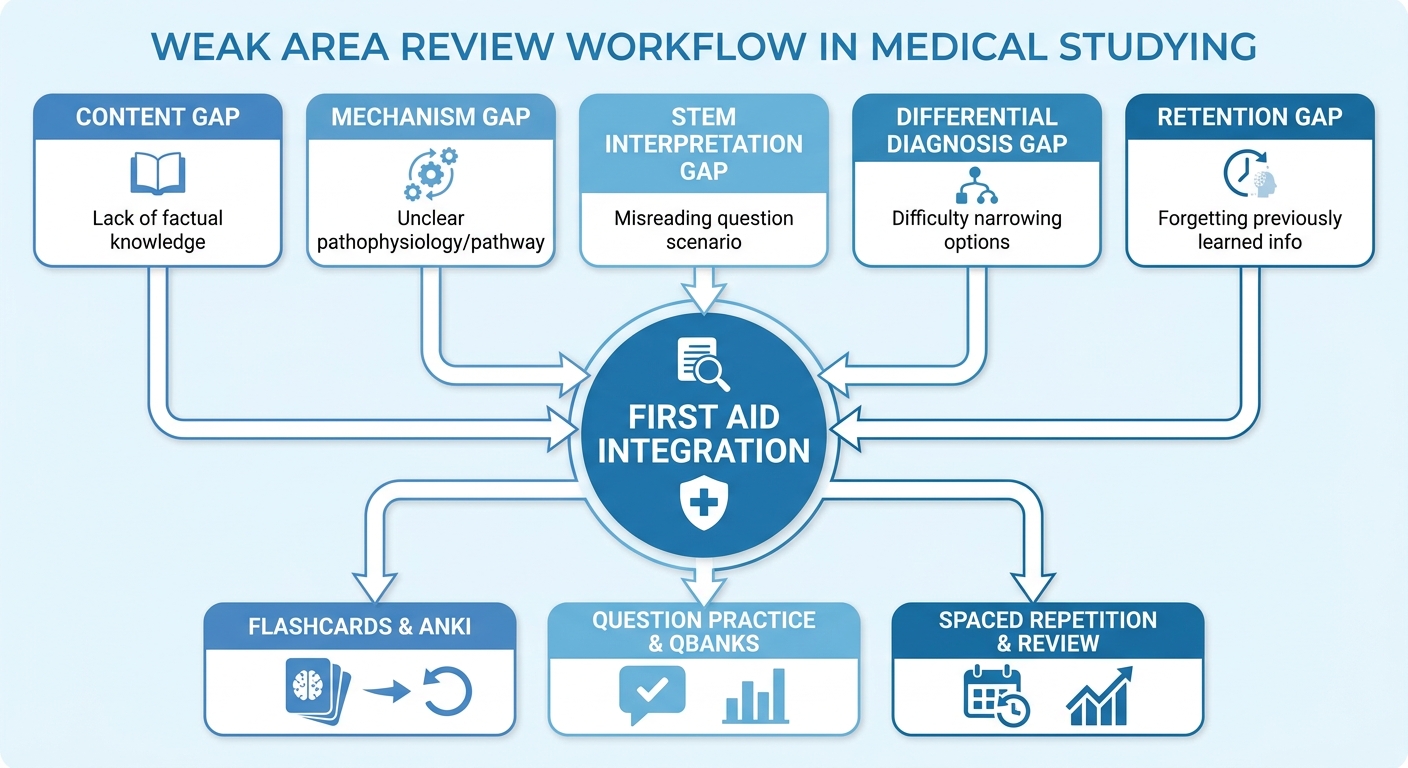
The 5 Types of Weak Areas
1. Content Gaps- You dont know the fact exists
- First Aid Strategy: Focus on high-yield facts, create flashcards for unknowns
- Example: Never heard of Kayser-Fleischer rings
- You know the fact but not the why
- First Aid Strategy: Use diagrams and pathways, connect cause-effect
- Example: Know ACE inhibitors lower BP, dont know the renin-angiotensin pathway
- You know the content but miss clinical context clues
- First Aid Strategy: Focus on "Real World" clinical boxes and image recognition
- Example: Know hyponatremia symptoms, miss them in a clinical vignette
- You jump to conclusions without considering alternatives
- First Aid Strategy: Study comparison tables, practice systematic thinking
- Example: See chest pain, think MI, miss PE or pneumothorax
- You knew it yesterday, forgot it today
- First Aid Strategy: Spaced repetition schedule, frequent self-testing
- Example: Keep forgetting drug side effects despite multiple reviews
Connecting First Aid to Your Question Bank Performance
First Aid becomes most powerful when it directly addresses your question bank mistakes. Heres the systematic approach:
The Question → First Aid → Retention Loop
After Missing a Question: 1. Identify the gap type (content, mechanism, interpretation, differential, retention) 2. Find the relevant First Aid page — this is where many students stop 3. Dont just reread — actively test the concept using the methods above 4. Create a connection between the missed question and the First Aid fact 5. Schedule a review in 2-3 days to test retentionThe Weekly First Aid Review Session
Every week, spend 30 minutes connecting your question bank performance to First Aid:
- Review your lowest-performing subjects from the past week
- Find the corresponding First Aid sections
- Create 5-10 active recall questions from those pages
- Test yourself on these questions throughout the week
The 90/60/30/14/7 Day Workflow
Your relationship with First Aid should evolve as you get closer to test day:
90 Days Out: Foundation Building
- Daily: 2-3 First Aid pages with active recall
- Focus: Building basic knowledge, identifying major gaps
- Method: Read → Cover → Recall → Test → Mark gaps
60 Days Out: Integration Phase
- Daily: Review 1-2 organ systems based on question performance
- Focus: Connecting concepts across systems
- Method: Cross-reference pages, build concept maps, practice explanations
30 Days Out: Weak-Area Intensive
- Daily: Target your 3 weakest First Aid sections
- Focus: Converting persistent weak spots into strengths
- Method: Rapid recall drills, teaching concepts out loud
14 Days Out: Rapid Review
- Daily: Quick pass through flagged pages and hit list
- Focus: Maintaining strengths, final weak-spot cleanup
- Method: 30-second recall tests per concept
7 Days Out: Confidence Building
- Daily: Light review of highest-yield facts
- Focus: Preventing last-minute panic, maintaining confidence
- Method: Skim familiar concepts, avoid new material
Common First Aid Mistakes That Kill Scores
Mistake #1: Rereading Comfortable Pages
You keep reviewing cardiology because it feels good, while ignoring nephrology where youre weak. Fix: Force yourself to spend 70% of review time on your bottom 3 systems.Mistake #2: Annotation Overload
Your First Aid looks like a rainbow, but you cant find anything. Fix: Stick to 2 colors maximum — one for gaps, one for high-yield additions.Mistake #3: Ignoring Incorrect Answer Choices
You review why A is correct but ignore why B, C, D were wrong. Fix: For each missed question, identify which First Aid concepts explain why each distractor is incorrect.Mistake #4: No Gap Categorization
You mark something as "weak" without understanding why. Fix: Always classify gaps (content, mechanism, interpretation, differential, retention) to choose the right First Aid strategy.Mistake #5: Using First Aid as a Question Substitute
You think reading First Aid replaces doing practice questions. Fix: First Aid supports question-based learning, never replaces it.Many students avoid these mistakes by using Oncourses Synapses feature for quick recall drills on First Aid concepts, helping them identify which facts theyre truly retaining versus just recognizing.
Advanced First Aid Integration Techniques
The First Aid Teaching Method
After studying a section, explain it out loud as if youre teaching it to a classmate. This reveals gaps in understanding that passive reading misses.The First Aid Cross-Reference System
When you find a concept mentioned in multiple First Aid sections, create cross-reference notes. This builds the system-based thinking Step 1 rewards.The First Aid → Flashcard Pipeline
Dont create flashcards from every First Aid fact. Only make cards for concepts you miss during active recall or question practice. This keeps your deck focused and high-yield.When students need help clarifying confusing First Aid explanations, they often turn to Oncourses explanation chat feature to ask follow-up questions and get AI-powered clarification without switching between multiple resources.
Frequently Asked Questions
How do I use First Aid for USMLE Step 1 2026?
Use First Aid as an active recall tool, not for passive reading. Cover sections, try to recall key facts, then check your accuracy. Focus review time on gaps identified through question bank performance.Is First Aid enough for Step 1?
No. First Aid is a reference tool that supports question-based learning. Success requires combining First Aid review with extensive question practice, not treating it as standalone study material.How many passes of First Aid should I do?
Quality over quantity. Rather than counting passes, focus on converting weak areas into active recall questions. Most successful students do 2-3 focused passes targeting their specific gaps.Should I annotate First Aid?
Yes, but strategically. Use one color for question bank gaps, another for retention issues. Avoid highlighting entire paragraphs or copying long explanations verbatim.How do I use First Aid with question banks?
After missing questions, identify the relevant First Aid section and actively test the concept rather than just rereading. Create connections between missed questions and First Aid facts for better retention.How do I review weak areas effectively?
Categorize weaknesses (content, mechanism, interpretation, differential, retention) and use targeted First Aid strategies for each type. Focus 70% of study time on your lowest-performing systems.Turn your First Aid into an active learning system and strengthen your weak areas with targeted practice. Download Oncourse AI for adaptive question banks, spaced repetition flashcards, and AI explanations that help you master Step 1 concepts faster than passive review alone.