Average Step 2 Score: How Rezzy Tutor + Explanation Chat Changes USMLE Prep in 2026
The average Step 2 score hit 250 in 2026. Learn how AI-powered explanation chat and Rezzy tutor are helping students score 260+ through personalized weak area review and clinical reasoning training.

Average Step 2 Score: How Rezzy Tutor + Explanation Chat Changes USMLE Prep in 2026
You probably opened this because you have that nagging question every Step 2 student asks: "What score do I actually need?" The short answer? Higher than you think. The average Step 2 score hit 250 for first-time US MD takers in 2026, and it keeps climbing. But here's what matters more — how you get there has completely changed.
Traditional prep used to mean grinding question banks alone, hoping explanations would click. Now? AI tutors like Rezzy are turning every wrong answer into a personalized teaching moment. The students scoring above 260 arent just doing more questions. They're studying smarter with AI that adapts to exactly where they're stuck.
Let me break down what these scores really mean and how explanation chat is reshaping how the top scorers prepare.
What Is the Average Step 2 Score in 2026?
The numbers are clear: 250 is the new normal for first-time US MD graduates. This represents a steady 2-3 point increase each year since 2022 when Step 1 went pass/fail.
Here's the current breakdown:
- US MD graduates: 250 average
- DO graduates: 248 average
- Passing score: 218 (raised from 214 in July 2025)
- Competitive threshold: 260+ for most specialties
But averages only tell part of the story. The real shift is in how scores distribute by specialty.
Score Targets by Specialty (2026 Match Data)
| Specialty | Matched US MD Average | Competitive Range |
|---|---|---|
| Dermatology | 257 | 255-270+ |
| Orthopedic Surgery | 257 | 255-270+ |
| Diagnostic Radiology | 256 | 250-265 |
| Neurosurgery | 254 | 250-265 |
| General Surgery | 252 | 245-260 |
| Internal Medicine | 251 | 240-260 |
| Emergency Medicine | 248 | 240-255 |
| Family Medicine | 244 | 235-250 |
What These Scores Actually Mean
A 250 puts you at the 50th percentile. That sounds average, but it represents solid clinical knowledge across all major specialties. Here's how to interpret your position:
- 240-245: Safe for primary care, need strong application elsewhere
- 246-254: Competitive for most specialties, good backup options
- 255-262: Strong for surgical specialties, excellent for medicine
- 263+: Opens doors everywhere, including dermatology and radiation oncology
How Study Workflows Changed with AI Explanation Chat
Traditional Step 2 prep followed a predictable pattern: UWorld questions, read explanations, move on. Maybe flag tough ones for later review. This worked when the bar was lower, but it has serious gaps.
The problem? Generic explanations dont connect to your specific knowledge gaps. You might understand why Choice A is wrong but still be fuzzy on the underlying pathophysiology. Or you get the answer right but for the wrong reasons.
Rezzy's explanation chat changed this completely. Instead of one-size-fits-all explanations, you get personalized follow-up that builds on what you already know.The New Study Workflow
Here's how top scorers are using AI tutors to optimize their prep:
1. Active Question Review (15-20 minutes per block)- Complete your UWorld block as usual
- For each incorrect answer: chat with Rezzy about why you chose wrong
- For correct answers you guessed: ask for the step-by-step reasoning
- Request flowcharts for complex management decisions
- Identify your lowest-performing specialties from practice tests
- Ask Rezzy to create comparison tables (e.g., different types of heart failure)
- Generate diagnostic algorithms for common presentations
- Practice explaining concepts back to Rezzy in voice mode
- When you miss questions on similar concepts repeatedly
- Ask for bedside teaching scenarios: "Walk me through managing this diabetic in DKA"
- Request differential diagnosis frameworks for chief complaints
- Get mnemonics and memory aids for drug classifications
Using Rezzy for Weak Area Review
Every Step 2 student has that specialty that makes them nervous. Maybe it's pediatric cardiology. Maybe it's psychiatry medications. Whatever it is, explanation chat turns your weakness into a strength through targeted review.
The Weak Area Protocol
Week 1-2: Diagnostic Phase 1. Take a specialty-specific practice test or NBME 2. Identify topics where you scored <60% 3. For each weak topic, ask Rezzy: "What are the highest-yield concepts for [topic] on Step 2?" 4. Create a study schedule focusing 40% of your time on these areas Week 3-4: Deep Dive Phase 1. Study one weak specialty per day 2. After reading about a topic, quiz yourself with Rezzy 3. Ask for clinical scenarios: "Give me a Step 2-style vignette about [condition]" 4. Practice explaining management back to Rezzy Week 5-6: Integration Phase 1. Mixed practice tests emphasizing your former weak areas 2. Use explanation chat to connect related concepts 3. Ask Rezzy to compare similar conditions (e.g., inflammatory bowel diseases) 4. Test your teaching ability: explain complex topics to RezzyThis systematic approach works because it's personalized. Rezzy remembers your conversation history and builds on previous explanations. If you struggled with heart failure classifications last week, it will reference that context when explaining cardiomyopathies this week.
Real Example: Cardiology Weak Spot
Let's say you keep missing cardiology questions. Here's how explanation chat helps:
Traditional approach: Read First Aid cardiology, do cardiology questions, hope it sticks. AI-enhanced approach: 1. After missing an MI question, ask Rezzy: "I chose thrombolysis instead of PCI. Walk me through the decision-making." 2. Rezzy explains STEMI vs NSTEMI criteria, then asks: "What would change your management if this patient had a history of recent surgery?" 3. You work through contraindications together 4. Rezzy generates a flowchart: "STEMI Management Decision Tree" 5. Next session, it references this flowchart when you encounter chest pain questionsThe conversation builds your clinical reasoning instead of just adding more facts to memorize.
Realistic Study Workflows That Actually Work
The biggest mistake Step 2 students make? Following someone else's study schedule without adapting it to their baseline or target score. A student aiming for 270 needs a different approach than someone targeting 245.
Here are three evidence-based workflows that scale with your goals:
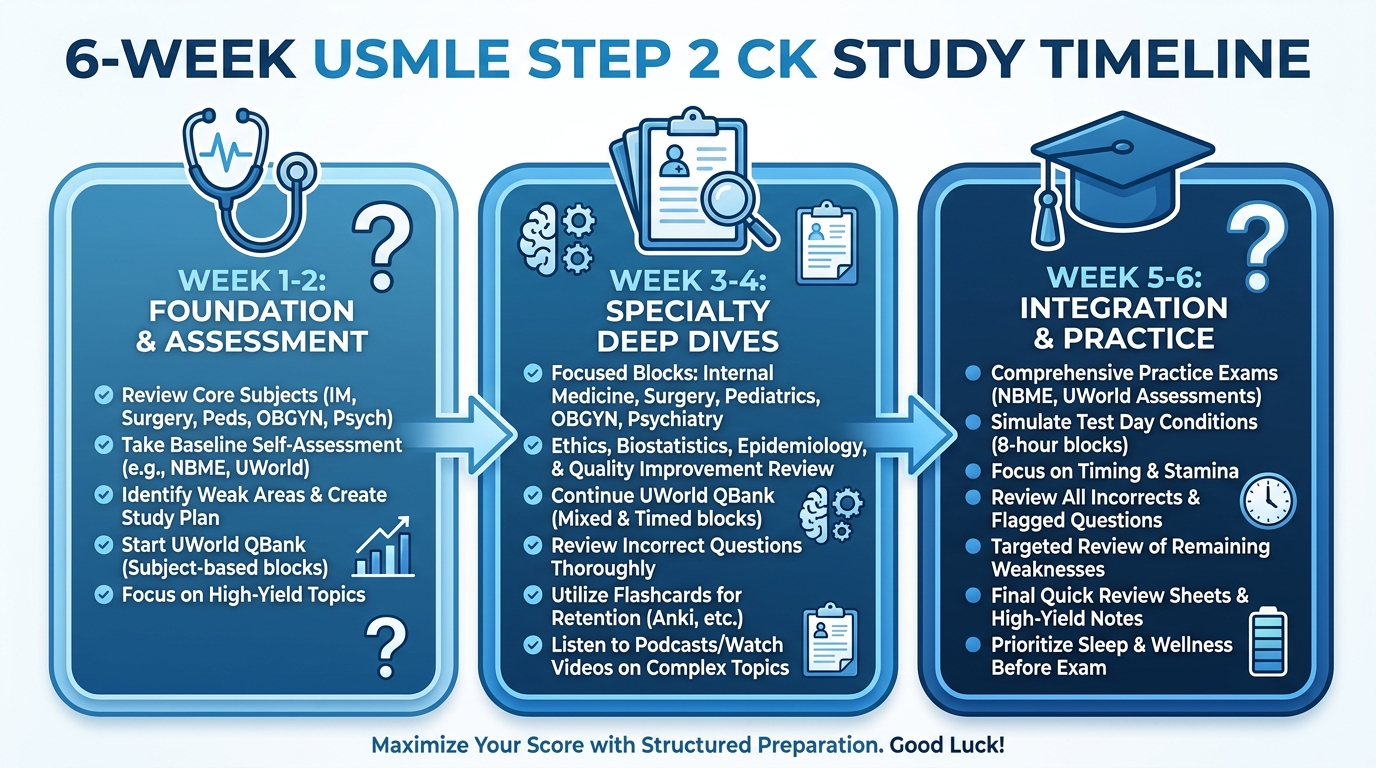
The 6-Week Standard Protocol (Target: 245-255)
Weeks 1-2: Foundation & Weak Area Identification- 2 UWorld blocks daily (80 questions)
- Step 2 CK lessons for high-yield topics
- Explanation chat for every incorrect answer
- Take first NBME to establish baseline
- 3 UWorld blocks daily (120 questions)
- Focus 60% of time on lowest-scoring specialties
- Practice questions by specialty for weak areas
- Daily Rezzy sessions to build clinical reasoning
- 2-3 blocks daily with mixed content
- Weekly practice NBMEs
- Spaced repetition flashcards for high-yield facts
- Final weak area review with Rezzy
The 4-Week Intensive (Target: 255-265)
For students with strong clinical rotation performance who need focused high-yield review:
Week 1: Rapid Assessment- 4 UWorld blocks daily (160 questions)
- Take NBME and UWSA within first 3 days
- Identify <5 weak areas for targeted focus
- Begin daily explanation chat sessions
- 3-4 blocks daily, entirely in weak areas
- Explanation chat for every question, right or wrong
- Create Rezzy-generated study aids (flowcharts, tables)
- Second practice test by end of Week 3
- 2 blocks daily with mixed content
- Final NBME 1 week before exam
- Light review of Rezzy-created materials
- Focus on test-taking strategy refinement
The 8-Week Deep Dive (Target: 260+)
For students targeting highly competitive specialties:
Weeks 1-3: Comprehensive Foundation- 2 UWorld blocks daily with thorough review
- Systematic content review using Step 2 lessons
- Daily explanation chat sessions building concept maps
- First practice test by Week 3
- 3 blocks daily focusing on hardest questions
- Teaching sessions with Rezzy (explain concepts back)
- Create comprehensive review materials with AI assistance
- Multiple practice tests to track improvement
- Maintain question volume but focus on speed
- Polish weak areas identified in recent practice tests
- Final memorization of high-yield facts using spaced repetition
- Peak confidence building with Rezzy explanations
Advanced Explanation Chat Techniques
Most students barely scratch the surface of what AI tutoring can do. Here are the advanced techniques that separate 260+ scorers from the pack:
The Socratic Method
Instead of asking "Why is this answer wrong?", use Rezzy to guide your thinking:- "What would you ask this patient next?"
- "Walk me through your differential diagnosis"
- "If the ECG showed X instead, how would that change things?"
Comparative Learning
Use Rezzy to create side-by-side comparisons:- "Make a table comparing different types of anemia"
- "Show me the differences between similar psychiatric conditions"
- "Create a flowchart for chest pain workup"
Voice Mode Mastery
Many students dont realize Rezzy has voice chat capabilities. This is game-changing for:- Explaining concepts aloud (tests true understanding)
- Hands-free review during commutes
- Practicing medical terminology pronunciation
- Building confidence in medical communication
Teaching Back Technique
The highest level of mastery: teach concepts back to Rezzy.- After learning about a condition, explain the pathophysiology to Rezzy
- Walk through a management algorithm step-by-step
- Justify why you'd choose one treatment over alternatives
How Score Interpretation Changed Since Step 1 Pass/Fail
The stakes for Step 2 scores have fundamentally shifted. Before 2022, a mediocre Step 2 could be offset by a stellar Step 1. Now Step 2 carries the entire numerical weight of your USMLE performance.
What Program Directors Actually Look For
Based on 2026 NRMP data, here's how scores influence matching:
240-245 Range:- Competitive for primary care (family, internal medicine, pediatrics)
- Need strong clinical grades and research for other specialties
- Geographic flexibility becomes important
- Safe for most specialties except surgical subspecialties
- Good backup options even if targeting competitive fields
- Score becomes less limiting factor than other application components
- Doors open to most specialties based on score alone
- Can overcome weaker research or clinical grades
- Geographic and program flexibility
The New Scoring Strategy
This changed landscape means your prep strategy should match your specialty goals:
If targeting primary care: Focus on consistent 245+ performance rather than chasing perfect scores. Use explanation chat to ensure you dont have any major knowledge gaps that could cause a bad test day. If targeting competitive specialties: Every point above 255 matters. Intensive explanation chat and AI-assisted weak area review become essential, not optional. If undecided on specialty: Aim for 255+ to keep all doors open. The opportunity cost of limiting your options is too high.Frequently Asked Questions
Is a 250 Step 2 score actually good in 2026?
A 250 is exactly average for first-time US MD graduates, which means it's competitive for most specialties but not outstanding. For internal medicine, emergency medicine, and primary care, 250 is solid. For surgical specialties and competitive fields, you'll want 255+ to be truly competitive.
How much can AI tutoring realistically improve my Step 2 score?
Students using explanation chat consistently see 10-20 point improvements over traditional prep alone. The biggest gains come from turning weak areas into strengths and building systematic clinical reasoning. However, your starting point matters — someone scoring 230 on practice tests has more upward potential than someone already at 250.
Should I delay my Step 2 if my practice scores are below average?
If you're consistently scoring below 240 on practice tests within 2 weeks of your exam, consider delaying. A failed attempt (below 218) is far worse than a delayed test date. Use explanation chat to identify exactly why you're missing questions — content gaps vs. test-taking issues require different solutions.
How many UWorld questions should I complete before taking Step 2?
Most successful students complete 80-100% of UWorld, but completion percentage matters less than how thoroughly you review each question. Using explanation chat to understand every incorrect answer from 60% of UWorld is better than rushing through 100% without deep review.
Do international students need higher Step 2 scores?
Yes. IMGs who matched averaged 242, while those who didn't match averaged 234. This 8-point difference suggests IMGs should target scores 5-10 points above the average for their desired specialty. AI tutoring becomes even more critical for identifying and fixing knowledge gaps that might not be obvious from practice test scores alone.
Can I rely on Rezzy instead of traditional resources like UWorld?
Rezzy works best as a supplement to, not replacement for, comprehensive question banks. Use UWorld for systematic practice and Rezzy for personalized explanation and weak area review. The combination of structured practice plus AI-enhanced learning gives you the best of both approaches.
---
The average Step 2 score might be 250, but getting there has never been more strategic. With explanation chat and AI tutoring, you're not just memorizing more facts — you're building the clinical reasoning patterns that actually matter on exam day.
The students scoring 260+ in 2026 arent necessarily smarter. They're using AI tools to study smarter, turning every practice question into a personalized teaching moment.
Prepare smarter with Oncourse AI — adaptive MCQs, spaced repetition, and AI explanations built for USMLE success. Download free on Android and iOS.