Average Step 2 Score: How Rezzy Tutor + Explanation Chat Changes USMLE Prep in 2026
Understand Step 2 CK score benchmarks by specialty and discover how Oncourse's Rezzy AI tutor with Explanation Chat transforms missed questions into targeted USMLE prep for higher scores.

Average Step 2 Score: How Rezzy Tutor + Explanation Chat Changes USMLE Prep in 2026
You get your NBME score back. 243. Is that good? Bad? What does it even mean?
The average Step 2 CK score hit 250 this year for US MD seniors, but here's what no one tells you: that number only matters if you understand what it means for your residency goals. More importantly, it only helps if you know how to actually improve from wherever you're starting.
The 2026 NRMP data shows Step 2 CK has become the primary screening metric since Step 1 went pass/fail. Programs use it to rank applicants before they even look at research or clinical grades. Your score doesn't just open doors — it determines which doors exist.
But here's where traditional prep falls short. You can memorize UWorld explanations and still miss the clinical reasoning patterns that separate a 240 from a 260. That's where Oncourse's Rezzy AI tutor changes everything. Instead of passive review, you get an AI that understands exactly where your thinking breaks down and fixes it in real-time.
Understanding Your Step 2 Score in Context
The New Score Landscape
Step 2 CK averages have climbed steadily. In 2026, the breakdown looks like this:
US MD Seniors (First-Time Takers):- Mean: 250 (50th percentile)
- 75th percentile: ~256
- 25th percentile: ~235
- 90th percentile: ~265
The score distribution means a 10-point jump from 245 to 255 takes you from the 35th to the 65th percentile. That's the difference between scrambling and matching your first choice.
Specialty-Specific Benchmarks
Your target score depends entirely on your residency goals. Here's what matched applicants averaged in 2026:
Ultra-Competitive (Mean 255-263):- Dermatology: 263
- Plastic Surgery: 261
- Orthopedic Surgery: 258
- Ophthalmology: 257
- Radiation Oncology: 256
- Anesthesiology: 252
- General Surgery: 252
- Urology: 253
- Emergency Medicine: 247
- Internal Medicine: 250
- Neurology: 249
- OB/GYN: 249
- Family Medicine: 244
- Pediatrics: 247
- Psychiatry: 246
- PM&R: 247
The Standard Error Reality Check
Your practice scores fluctuate ±6 points due to measurement error alone. That means a 248 and 254 on consecutive NBMEs might reflect testing conditions, not actual improvement.
Track trends over 4-5 assessments instead of obsessing over individual scores. If you're consistently scoring 245-250, your true ability likely sits in that range. Rezzy helps identify whether score improvements reflect real knowledge gains by analyzing your mistake patterns across topics.
How Traditional Question Banks Fall Short
Most students follow the same broken pattern: hammer UWorld, memorize explanations, repeat. But memorizing that "nitroglycerin treats angina" won't help you recognize atypical chest pain in a 65-year-old diabetic woman.
The Explanation Gap
Traditional explanations tell you why A is correct. They rarely explain why your brain picked C, or how to recognize the pattern that makes A obvious next time.
When you miss a heart failure question, the standard explanation covers pathophysiology, treatment algorithms, and diagnostic criteria. But it doesn't address why you confused systolic vs diastolic dysfunction, or why you fell for the distractor about BNP levels.
The Isolation Problem
Most prep resources treat questions as isolated events. You miss a question about hyponatremia, read a lengthy explanation, then move on. There's no connection to the dozen other electrolyte questions you've missed, no pattern recognition about how SIADH appears differently across Step 2 vignettes.
This is where comprehensive USMLE Step 2 CK lessons become crucial — they connect isolated facts into clinical reasoning frameworks.
Enter Rezzy: AI Tutoring That Actually Adapts
Oncourse's Rezzy AI tutor doesn't just explain answers. It understands why you made specific mistakes and adjusts its teaching approach accordingly.
Real-Time Error Analysis
When you pick the wrong answer, Rezzy analyzes your mistake pattern:
- Knowledge gap: You didn't know ACE inhibitors reduce preload and afterload
- Application error: You knew the facts but couldn't apply them to the clinical scenario
- Pattern recognition failure: You missed the diagnostic clues that point to heart failure with reduced ejection fraction
The Explanation Chat Advantage
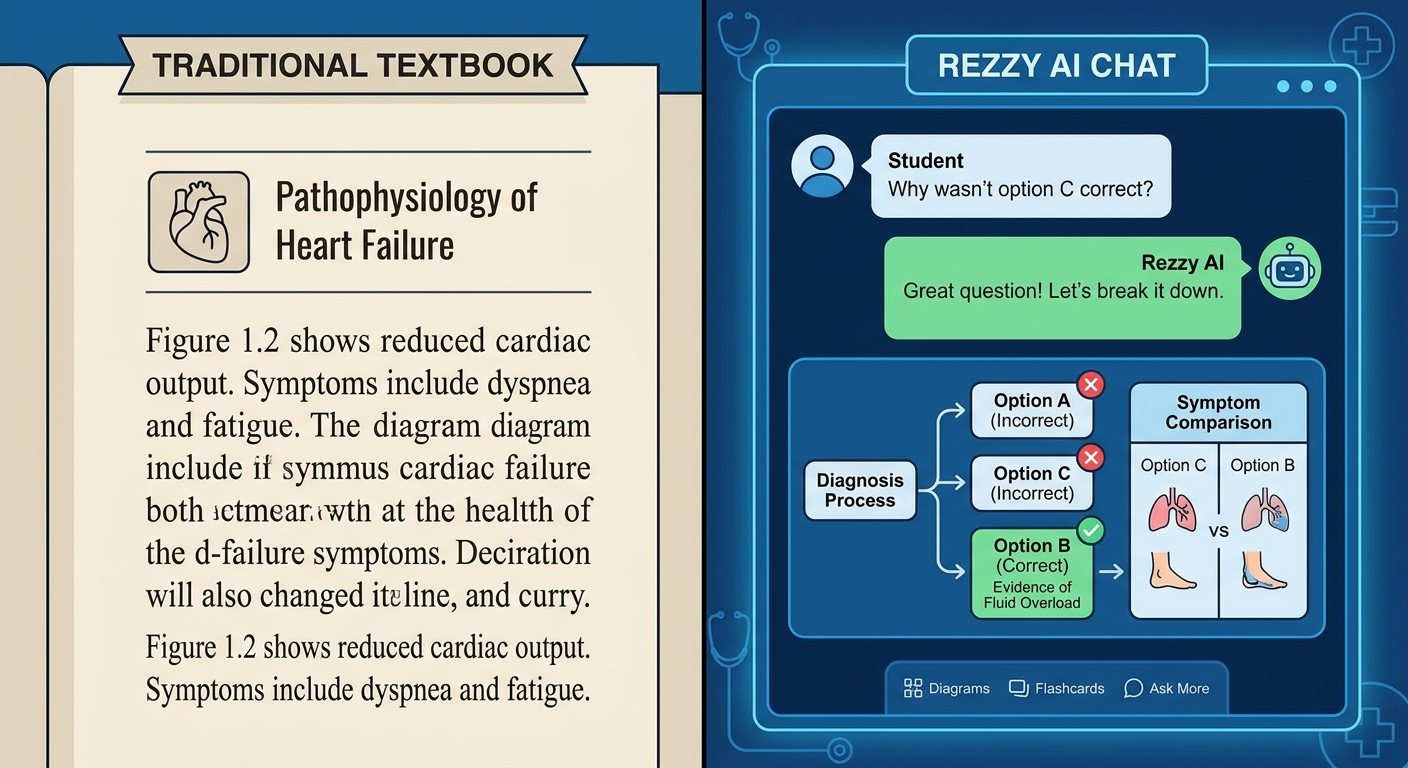
Here's where Rezzy transforms static learning into interactive understanding. After any explanation, you can ask:
- "Why wasn't furosemide the better choice here?"
- "Show me a flowchart for acute vs chronic heart failure management"
- "What would change if this patient had preserved ejection fraction?"
Personalized Learning Paths
Rezzy tracks your performance across all topics and adjusts future content accordingly. Miss three cardiology questions about murmurs? Your next study session prioritizes cardiac auscultation with focused Step 2 CK cardiology questions that target your specific weak spots.
This isn't random question selection. Rezzy identifies the underlying concepts you're struggling with and presents them through different clinical scenarios until the pattern clicks.
The Score Impact: Before and After Rezzy
Traditional Prep Timeline
Most students hit a plateau around their 6th month of dedicated prep. You've seen most question types, memorized the high-yield facts, but your scores stagnate. The issue isn't knowledge volume — it's application efficiency.
Sarah, a third-year at a mid-tier US MD school, exemplifies this pattern. After 4 months of UWorld, her NBME scores hovered around 235-240. She knew the content but couldn't reliably apply it under time pressure.
The Rezzy Difference
After integrating Rezzy into her routine, Sarah's approach changed completely. Instead of reading static explanations, she questioned every answer choice:
- "Rezzy, why did they include normal saline as a distractor in this dehydration question?"
- "Show me how to differentiate prerenal from intrarenal AKI in 30 seconds"
- "Create a comparison table for all the nephrotoxic drugs they love to test"
Her scores jumped from 240 to 255 over 8 weeks. The breakthrough wasn't memorizing more facts — it was developing faster, more accurate clinical reasoning patterns.
Data-Driven Improvement
Rezzy's analytics show exactly where improvement occurs. Students using interactive explanations average 12-point higher score increases compared to passive review. The AI identifies which question types consistently trip you up and adjusts practice accordingly.
You can review comprehensive Step 2 CK flashcards for spaced repetition while Rezzy ensures each card targets your specific knowledge gaps.
Study Strategy: Integrating AI Tutoring
The 4-Week Score Boost Protocol
Week 1: Diagnostic Deep-Dive- Take an NBME to establish baseline
- Review every incorrect answer with Rezzy
- Ask specific questions about each mistake
- Let Rezzy generate weakness-targeted study plans
- Focus on your two weakest subjects
- Use Rezzy to create comparison tables for commonly confused concepts
- Practice timed blocks with immediate AI feedback
- Request flowcharts for complex diagnostic algorithms
- Mixed practice across all systems
- Use explanation chat to understand distractor logic
- Ask Rezzy to explain why your initial approach was suboptimal
- Generate custom mnemonics for recurring weak spots
- Full-length practice tests
- Quick Rezzy consultations for any lingering confusion
- Focus on question stem parsing and elimination strategies
- Final weak-spot review with AI-generated summary cards
Daily Integration Tips
During Questions (5 minutes per wrong answer): 1. Read the explanation 2. Ask Rezzy: "What pattern should I have recognized?" 3. Request a comparison table if multiple conditions were considered 4. Get a custom mnemonic if it's a memory-heavy topic During Review (15 minutes daily): 1. Chat with Rezzy about persistent weak areas 2. Request practice vignettes targeting your gaps 3. Generate visual aids for complex pathways 4. Create abbreviated review sheets for high-yield topicsIntegration with Existing Resources
Rezzy works alongside your current prep materials, not instead of them. Use UWorld for comprehensive question exposure, Anki for spaced repetition, and Rezzy for the gaps in between — the moments when you're confused, when explanations don't click, or when you need to understand the test-writer's mindset.
The AI excels at connecting isolated facts into coherent clinical reasoning frameworks. When your traditional resources give you the "what," Rezzy explains the "why" and "how."
Benchmarking Your Progress
Weekly Score Tracking
Chart your NBME scores alongside specific metrics:
| Week | NBME Score | Cardio % | Pulm % | GI % | Top Weakness |
|---|---|---|---|---|---|
| 1 | 240 | 65% | 58% | 71% | Electrolytes |
| 2 | 245 | 72% | 61% | 74% | Renal |
| 3 | 251 | 75% | 68% | 78% | Endocrine |
| 4 | 257 | 78% | 74% | 82% | Rheumatology |
The 10-Point Jump Reality
A 10-point USMLE score increase typically requires addressing 15-20 knowledge gaps or pattern recognition failures. Traditional methods might take 200+ practice questions to achieve this. With Rezzy's targeted approach, students often see similar gains with 100-150 questions plus focused AI tutoring.
The efficiency comes from addressing root causes rather than symptoms. Instead of grinding through random questions hoping to stumble on your weak spots, you systematically identify and fix specific reasoning errors.
Common Score Plateau Solutions
The 235-245 Plateau: Knowledge Gaps
Students stuck in this range typically have scattered knowledge gaps across multiple systems. You know cardiology basics but miss nuanced questions about heart failure with preserved ejection fraction. You understand diabetes management but struggle with DKA vs HHS differentiation.
Rezzy's approach: Create comprehensive comparison tables for frequently confused conditions. Request detailed flowcharts for diagnostic approaches. Ask for mnemonics that stick.Example interaction:
"Rezzy, I keep missing DKA vs HHS questions. Show me a comparison table with all the key differences."
The AI generates a custom table highlighting glucose levels, ketones, osmolality, and treatment differences — exactly what you need for rapid recognition.
The 245-255 Plateau: Application Issues
You know the facts but struggle with complex clinical scenarios. Multi-step questions throw you off. You second-guess yourself on management decisions.
Rezzy's approach: Focus on clinical reasoning pathways. Request step-by-step thinking for missed questions. Ask for explanation of distractor logic.Example: "Walk me through the thought process for this chest pain question. Why did they include unstable angina as a choice when the patient clearly had STEMI?"
The 255+ Push: Test-Taking Refinement
At this level, small improvements in pattern recognition and timing create large score jumps. You need to think like the test writers and eliminate answers efficiently.
Rezzy's approach: Analyze why specific distractors were included. Request timing strategies for complex vignettes. Focus on high-yield, low-frequency topics that separate top performers.The ROI of AI-Enhanced Prep
Time Investment vs Score Gains
Traditional prep often follows the "more hours equals higher scores" fallacy. Students spend 8-10 hours daily reviewing content, much of it redundant or irrelevant to their specific gaps.
Rezzy users average 6-7 hours of daily study with better outcomes. The AI eliminates time wasted on concepts you've already mastered, focusing energy on actual improvement areas.
Sample Time Allocation:- 3 hours: Timed question blocks
- 1 hour: Rezzy explanation chat for missed questions
- 1.5 hours: Weak-topic review with AI-generated materials
- 1 hour: Spaced repetition with targeted flashcards
- 30 minutes: Progress analysis and next-day planning
Match Outcome Impact
Score improvements translate directly to match rates. According to 2026 NRMP data:
Internal Medicine:- 270+: 98% match rate
- 260-269: 94% match rate
- 250-259: 87% match rate
- 240-249: 76% match rate
Frequently Asked Questions
What's considered a good Step 2 CK score in 2026?
"Good" depends entirely on your specialty goals. For primary care, 245+ is solid. For competitive specialties like dermatology or orthopedics, you need 255-260+. The national average is 250 for US MD seniors, but programs often screen at higher thresholds.
How much can I realistically improve my Step 2 score?
Most students can improve 10-15 points with focused preparation. Some see 20+ point jumps by addressing fundamental reasoning gaps. Your improvement potential depends on your starting point and how efficiently you identify weak areas. AI tutoring like Rezzy accelerates this process by pinpointing exactly where your thinking breaks down.
Is 6 months enough time to prepare for Step 2 CK?
Six months is typically sufficient if you study efficiently. The key is quality over quantity — targeting your specific gaps rather than reviewing everything broadly. Students using AI-enhanced prep often achieve their target scores in 4-5 months because they spend time on actual improvement areas.
How does Rezzy compare to just using UWorld explanations?
UWorld provides comprehensive explanations but doesn't adapt to your specific confusion points. Rezzy analyzes why you made particular mistakes and creates personalized study materials accordingly. You can ask follow-up questions, request different explanation formats, and get custom diagrams — none of which static explanations provide.
Should I retake Step 2 CK if I'm below my specialty average?
Consider retaking if you're more than 10 points below your target specialty's mean, especially for competitive fields. A 15+ point improvement can significantly boost your match chances. Use practice tests and AI analysis to estimate your improvement potential before committing to a retake.
How do I know if I'm ready to take Step 2 CK?
You're ready when your practice scores consistently hit your target range across multiple NBMEs. Aim for 3-4 scores within 5 points of your goal before scheduling. Rezzy can help identify any remaining weak spots that might cause last-minute score drops.
---
The average Step 2 CK score of 250 isn't just a number — it's a gateway to your medical career. But knowing the benchmark means nothing without a strategy to reach it.
Traditional prep methods leave too much to chance. You might stumble on your weak spots, or you might not. You might develop efficient reasoning patterns, or you might plateau at memorized facts.
Rezzy eliminates that uncertainty. Every mistake becomes a personalized lesson. Every confusion point gets targeted explanation. Every weak area receives focused practice until it becomes a strength.
Prepare smarter with Oncourse AI — adaptive MCQs, spaced repetition, and AI explanations built for USMLE success. Download free on Android and iOS.