Average Step 2 Score: How Rezzy Tutor + Explanation Chat Changes USMLE Prep in 2026
Learn what the average Step 2 CK score means for your residency match and how Oncourse's Rezzy AI tutor transforms weak areas into targeted practice for USMLE success.

Average Step 2 Score: How Rezzy Tutor + Explanation Chat Changes USMLE Prep in 2026
You probably opened this article because you want to know where you stand. Is your Step 2 CK practice score good enough? What does "average" even mean when every specialty seems to want something different?
The average Step 2 CK score is 250 for matched US MD graduates. That single number carries more weight than ever since Step 1 went pass/fail in 2022. But here's what most students miss: knowing the average is useless without understanding how to actually reach it.
Most students study the same way for months, hit a plateau around 235-245, and panic. They add more question banks, extend their dedicated period, or switch resources entirely. What they dont realize is that generic study approaches cant fix specific weaknesses.
This is where targeted practice changes everything.
What Does the Average Step 2 CK Score Actually Mean?
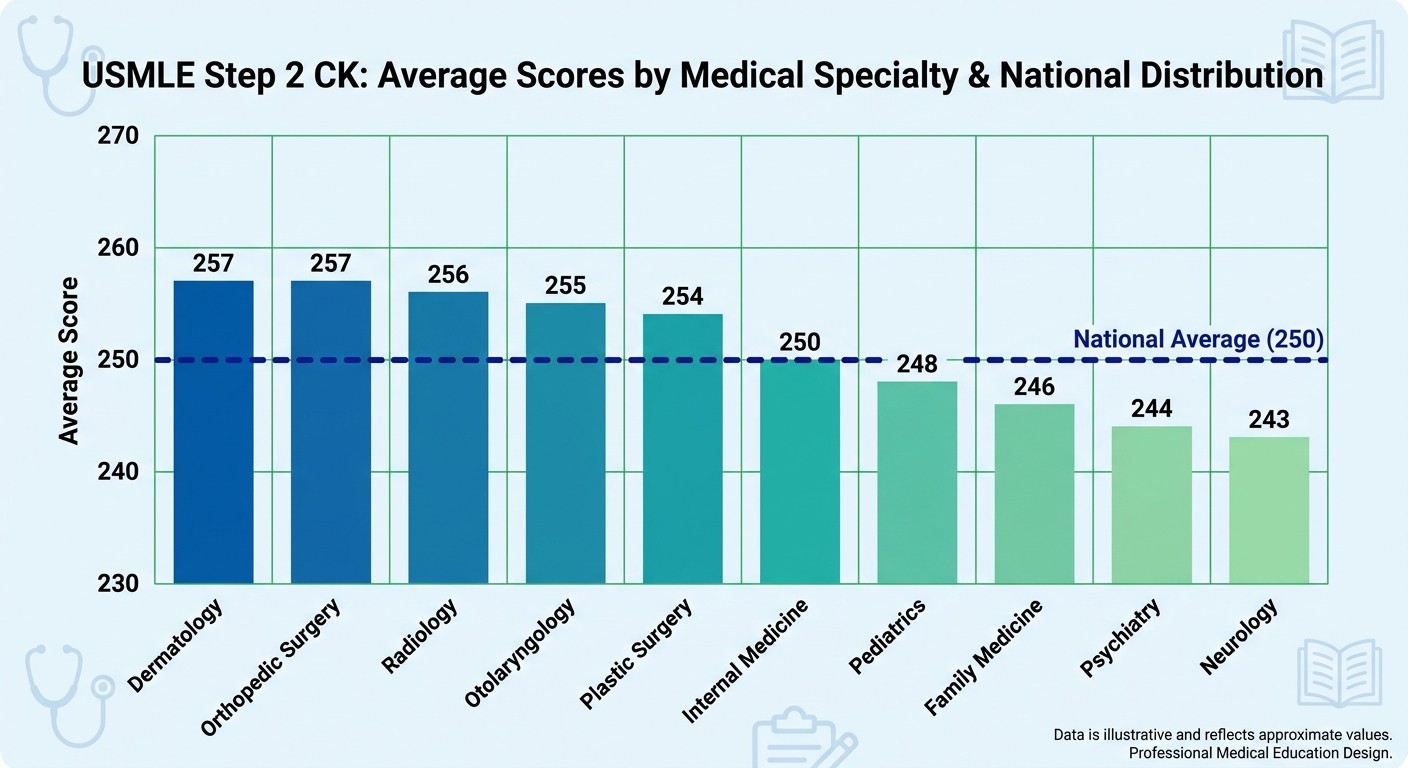
The American Medical Association reports that the overall average Step 2 CK score for matched US MD graduates is 250. But averages hide massive variations:
Top-scoring specialties: Dermatology and orthopedic surgery both average 257
Competitive procedural fields: Diagnostic radiology, plastic surgery, and otolaryngology average 256
Surgical specialties: Neurological surgery (255), vascular surgery (253), general surgery (253)
Primary care leaders: Internal medicine-pediatrics (253), internal medicine (251)
The spread across 22 specialties is only 13 points, which means small improvements can dramatically expand your options.
The New Reality: Step 2 CK as Your Primary Filter
Since Step 1 became pass/fail, Step 2 CK has become the fourth most important factor program directors use for interview invitations. This means your score isnt just about passing anymore – it's about opening doors.
With the minimum passing score increasing to 218 in July 2025, the bar has effectively moved higher. Students scoring 240-245 who previously felt "safe" now find themselves below competitive thresholds for many programs.
Why Most Students Plateau Below Average
The typical plateau happens because students practice broadly rather than strategically. They complete 2,000+ questions but cant identify why they consistently miss certain question types.
Here's the pattern: you start at 220, climb to 235 in your first month, then spend the next two months fluctuating between 235-245. Sound familiar?
This happens because generic question banks treat every mistake the same. Missing a dermatology question gets the same review time as missing cardiology – even though cardiology makes up 15% of your exam and dermatology makes up 2%.
Traditional resources also provide passive explanations. You read why C was correct, maybe why A was wrong, then move on. There's no mechanism to probe deeper, build decision frameworks, or connect patterns across questions.
How AI Tutoring Transforms Weak Area Practice
The breakthrough comes when you can identify specific patterns in your mistakes and get targeted practice for exactly those gaps. Oncourse's Rezzy AI tutor does this through two key features that traditional resources cant match.
Explanation Chat: Going Beyond "Why C is Correct"
When you miss a question about heart failure management, Rezzy doesn't just tell you the answer. It walks you through the clinical reasoning:
"Let's break down why this patient needs an ACE inhibitor first. What clinical findings suggest reduced ejection fraction versus preserved? Now, if this same patient had a creatinine of 2.5, how would your approach change?"
This conversational approach builds decision trees rather than isolated facts. When you encounter similar presentations on test day, you have a framework instead of hoping to recall a specific explanation.
The chat feature identifies knowledge gaps versus reasoning errors. If you consistently choose diuretics over ACE inhibitors in heart failure questions, Rezzy can probe whether you understand the mechanism, the guidelines, or just need practice with clinical scenarios.
Targeted Practice That Actually Adapts
Instead of random question blocks, Rezzy analyzes your performance patterns and creates focused practice sessions. If your cardiology accuracy is 65% while your overall average is 75%, it increases cardiology question frequency and complexity.
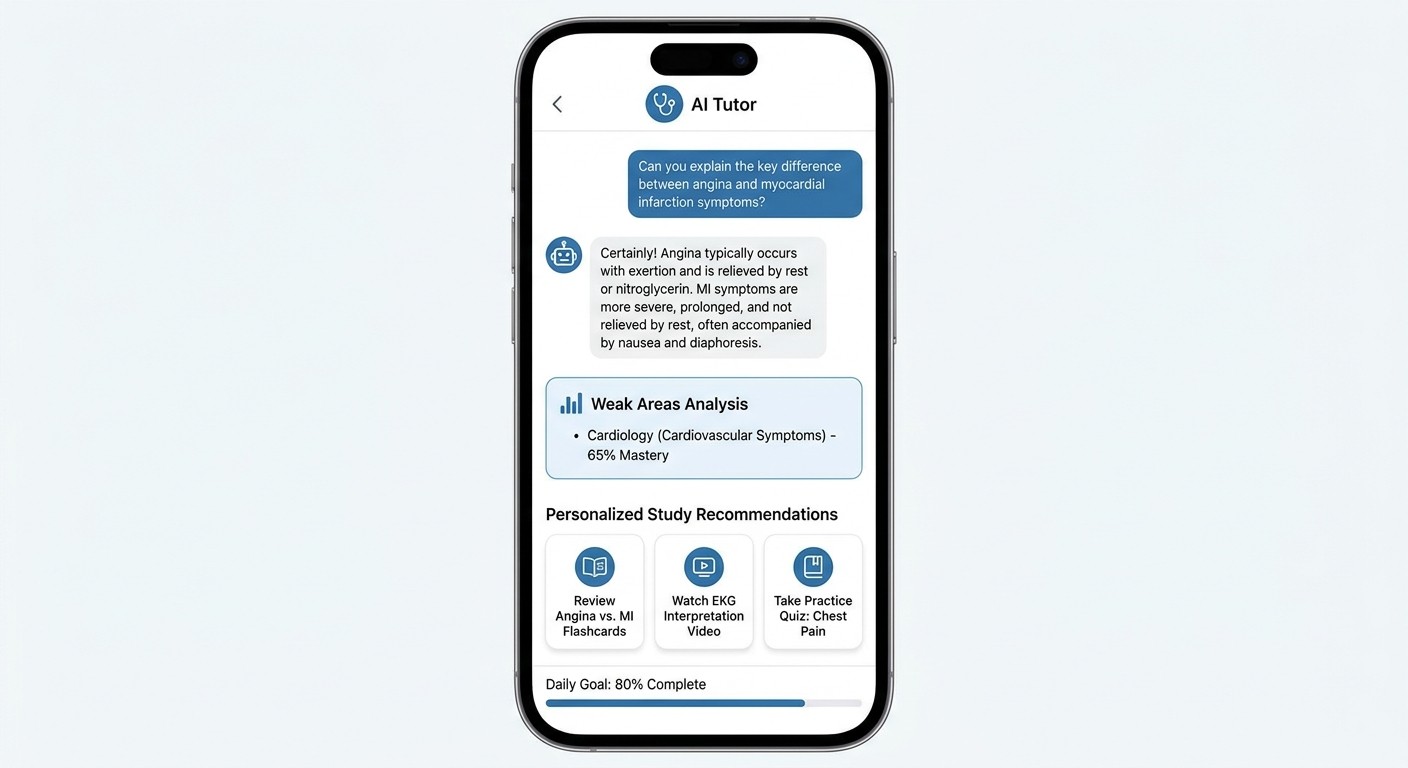
More importantly, it adjusts the question types. Struggling with "next best step" questions gets you more management scenarios. Missing diagnostic questions gets you more differential diagnosis practice with similar presentations.
This targeted approach typically moves students from plateau scores to their goal scores within 3-4 weeks, compared to months of unfocused practice.
Converting Weak Areas into High-Yield Practice
The most effective approach combines analytics with active learning. Here's how to systematically convert your weakest topics into scoring opportunities:
Step 1: Identify True Weak Areas
Most students think they know their weak subjects, but gut feelings are unreliable. Use performance data from your last 200 practice questions to identify subjects where your accuracy is more than 10 percentage points below your overall average.
For example, if your overall accuracy is 75%:
Critical weak areas: Subjects below 65%
Moderate weak areas: Subjects between 65-70%
Stable areas: Subjects above 70%
Step 2: Build Topic-Specific Decision Frameworks
For each critical weak area, create one-page decision algorithms covering:
Common presentations
Red flag symptoms
First-line workup
Treatment thresholds
Common traps
When practicing cardiology, Rezzy helps you build frameworks like: "Chest pain + ST elevation = emergent cath lab, but what if there's a contraindication to anticoagulation?" These branches prepare you for complex scenarios.
Step 3: Test Frameworks Under Time Pressure
Once you can reproduce your decision trees from memory, test them with timed, subject-specific blocks. This confirms your frameworks work under pressure before moving to mixed practice.
Students often skip this step and go straight to mixed blocks, making it impossible to distinguish knowledge gaps from time management issues.
The Strategic Advantage of AI-Powered Explanations
Traditional question banks give you the same explanation whether you missed the question due to knowledge gaps, misreading the stem, or poor reasoning. AI tutoring can distinguish between these error types and adjust accordingly.
Knowledge gap: If you dont know that metformin causes lactic acidosis, Rezzy provides the mechanism, associations, and related concepts. Then it tests this knowledge in different clinical contexts. Reasoning error: If you know the facts but consistently choose the second-best answer, Rezzy walks through the decision-making process: "You identified the correct diagnosis. Now, what's the most immediate priority – treating the condition or ruling out complications?" Pattern recognition: If you miss questions about the same presentation (e.g., postmenopausal bleeding) across different specialties, Rezzy creates targeted practice focusing on that specific presentation type.
This diagnostic capability is what helps students break through score plateaus that persist for months with traditional study methods.
Building Your Targeted Study Plan
A systematic approach to reaching average or above-average Step 2 scores focuses on converting weaknesses into strengths:
Weeks 6-8 Before Your Exam
Focus on diagnostic analytics and framework building. Complete 40 questions daily in subject-specific blocks, concentrating on your two weakest areas. Use comprehensive Step 2 CK practice questions to build familiarity with exam-style vignettes.
Weeks 4-5 Before Your Exam
Transition to mixed blocks while maintaining targeted practice for persistent weak areas. This is when AI explanations become crucial – you need immediate feedback on reasoning errors across different specialties.
Final 3 Weeks
Emphasize timed, mixed practice that mirrors exam conditions. Use explanation chat to rapidly diagnose why you're missing questions and adjust on the fly.
Score Benchmarks: What to Target by Specialty
Understanding specialty-specific averages helps set realistic goals:
Highly Competitive (255+ average)
Dermatology, orthopedic surgery, neurological surgery require scores well above the general average. Target 260+ for competitive applications.
Moderately Competitive (250-254 average)
Diagnostic radiology, plastic surgery, internal medicine-pediatrics. Target 255+ to be competitive.
Less Competitive (245-249 average)
Family medicine, psychiatry, pediatrics. Target 250+ to be comfortable.
IMG Considerations
US citizen IMGs average 236, while non-US citizen IMGs average 245. Target 10-15 points above your specialty's average to compensate for other application factors.
Common Mistakes That Keep Students Below Average
Mistake 1: Treating all subjects equally
Spending equal time on high-yield internal medicine and low-yield dermatology wastes precious study time.
Mistake 2: Passive explanation review
Reading explanations without testing your understanding leads to false confidence.
Mistake 3: Avoiding weak areas
Students often unconsciously avoid subjects they struggle with, reinforcing knowledge gaps.
Mistake 4: Generic time management
Using the same approach for every question type ignores the fact that some require more analytical time than others.
AI tutoring addresses each of these by forcing you to confront weak areas, actively engaging with explanations, and adapting to your specific learning patterns.
Maximizing AI Tutor Effectiveness
To get the most from explanation chat and targeted practice:
Be specific with questions: Instead of "Why is this wrong?", ask "What clinical finding rules out my first choice?" Challenge the reasoning: Ask follow-up questions about edge cases and exceptions to build robust decision frameworks. Test your understanding: Have the AI quiz you on related scenarios to confirm you've internalized the reasoning. Track improvement patterns: Use analytics to verify that targeted practice is actually improving your weak area scores.
The Path from Plateau to Target Score
Breaking through score plateaus requires identifying the specific gaps between your current performance and your target. Most students need structured feedback on reasoning patterns, not just more practice questions.
The combination of AI-powered explanation chat and adaptive practice creates a feedback loop that traditional resources cant match. When you understand exactly why you're missing questions and get targeted practice for those specific patterns, plateau-breaking improvements happen within weeks rather than months.
This approach consistently helps students move from the 235-245 range to 250+ scores – the difference between limiting your specialty options and keeping all doors open.
Frequently Asked Questions
What's considered a good Step 2 CK score in 2026?
A score of 250+ is considered good and matches the national average for US MD graduates. Scores above 255 are competitive for most specialties, while 260+ is excellent for highly competitive fields.
How much can I realistically improve my Step 2 CK score?
With targeted practice and AI tutoring, most students can improve 15-25 points from their plateau score. The key is identifying specific weak patterns rather than just doing more questions.
Is 245 a competitive Step 2 CK score?
A 245 is below the national average and may limit options for competitive specialties. However, it's passing and can be competitive for family medicine, psychiatry, and some internal medicine programs, especially with strong clinical grades.
How long does it take to see score improvements with AI tutoring?
Students typically see meaningful improvements within 2-3 weeks of targeted practice with AI explanation chat. The key is consistent daily practice focusing on identified weak areas.
Can AI tutoring replace traditional question banks?
AI tutoring works best as a complement to quality question banks like UWorld. The combination provides comprehensive content coverage with personalized explanations and adaptive practice.
What's the minimum Step 2 CK score needed for residency?
The passing score is 218, but competitive residency applications typically require scores well above this minimum. Most successful applicants score 240+ even for less competitive specialties.
Prepare smarter with Oncourse AI – adaptive MCQs, spaced repetition, and AI explanations built for USMLE Step 2 CK. Download free on Android and iOS.