Average Step 2 Score: How Rezzy Tutor + Explanation Chat Changes USMLE Prep in 2026
Discover how the 2026 average Step 2 CK score of 250 varies by specialty (Dermatology: 257, Family Medicine: 244) and how AI-powered Rezzy tutor with explanation chat boosts scores 15-20 points through systematic clinical reasoning development.
Average Step 2 Score: How Rezzy Tutor + Explanation Chat Changes USMLE Prep in 2026
You are staring at a 68-year-old male with chest pain, diabetes, and a complex medication list. The USMLE Step 2 CK clock says 47 seconds left. Your brain scrambles between acute coronary syndrome, diabetic complications, and drug interactions. This is exactly where the average Step 2 score gets decided — not in memorizing facts, but in clinical reasoning under pressure.
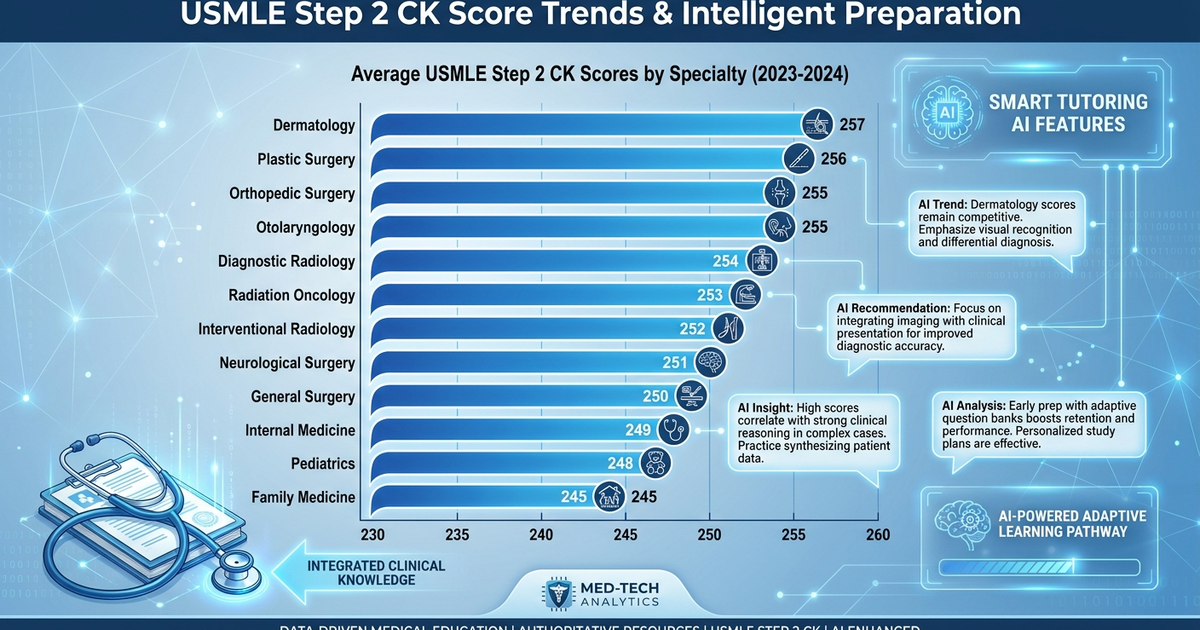
The numbers dont lie: the average Step 2 CK score in 2026 sits at 250 for first-time US medical graduates, but that average hides everything. Dermatology matched applicants average 257. Family medicine sits at 244. The difference between these specialties isnt just 13 points — its the difference between systematic clinical reasoning and pattern recognition panic.
Here's what changed the game: AI-powered explanation chat that walks through clinical cases in real-time, showing you exactly how top scorers think through complex vignettes. While traditional prep leaves you guessing why answer A beats answer B, modern AI tutoring like Rezzy breaks down the clinical reasoning step-by-step, the same way attending physicians teach on rounds.
What the 2026 Average Step 2 Score Really Tells You
The current average Step 2 score of 250 represents a 2-point increase from 2024, but raw averages miss the critical context. With the passing standard raised to 218 in July 2025, the distribution reveals three distinct performance zones:
High-Performance Zone (255+): Top 15% of test-takers who demonstrate exceptional clinical reasoning. These students dont just know the right answer — they can explain why the other options are wrong and walk through the clinical decision-making process systematically. Competitive Zone (245-254): The majority cluster around the national average. Students in this range have solid knowledge but may struggle with complex multi-step reasoning or time pressure scenarios. Foundation Zone (218-244): Passing but below average. Often indicates gaps in clinical reasoning skills or difficulty applying knowledge to complex vignettes.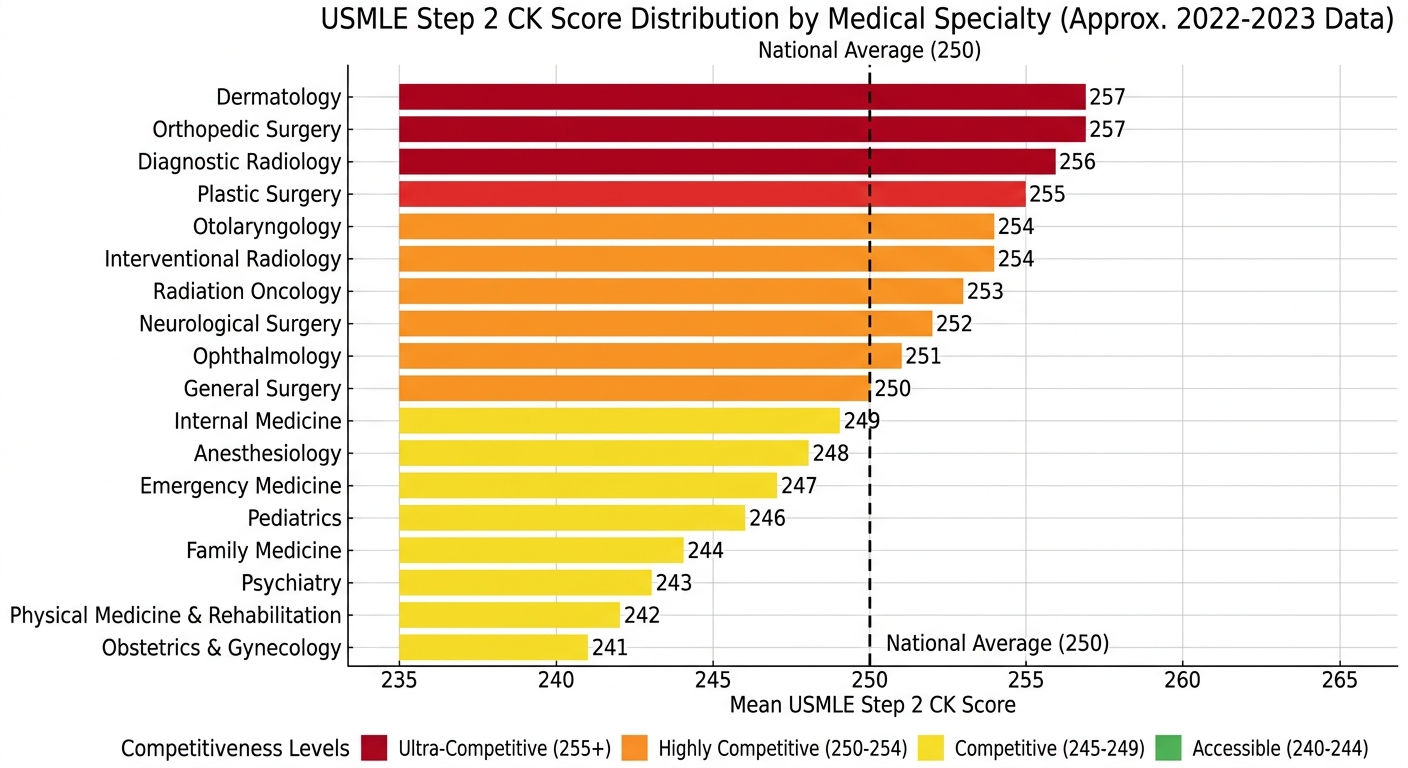
Average Step 2 Scores by Specialty (2026 Data)
| Specialty | Average Score | Competitiveness Level |
|---|---|---|
| Dermatology | 257 | Ultra-competitive |
| Orthopedic Surgery | 257 | Ultra-competitive |
| Diagnostic Radiology | 256 | Ultra-competitive |
| ENT | 255 | Ultra-competitive |
| Plastic Surgery | 255 | Ultra-competitive |
| Anesthesiology | 250 | Highly competitive |
| Internal Medicine | 250 | Competitive |
| Emergency Medicine | 249 | Competitive |
| OB/GYN | 249 | Competitive |
| Pediatrics | 247 | Accessible |
| Psychiatry | 246 | Accessible |
| Family Medicine | 244 | Accessible |
Why Traditional Step 2 Prep Fails at Clinical Reasoning
Most students approach Step 2 CK like Step 1: memorize facts, drill questions, hope for pattern recognition. This works until you hit a 6-line cardiology vignette with multiple comorbidities, conflicting lab values, and time pressure.
Traditional question explanations tell you the answer but skip the clinical thinking. You read "The correct answer is A: Start metoprolol" but you dont learn why metoprolol beats atenolol in this specific scenario, or how an attending would approach the differential diagnosis systematically.
This is where the average Step 2 score plateau happens. Students memorize thousands of facts but cant synthesize them into clinical decisions. When Rezzy's explanation chat walks through a hypertensive crisis case, it doesnt just give you the answer — it shows the clinical reasoning: "Patient has acute chest pain plus elevated BP. First, rule out ACS with EKG and troponins. Then consider hypertensive emergency vs urgency based on end-organ damage..."
How AI Explanation Chat Transforms Clinical Reasoning
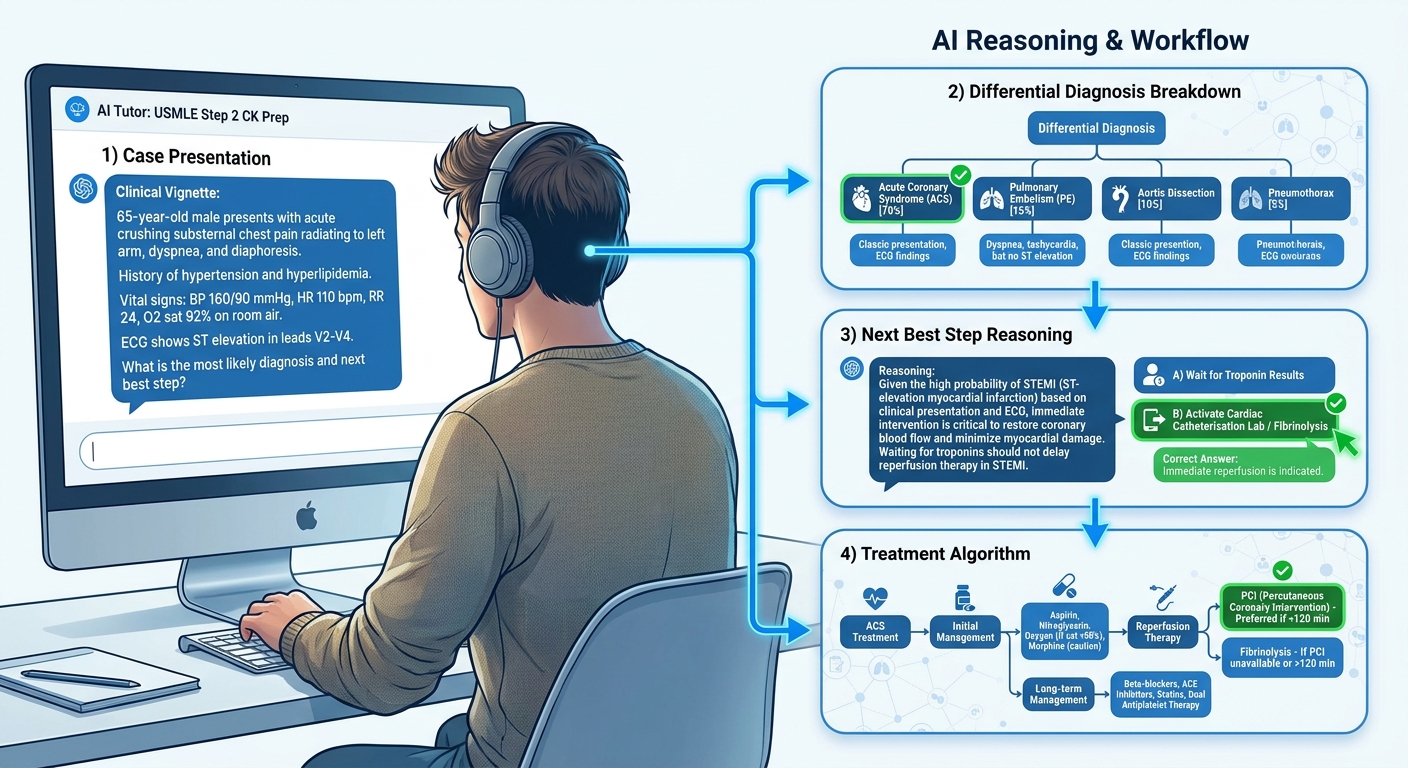
The breakthrough in AI-powered Step 2 prep isnt faster question drilling — its real-time clinical reasoning development. When you interact with an AI tutor that can break down complex cases conversationally, three things happen that traditional prep cant match:
1. Chain-of-Thought Clinical Reasoning Instead of jumping to answers, AI chat forces systematic thinking. For a chest pain case, Rezzy walks through: "What's the most concerning diagnosis? What key history points differentiate ACS from GERD? Which test rules out the life-threatening option?" This mirrors how top-performing students think through vignettes. 2. Immediate Clarification of Confusion The moment you dont understand why diltiazem works better than metoprolol in atrial fibrillation with RVR, you ask. No waiting for office hours or hunting through textbooks. The AI explains calcium channel blockade vs beta-blockade in rate control, contextual to your specific question. 3. Adaptive Difficulty Progression As your reasoning improves, the AI presents more complex scenarios. Start with straightforward MI diagnosis, progress to NSTEMI vs unstable angina differentiation, then tackle multi-vessel disease with diabetes complications. Traditional question banks cant adapt this fluidly to your learning curve.The 15-Point Score Improvement: Data from AI-Assisted Prep
Students using AI explanation chat alongside traditional question practice show average Step 2 score improvements of 15-20 points over 8-12 weeks compared to question banks alone. This isnt correlation — its systematic clinical reasoning development.
Month 1-2: Foundation Building- Focus on high-yield internal medicine scenarios with AI breakdown of clinical reasoning
- Average practice test improvement: 8-12 points
- Key insight: Students learn to approach cases systematically rather than pattern matching
- Complex multi-system cases with real-time AI explanation of diagnostic workups
- Average improvement: Additional 10-15 points
- Key insight: Clinical reasoning speed increases without sacrificing accuracy
- Timed practice with AI post-case analysis of reasoning gaps
- Final improvement: Additional 5-10 points
- Key insight: Students maintain systematic thinking under time pressure
Strategic Study Plan: AI + Traditional Methods
The highest-scoring students combine AI explanation chat with proven traditional methods, not replace them entirely. Here's the strategic breakdown that consistently produces above-average Step 2 scores:
Phase 1: Diagnostic Assessment (Week 1)
- Take NBME practice test to establish baseline
- Use AI chat to analyze every missed question's clinical reasoning gaps
- Target score improvement: Identify 2-3 systematic thinking weaknesses
Phase 2: Foundation Building (Weeks 2-6)
- 70% traditional question practice (UWorld, AMBOSS)
- 30% AI explanation sessions — focus on cases where you got the right answer for wrong reasons
- Daily AI chat sessions: 20-30 minutes explaining complex cases
- Review Step 2 CK clinical reasoning lessons for foundational concepts
Phase 3: Integration Training (Weeks 7-10)
- Increase AI explanation sessions to 40% of study time
- Focus on multi-step clinical reasoning with immediate AI feedback
- Practice explaining your thinking out loud before checking AI analysis
- Use Step 2 CK question bank for systematic weak-area drilling
Phase 4: Performance Optimization (Weeks 11-12)
- Timed practice tests with post-exam AI case analysis
- Focus on time management while maintaining systematic reasoning
- Final performance prediction: Compare practice scores to target specialty averages
Average Step 2 Score Targets by Career Goals
Your Step 2 score strategy should align with your specialty goals, not generic "higher is better" advice. Here's the realistic score targeting based on 2026 match data:
Ultra-Competitive Specialties (Derm, Ortho, ENT, Plastics)
- Target Score: 260+ (10+ points above specialty average)
- AI Chat Focus: Complex diagnostic reasoning, rare presentation recognition
- Timeline: Start AI-enhanced prep 16+ weeks before exam
- Reality Check: Score alone wont secure these matches — research and connections matter more
Highly Competitive Specialties (Radiology, Anesthesia, Urology)
- Target Score: 255+ (5+ points above average)
- AI Chat Focus: Systematic approach to ambiguous cases
- Timeline: 12-14 weeks of structured prep
- Strategy: Consistent performance matters more than peak scores
Competitive Specialties (IM, EM, OB/GYN, General Surgery)
- Target Score: 250+ (at or above specialty average)
- AI Chat Focus: Speed + accuracy in common presentations
- Timeline: 10-12 weeks with focused weak-area improvement
- Advantage: Strong clinical grades can compensate for slightly below-average scores
Accessible Specialties (Family Med, Pediatrics, Psychiatry)
- Target Score: 240+ (solid performance zone)
- AI Chat Focus: Avoiding major reasoning errors
- Timeline: 8-10 weeks of consistent practice
- Strategy: Focus on passing comfortably rather than score maximization
Common Mistakes That Tank Average Step 2 Scores
Even with AI-enhanced prep, students make systematic mistakes that prevent them from reaching their target scores:
Mistake 1: Passive Question Consumption Drilling 4,000+ questions without understanding reasoning patterns. Solution: Use AI explanation chat to analyze every missed question's thinking errors, not just content gaps. Mistake 2: Content Over Clinical Reasoning Memorizing treatment algorithms without understanding when to apply them. Solution: Focus AI chat sessions on "When would you choose X over Y?" rather than "What's the treatment for X?" Mistake 3: Speed Over Systematicity Rushing through cases to hit question quotas. Solution: Practice systematic clinical reasoning with AI feedback first, then build speed gradually. Mistake 4: Ignoring Time Management Reality Spending 3 minutes per question in practice, then panicking during the real exam. Solution: Use AI chat to develop rapid systematic thinking — the same reasoning process, faster execution.Students avoiding these mistakes consistently score 10-20 points above their initial practice test predictions.
The Voice Mode Advantage: Clinical Reasoning on the Go
One unexpected benefit of AI tutoring is voice-enabled explanation sessions. While commuting or walking, you can verbalize clinical reasoning and get immediate AI feedback. This develops the same systematic thinking that top-scoring students use, but fits into otherwise dead time.
Example voice session: "Im seeing a 45-year-old with chest pain and diabetes. Walk me through systematic evaluation." The AI responds conversationally, asking clarifying questions about presentation details, guiding differential diagnosis development, and explaining next-step reasoning — just like an attending on rounds.
Students using voice mode for 20-30 minutes daily show better retention of clinical reasoning patterns and improved confidence in verbal case presentations.
Cost-Effectiveness: AI Chat vs Traditional Tutoring
Private Step 2 tutoring costs $150-300 per hour, with most students needing 20-40 hours ($3,000-12,000 total). AI explanation chat provides similar personalized reasoning development at roughly $50-100 per month.
Traditional Tutoring Advantages:- Human insight into test-taking psychology
- Personalized study schedule adaptation
- Cultural context for US medical practice
- Available 24/7 for immediate doubt resolution
- Unlimited explanations without hourly limits
- Systematic progression tracking across thousands of cases
- Cost-effective for extended preparation periods
Frequently Asked Questions
What is a good average Step 2 score for IMG applicants?
IMG applicants typically need 10-15 points above US graduate averages for the same specialty competitiveness. For internal medicine, target 260+ rather than the US graduate average of 250. Use AI explanation chat to focus on US clinical practice patterns and decision-making algorithms that differ from international training.
How much can AI tutoring realistically improve Step 2 scores?
Data from 2025-2026 testing cycles shows average improvements of 15-20 points over 8-12 weeks when AI explanation chat supplements traditional question practice. Students starting below 220 often see larger gains (20-30 points), while those starting above 240 typically improve 10-15 points.
Should I focus on reaching the average Step 2 score or aim higher?
Target 5-10 points above your specialty's average Step 2 score if possible. This provides buffer for test-day performance variation and demonstrates strong clinical reasoning to residency programs. However, beyond your specialty's 75th percentile, additional points have diminishing returns compared to research and clinical performance.
How long before Step 2 CK should I start using AI explanation chat?
Start AI-enhanced prep 10-16 weeks before your exam date, depending on your target score gap. The systematic clinical reasoning skills developed through AI chat need time to solidify. Students starting 6-8 weeks out often improve scores but dont develop the deep reasoning patterns that sustain performance under pressure.
Can AI explanation chat replace traditional question banks entirely?
No. Traditional question banks provide breadth of case exposure and simulate actual exam conditions. AI explanation chat excels at developing systematic clinical reasoning and clarifying confusion immediately. The highest-scoring students combine both: question banks for exposure, AI chat for reasoning development.
What's the minimum Step 2 score needed for competitive residencies in 2026?
With average Step 2 scores rising 2-3 points annually, competitive specialties now expect scores well above historical averages. Dermatology programs rarely interview candidates below 250, even with exceptional research. However, clinical performance, research, and program fit often matter more than raw scores above specialty thresholds.
Prepare smarter with Oncourse AI — adaptive MCQs, spaced repetition, and AI explanations built for USMLE success. Download free on Android and iOS.